
Newgrange (Bru na Boinne)
A 5,000-year-old passage tomb on the Boyne, built for the winter solstice centuries before the Celts arrived — later remembered as the Dagda's own hall.
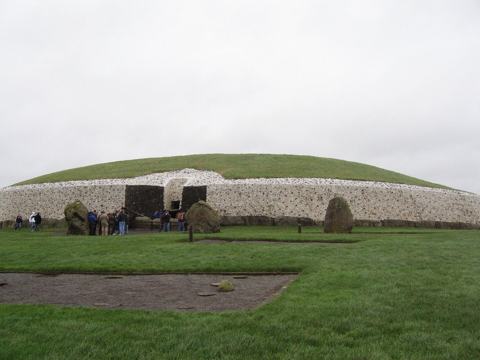
Entrance and roofbox at Newgrange, County Meath, Ireland (photograph) · CC BY-SA 2.0 · source
A Tomb Older Than the Pyramids
Newgrange, Irish Sí an Bhrú or, in the medieval texts, Brug na Bóinne, is a Neolithic passage tomb on a ridge above the River Boyne in County Meath. It was raised around 3200 BC, which makes it older than Stonehenge's sarsen circle and older than the Great Pyramid of Giza, and it predates the arrival of Celtic-speaking peoples in Ireland by two and a half thousand years or more — everything the medieval Irish said about it was said by people looking at a monument already ancient and already mysterious to them 1,5. It is the largest of three great mounds — Newgrange, Knowth, and Dowth — that together with dozens of smaller sites make up the passage-tomb cemetery now called Brú na Bóinne, inscribed as a UNESCO World Heritage Site in 1993 2,5.
The mound itself is roughly 85 metres across and 12 metres high, built of layered turf and stone around a cruciform stone chamber reached by a 19-metre passage. It is ringed by 97 kerbstones, several of them carved with spirals, lozenges, and zigzags in one of the largest surviving collections of megalithic art in Europe 1,2.
The Roofbox and the Solstice
Newgrange's most famous feature was invisible for most of its recorded history. During restoration work in the 1960s, archaeologist Michael J. O'Kelly noticed a narrow slit, now called the roofbox, set into the stonework directly above the passage entrance, and reasoned that it might have an astronomical purpose. On the morning of 21 December 1967 he sat inside the chamber before dawn and watched a beam of sunlight enter through the roofbox, cross the full length of the passage, and light the inner chamber floor — the first person to see it happen, so far as anyone knows, in some four thousand years 1.
Around the winter solstice each year, for about seventeen minutes just after sunrise, the beam still repeats that path. The alignment appears to be deliberate: the passage and roofbox together form a purpose-built instrument for admitting light at one specific point in the solar year and no other 1,2. What that admission meant to the people who built it is not recoverable — no written record survives from Neolithic Ireland — and O'Kelly himself was careful to describe the mechanism without claiming to know the ritual behind it 1.
Reading the Stones
The great kerbstone at the entrance, known as K1, carries a triple spiral and a double spiral cut into its surface with remarkable technical control, and it is among the most reproduced pieces of prehistoric art in the world 1,2. Its meaning is unknown; readings ranging from solar symbolism to pure decoration have all been proposed, and none is demonstrable from the stone itself 2.
The gleaming white quartz facade that visitors see today is a modern reconstruction, built by O'Kelly's team from quartz and granite cobbles found collapsed at the foot of the mound. O'Kelly read this material as evidence of a deliberate vertical wall faced in white stone; other archaeologists, including Stout, have argued the same evidence could just as easily represent a low quartz platform laid in front of the entrance rather than a standing wall, and that the reconstruction, however striking, represents one interpretation rather than a certainty 1,2.
The Dwelling of the Dagda and Aengus
By the time Irish literature was written down, Newgrange had a second life as an Otherworld residence. Tochmarc Étaíne and the Dindshenchas place-poems identify Brug na Bóinne as the hall of The Dagda, father of the gods, and tell how his son Aengus wins it from him through a pun: asked to lend the Brug for "a day and a night," a phrase that can also be read as "all days and nights," Aengus simply never leaves 3,4. The medieval writers plainly understood they were attaching a story to something already ancient and inexplicable in their own time, and the Dindshenchas treats the whole Boyne valley as a landscape touched by the Otherworld 3,4.
Rediscovery and Excavation
Newgrange re-entered written history in 1699, when a landowner quarrying stone for road material broke into the passage; the Welsh antiquary Edward Lhwyd visited soon after and left one of the earliest descriptions of the interior 1. The site then sat open and eroded for over two and a half centuries before Michael O'Kelly's state-sponsored excavation and conservation project, carried out for the Office of Public Works between 1962 and 1975, which uncovered the roofbox, stabilised the mound, and produced the modern facade 1,2.
Newgrange Today
Newgrange is state-owned and managed through the Brú na Bóinne Visitor Centre, which controls access to the passage and chamber. Because only a few dozen people can stand inside at solstice, places for the winter solstice mornings are allocated by public lottery, and the sunrise is broadcast live for everyone else 2. Reference works on Irish mythology still list it under its literary name, Brug na Bóinne, alongside its identification as the Dagda's residence — a reminder that the site keeps two separate histories, archaeological and literary, running side by side 6. Alongside Knowth and Dowth, it remains one of the few places in Ireland where a five-thousand-year-old structure, a piece of medieval literature, and a modern research question about the same building can all be discussed in the same breath 1,2,5.
Continue Exploring
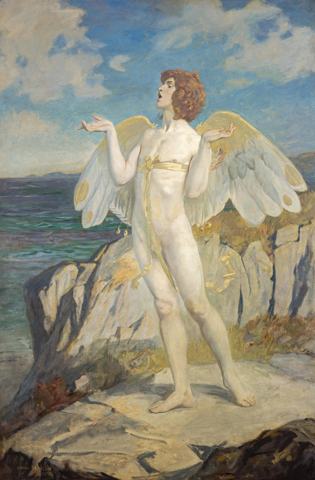
The young god of Brú na Bóinne — conceived in a stolen day, owner of a house won by a pun, and the lover who followed a dream into a lake of swans.
The good god — not morally good but good at everything: the club-bearing, cauldron-owning father figure of the Tuatha De Danann, and their crudest comedian.
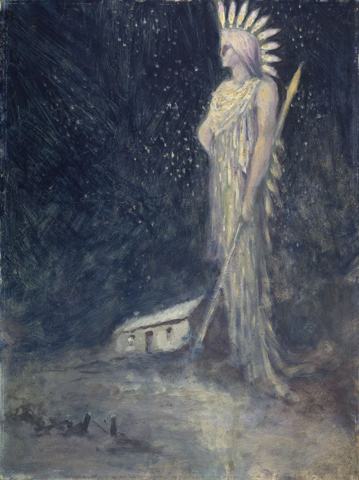
Not an afterlife but a parallel country — the sid mounds, the islands west of the sea, and the aos si who kept Ireland after they lost it.
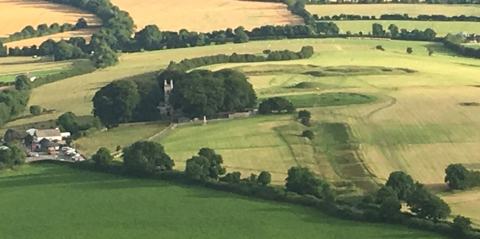
A low Meath hilltop layered with 5,000 years of earthworks, remembered as the seat of Ireland's High Kings — a title the archaeology alone cannot confirm.
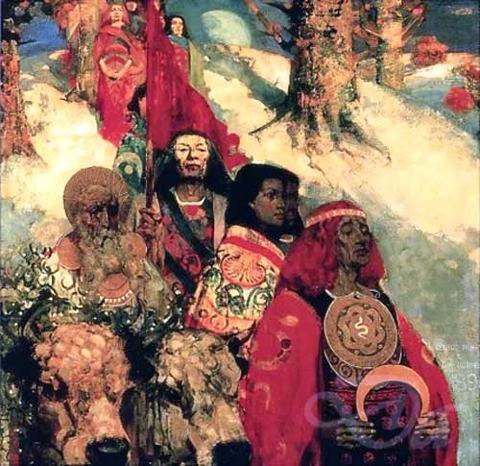
The learned class of Iron Age Gaul and Britain, known mostly through hostile Roman writers and later Irish legend — and reinvented from scratch in the 1700s.
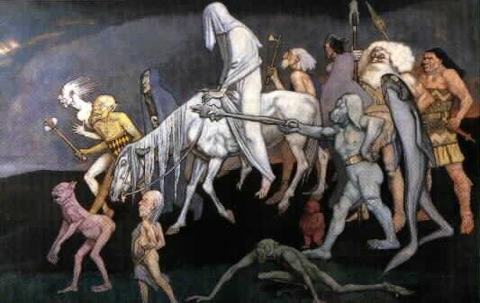
Ireland's monstrous sea-people — raiders, tribute-takers and kin to the gods they fight, led by Balor of the destroying eye.
Sources & Further Reading
- 1.O'Kelly, Michael J. Newgrange: Archaeology, Art and Legend. Thames & Hudson, 1982.
- 2.Stout, Geraldine. Newgrange and the Bend of the Boyne. Cork University Press, 2002.
- 3.Tochmarc Etaine (The Wooing of Etain), ed. and trans. Osborn Bergin and R. I. Best, Eriu 12, 1938 (CELT edition).
- 4.The Metrical Dindshenchas, ed. and trans. Edward Gwynn. Royal Irish Academy, 1903-1935.
- 5.Eogan, George. Knowth and the Passage-Tombs of Ireland. Thames and Hudson, 1986.
- 6.MacKillop, James. Dictionary of Celtic Mythology. Oxford University Press, 1998.
Spot an error or have a source to suggest? Write to info@viseterna.com. We cite primary sources and modern scholarship, and we correct fast.