
Selkie (Seal Folk)
The seal-people of Orkney, Shetland, and the Scottish and Irish coasts, who shed their skins to walk on land — and must find them again to go home.
Grey seals on North Ronaldsay, Orkney, Dai O'Nysius · CC BY-SA 3.0 · source
Seal by Sea, Human by Land
The selkie (Scots, from Older Scots selch, "seal") is a shapeshifting being of the folklore of Orkney, Shetland, the Hebrides, and the Irish coast: a seal in the water that, on certain shores and at certain times, sheds its skin to walk on land in human form 2,4. The belief is thickest in the Northern Isles, where Norse settlement left the local culture heavily inflected by Scandinavian tradition, and comparable seal-people appear further afield in Faroese and Icelandic folklore under other names — a spread that suggests a shared North Atlantic maritime motif rather than one story radiating out from a single origin point 2,3. Selkies are usually described as beautiful in human shape and are said to gather to dance on skerries and lonely beaches on certain nights, leaving their sealskins in a pile on the rocks while they do 2,4.
The Stolen Skin
The best-known selkie story is a wife-tale: a man walking the shore finds a selkie woman dancing out of her skin, steals or hides the skin before she can put it back on, and so traps her on land, where she becomes his wife and bears his children 3,4. She stays only as long as the skin stays hidden. In most versions she eventually finds it again — sometimes given to her unknowingly by one of her own children, sometimes discovered by chance — and the moment she puts it on she returns to the sea, often for good, sometimes still visiting the shore afterward to watch over the family she has left 3,4. Thomson, collecting versions of the tale across the Hebrides, the Northern Isles, and the west coast of Ireland in the early 1950s, found it told less as entertainment than as real family history in some households, with particular local families said to be descended from just such a union 3.
The Great Silkie of Sule Skerry
The clearest early textual trace of the belief is a ballad rather than a prose tale: "The Great Silkie of Sule Skerry," catalogued by Francis James Child as number 113 in his collection of English and Scottish popular ballads, first recorded from a woman in Shetland in the mid-nineteenth century 1. In it, a man rises to tell a nursing mother that he is the father of her child and that he is a selkie, "a man upon the land" and "a silkie in the sea"; he takes the boy, leaves her a purse of gold, and predicts she will marry a gunner who will one day shoot them both, father and son, together 1. The ballad reverses the more common story's gender roles — here it is a male selkie who fathers a child and departs, rather than a captured selkie wife — and Orcadian versions of the same story exist in longer, more embellished forms under related titles 1.
Families of the Seal
Several Scottish and Irish families were traditionally said to descend from a selkie ancestor, most famously the MacCodrums of North Uist, known in Scottish Gaelic as Clann 'ic Codrum nan ròn, "the MacCodrums of the seals" 3. Saxby's collection of Shetland lore records similar family traditions further north, sometimes offered as an explanation for a physical trait — webbed-looking fingers or an unusually smooth gait — running in a particular line 2. Folklorists generally treat these genealogies as a form of local identity-making as much as literal belief: a way for a family to root itself in the sea that fed it, using a story pattern that recurs, with variations, in coastal cultures well beyond Scotland and Ireland 3,4.
Cousins in the Water
Selkies sit alongside, but are distinct from, other Gaelic water beings such as the dangerous horse-shaped kelpie or each-uisge and the more ambiguous Púca: unlike those figures, selkies are rarely described as actively malicious, and the harm in their stories usually falls on the human who traps one, not the other way round 4,5. They belong to the same wider imaginative world as Manannán mac Lir and the sea-approaches to the Irish Otherworld, where the boundary between the human community and the water is porous rather than fixed 5. Black's edition of nineteenth-century Highland lore situates the selkie belief within a broader Gaelic sense that the sea was inhabited, watchful, and capable of claiming people back — a framework that makes the selkie less an isolated curiosity than one expression of a much wider set of ideas about the coast 5.
Continue Exploring
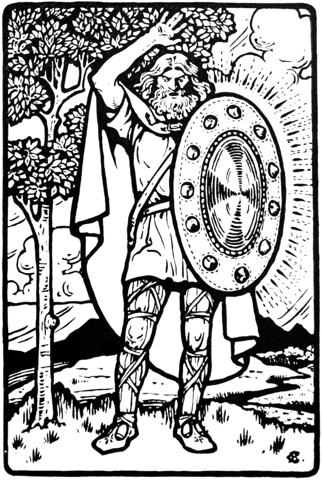
The Irish sea god — ferryman between worlds, master of illusion and the mist of invisibility, and the presiding figure of the Otherworld voyages.
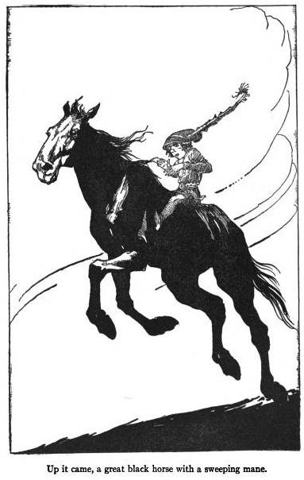
An Irish shapeshifting spirit, usually a wild black horse, who claims a share of the harvest at Samhain and is helpful or frightening depending on the teller.
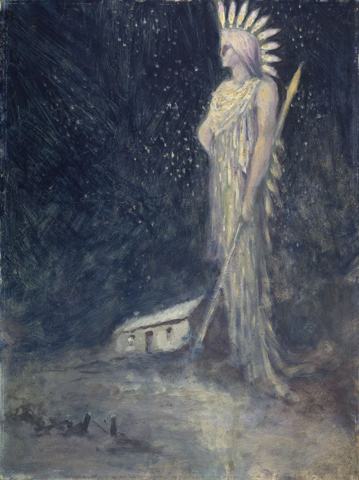
Not an afterlife but a parallel country — the sid mounds, the islands west of the sea, and the aos si who kept Ireland after they lost it.
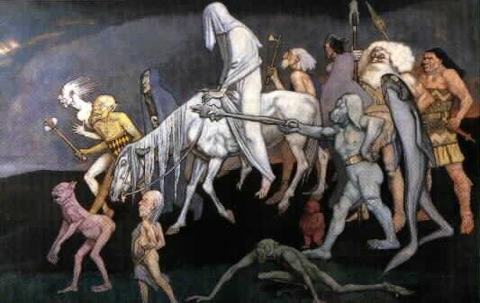
Ireland's monstrous sea-people — raiders, tribute-takers and kin to the gods they fight, led by Balor of the destroying eye.
The Gaelic quarter day that opened winter and the Otherworld alike in medieval Irish literature — not, despite a popular myth, the name of a god of the dead.
Ireland's race of gods — arriving with four treasures from four lost cities, winning Ireland twice, then losing it once and withdrawing into the mounds.
Sources & Further Reading
- 1.Child, Francis James, ed. The English and Scottish Popular Ballads, vol. 2 (no. 113, The Great Silkie of Sule Skerry). Houghton, Mifflin, 1882-1898.
- 2.Saxby, Jessie M. E. Shetland Traditional Lore. Grant & Murray, 1932.
- 3.Thomson, David. The People of the Sea: A Journey in Search of the Seal Legend (1954).
- 4.Briggs, Katharine. An Encyclopedia of Fairies. Pantheon Books, 1976.
- 5.Black, Ronald (ed). The Gaelic Otherworld. Birlinn, 2005.
Spot an error or have a source to suggest? Write to info@viseterna.com. We cite primary sources and modern scholarship, and we correct fast.