
Lebor Gabala Erenn (The Book of Invasions)
A medieval synthetic history of Ireland: six waves of settlers, the Tuatha De Danann, and the Gaelic Milesians, engineered to answer to the Bible.
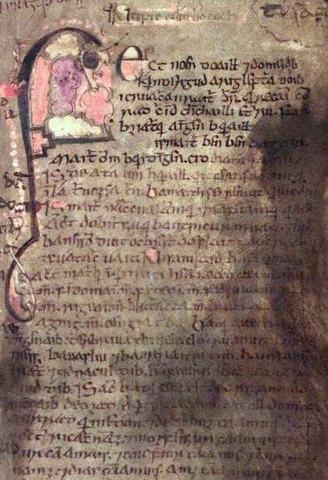
Book of Ballymote, folio 8 recto, opening of Lebor Gabala Erenn, late 14th century (Royal Irish Academy) · Public domain · source
A History Built to Explain a People
Lebor Gabala Erenn, "the Book of the Taking of Ireland," is the great medieval origin-legend of the Irish: a prose-and-verse compilation that narrates Ireland's settlement from before Noah's Flood down to the coming of the Gaels, in six successive waves. It is not a record of prehistoric events. It is, as John Carey's standard modern study puts it bluntly in its subtitle, synthetic pseudohistory: a learned construction assembled by Christian scholars who wanted native Irish tradition to take its place inside universal, Bible-based world history rather than sit outside it 5,6. The text as it survives took shape in stages across the eleventh and twelfth centuries, building on earlier synthetic-history poems by named poets such as Eochaid ua Floinn, Flann Mainistrech, and Gilla Coemain, and it kept being redacted, expanded, and copied into new manuscripts for centuries afterward 3,4.
The Six Takings
The framework is a sequence of settlements, most of them ending in disaster. Cessair, a granddaughter of Noah, leads the first people to Ireland just ahead of the Flood; nearly all of them drown, except for Fintan mac Bochra, who survives by shape-changing across millennia and becomes Ireland's oldest witness in later tradition 1,6. Partholon's people arrive generations after the Flood and are wiped out by plague; Nemed's follow and are worn down by the monstrous Fomorians before scattering abroad 1,6. Nemed's descendants return as the Fir Bolg, who divide Ireland into provinces, and are in turn displaced by the Tuatha De Danann, who arrive "in a dark cloud," defeat the Fir Bolg at the first battle of Mag Tuired and the Fomorians at the second, and bring with them the four treasures associated with their cities of origin, among them the Lia Fail 1,7. Ireland's actual human ancestors, in the text's own logic, are the last arrivals: the Sons of Mil, Gaelic-speaking settlers who sail from Spain, defeat the Tuatha De Danann in battle, and divide the island between them, while the defeated De Danann withdraw into the sidhe mounds of the Otherworld 1,6.
Genealogy as Argument
The point of all this is not narrative colour but claim-staking. By tracing the Gaels back through Spain, Scythia, and Egypt to the sons of Noah, the compilers gave Ireland a place in the same biblical family tree as every other Christian nation, while still keeping a distinct, non-Roman national origin separate from Britain's 5,6. Carey reads the whole project as a deliberate response to a genuine intellectual problem faced by early medieval Irish scholars: how to reconcile inherited native genealogical and legendary material, which they took seriously, with the universal history taught by the Church, without simply discarding either one 5. Scowcroft's textual analysis shows the same synthetic ambition at the level of the manuscripts, tracing how successive redactors kept re-editing the settlement narrative to absorb more genealogical and place-name material without ever quite finishing the job 3,4.
Manuscripts and Growth
No single authoritative text exists; Lebor Gabala Erenn survives in numerous recensions copied across the later medieval period, and reconstructing its growth is a textual puzzle in its own right 3,4. Among the manuscript witnesses, the Book of Leinster, compiled around 1160, preserves one of the earlier organized versions, while the fifteenth-century Great Book of Lecan and the fourteenth-century Book of Ballymote transmit later, more elaborated recensions alongside a great deal of other historical and genealogical material 2,3. R. A. Stewart Macalister's Irish Texts Society edition, published in five parts between 1938 and 1956, remains the standard collated edition and translation, printing several recensions in parallel so readers can see the tradition still visibly growing between manuscripts 1.
After the Manuscripts
The text did not stop working once the medieval period ended. Its framework of six takings and its genealogies were treated as authoritative Irish history well into the early modern period, most influentially by Geoffrey Keating's seventeenth-century Foras Feasa ar Eirinn, which draws heavily on Lebor Gabala material, and by the Annals of the Four Masters 6,7. Modern scholarship has firmly separated the text's literary and ideological purposes from any value as a record of actual Bronze or Iron Age settlement, though its story of successive divine and semi-divine peoples remains the framework within which figures such as Lugh, Danu, and the Dagda are traditionally introduced 6,7. Reading it honestly means holding both things at once: it preserves genuinely old native tradition, reworked by generations of learned redaction, inside a frame invented to make that tradition answer to the Bible 5,6.
Continue Exploring
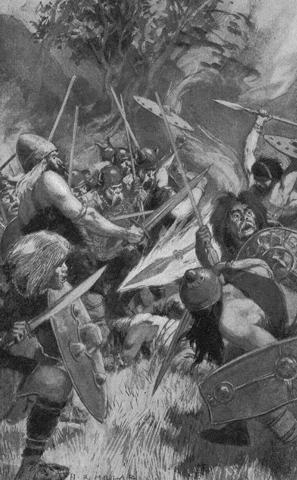
Ireland's race of gods — arriving with four treasures from four lost cities, winning Ireland twice, then losing it once and withdrawing into the mounds.
The mother goddess of the Tuatha De Danann — and the most famous Irish deity who may never have existed under that name.
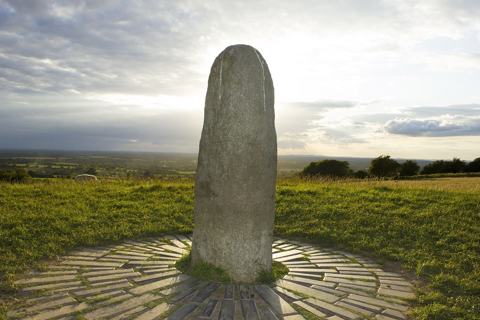
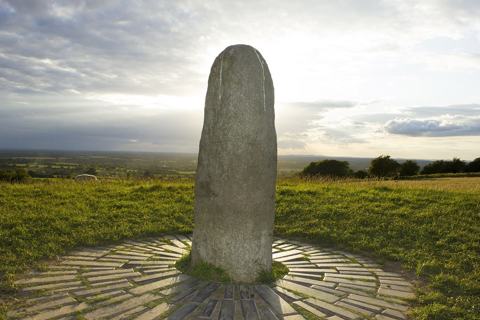
A standing stone on the Hill of Tara said to roar beneath Ireland's rightful king; the rival Scottish claim on it is a much later legend, not medieval fact.
Four wonder-objects the Tuatha De Danann brought to Ireland: a screaming stone, an unstoppable spear, an inescapable sword, and a cauldron that never runs dry.
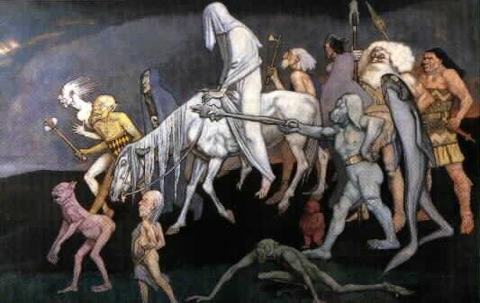
Ireland's monstrous sea-people — raiders, tribute-takers and kin to the gods they fight, led by Balor of the destroying eye.
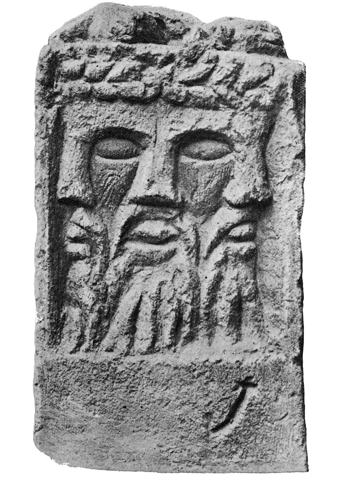
Master of every skill — the young god admitted to Tara because he alone could do all the crafts at once, and who killed his own grandfather Balor.
Also mentioned inThe Salmon of Knowledge
Sources & Further Reading
- 1.Macalister, R. A. Stewart (ed. and trans.). Lebor Gabala Erenn: The Book of the Taking of Ireland, Parts I-V. Irish Texts Society, 1938-1956.
- 2.Book of Leinster (Lebor Laignech), compiled c. 1160, one of the principal manuscript witnesses to the text.
- 3.Scowcroft, R. Mark. "Leabhar Gabhala, Part I: The Growth of the Text." Eriu 38 (1987), 79-140.
- 4.Scowcroft, R. Mark. "Leabhar Gabhala, Part II: The Growth of the Tradition." Eriu 39 (1988), 1-66.
- 5.Carey, John. The Irish National Origin-Legend, Synthetic Pseudohistory. E. C. Quiggin Memorial Lectures 1. Department of Anglo-Saxon, Norse and Celtic, University of Cambridge, 1994.
- 6.MacKillop, James. Dictionary of Celtic Mythology. Oxford University Press, 1998.
- 7.Koch, John T. (ed.). Celtic Culture: A Historical Encyclopedia. ABC-CLIO, 2006.
Spot an error or have a source to suggest? Write to info@viseterna.com. We cite primary sources and modern scholarship, and we correct fast.