
Danu
The mother goddess of the Tuatha De Danann — and the most famous Irish deity who may never have existed under that name.
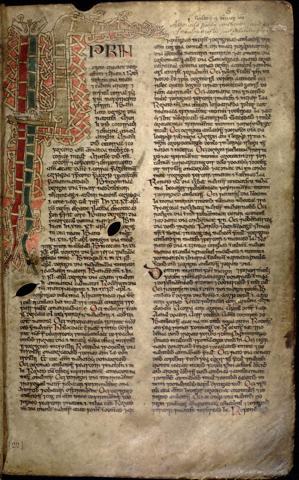
Book of Leinster, folio 53, Ireland, 12th century (Trinity College Dublin, MS 1339) · Public domain · source
A Goddess Reconstructed from a Genitive
Danu is the presumed mother goddess of the Tuatha De Danann, the divine race of medieval Irish literature, and her entire attestation rests on the second half of that name. The form Danu itself appears in no medieval Irish text. What the manuscripts give is the genitive Danann — also written Donand or Danand — in the phrase Tuatha De Danann, "the peoples of the goddess Danann," from which nineteenth- and twentieth-century scholars reconstructed a nominative 1,5,6.
This is not an exotic situation in Celtic studies, where a great many divine names survive only in oblique cases, place names or derived forms. But it does mean that almost everything popularly said about Danu — that she is the mother of all the gods, the earth itself, the river-source of Irish sovereignty — is inference layered on a single word rather than narrative the texts actually tell 5,6,7. She has no myth. She does nothing, says nothing, and appears in no episode.
Anu, Ana, and the Paps
The nearest thing to a positive attestation belongs to a related name. Sanas Cormaic, the ninth- to tenth-century glossary, has an entry for Anu describing her as mater deorum Hibernensium, "mother of the Irish gods," and noting that she nourished the gods well — with a gloss connecting her to prosperity 2,6. The same tradition attaches her to the two conspicuous rounded hills in County Kerry called Da Chich Anann, "the Paps of Anu," a landscape naming that is old and geographically unambiguous 2,6,8.
Whether Anu and Danu are one goddess is a long-running argument. One proposal reads Danann as a contraction of di Anann, "of the goddess Anu," which would collapse the two into a single figure and explain why one has a gloss and the other a genitive 5,6. Others keep them separate, and note that the manuscripts themselves also list a Danand or Donand as mother of the "three gods of Danu" (tri dee Dana) — Brian, Iuchar and Iucharba — which is a distinct genealogical role 1,5,6.
What "Tuatha De Danann" Might Mean
The phrase itself has a history. The older designation in the pseudo-histories is simply Tuath De, "the people of God" or "the divine people" — a term that also translated Latin usage for the Israelites, which is precisely why medieval Irish scribes had reason to modify it. Adding Danann disambiguated the divine race of Irish legend from the people of God in scripture, and the compound form becomes standard in the later tradition 5,7.
That leaves several readings on the table. If Danann is a goddess-name, the phrase means "the peoples of the goddess Danu." Some scholars have connected the name to the Proto-Indo-European root behind "flow," the same root that produces the Vedic water-goddess Danu and the river-names Danube, Don, Dnieper and Dniester — an attractive fit for a mythology full of river goddesses, but one that rests on comparative reconstruction rather than Irish evidence 5,6,8. Another proposal derives the element from Old Irish dan, "skill, art, craft," which would make the Tuatha De Danann "the peoples of the god of skill" — a reading that suits a race defined in Cath Maige Tuired by its mastery of crafts and its four treasures 3,5.
The Race She Names
Whatever her status, the collective she names is central. Lebor Gabala Erenn places the Tuatha De Danann as the fifth of the successive peoples to take Ireland, arriving from four northern cities — Falias, Gorias, Findias and Murias — with the four treasures: the Lia Fail, the spear of Lugh, the sword of Nuada, and the cauldron of The Dagda 1,5. They defeat the Fir Bolg at the first battle of Mag Tuired and the Fomorians at the second, then lose Ireland to the Milesians and withdraw into the mounds, becoming the aes side of the Otherworld 1,3,7.
John Carey's work on the origin-legend is a useful corrective here. The Lebor Gabala is a synthetic construction: monastic scholars fitting native tradition into a biblical and Isidorean world-history, harmonising contradictory sources, and inventing connective tissue where they needed it. Genealogies of the Tuatha De within it are therefore evidence for how twelfth-century Irish learning organised its inheritance, not a straightforward register of who was worshipped in pre-Christian Ireland 7.
Danu in Modern Use
Modern popular writing, and modern Celtic-revival and neo-pagan practice, have given Danu a full biography — primordial mother, goddess of the earth and of rivers, consort of Bile, ancestress of every Irish god. None of that is medieval, and it is worth stating plainly rather than repeating 5,6,8. The reconstruction is intelligible: a named divine ancestress is a natural thing to want at the head of a pantheon, and comparative Indo-European material supplies a template.
The honest position is that Danu is a scholarly reconstruction that acquired a cult after the fact. That is not nothing — the medieval scribes were clearly working with a divine name in the genitive, and the Anu gloss shows a mother goddess in the same conceptual space 2,5,6. But between "there was probably a goddess behind the name" and the detailed portrait now circulating lies a gap that no Irish manuscript fills, and readers of the Codex are better served knowing where it starts.
Continue Exploring
A medieval synthetic history of Ireland: six waves of settlers, the Tuatha De Danann, and the Gaelic Milesians, engineered to answer to the Bible.
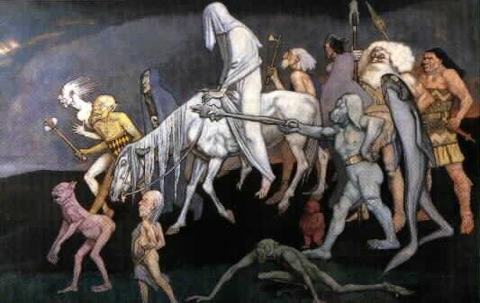
Ireland's monstrous sea-people — raiders, tribute-takers and kin to the gods they fight, led by Balor of the destroying eye.
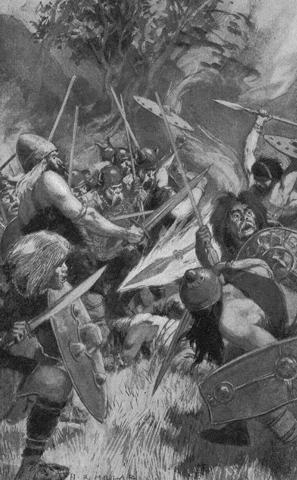
Ireland's race of gods — arriving with four treasures from four lost cities, winning Ireland twice, then losing it once and withdrawing into the mounds.
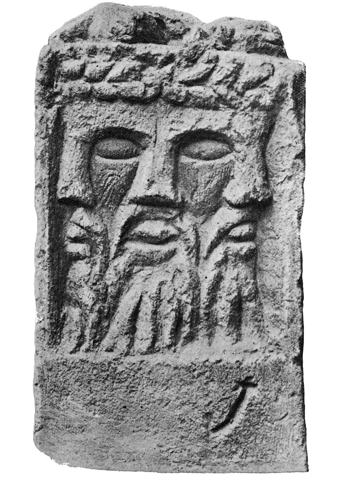
Master of every skill — the young god admitted to Tara because he alone could do all the crafts at once, and who killed his own grandfather Balor.
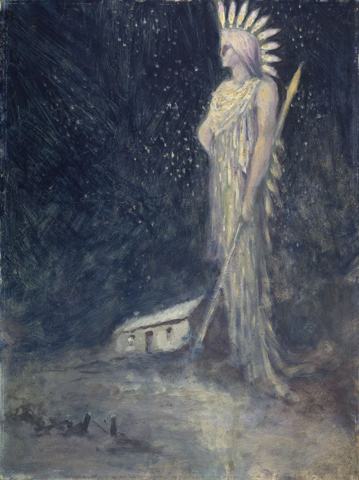
The good god — not morally good but good at everything: the club-bearing, cauldron-owning father figure of the Tuatha De Danann, and their crudest comedian.
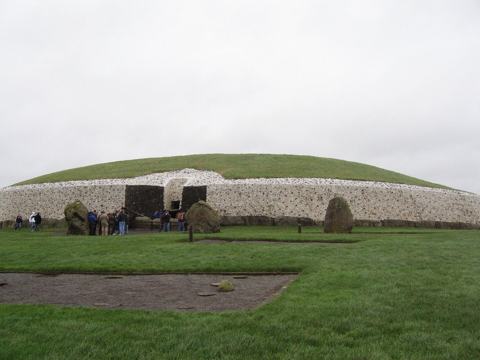
Not an afterlife but a parallel country — the sid mounds, the islands west of the sea, and the aos si who kept Ireland after they lost it.
Also mentioned inEpona (Celtic Horse Goddess)
Sources & Further Reading
- 1.Lebor Gabala Erenn (The Book of the Taking of Ireland), ed. R. A. S. Macalister. Irish Texts Society, 1938-1956.
- 2.Sanas Cormaic (Cormac's Glossary), attributed to Cormac mac Cuilennain, 9th-10th century; ed. Kuno Meyer, Anecdota from Irish Manuscripts IV, 1912.
- 3.Cath Maige Tuired: The Second Battle of Mag Tuired, ed. and trans. Elizabeth A. Gray. Irish Texts Society vol. 52, 1982 (CELT edition).
- 4.O'Mulconry's Glossary and the medieval Irish glossary tradition, ed. Whitley Stokes, Archiv fur celtische Lexikographie, 1900.
- 5.Koch, John T. (ed.). Celtic Culture: A Historical Encyclopedia. ABC-CLIO, 2006.
- 6.MacKillop, James. Dictionary of Celtic Mythology. Oxford University Press, 1998.
- 7.Carey, John. The Irish National Origin-Legend: Synthetic Pseudohistory. Department of Anglo-Saxon, Norse and Celtic, University of Cambridge, 1994.
- 8.Green, Miranda J. Dictionary of Celtic Myth and Legend. Thames & Hudson, 1992.
Spot an error or have a source to suggest? Write to info@viseterna.com. We cite primary sources and modern scholarship, and we correct fast.