
Samhain
The Gaelic quarter day that opened winter and the Otherworld alike in medieval Irish literature — not, despite a popular myth, the name of a god of the dead.
Traditional Irish turnip jack-o'-lantern, early 20th century (National Museum of Ireland, Museum of Country Life) · CC BY-SA 3.0 · source
The Turning of the Year
Samhain (Old Irish samain, roughly "summer's end") is one of the four quarter days of the medieval Irish calendar, alongside Imbolc, Beltaine, and Lughnasadh, and it marks the hinge between the light half of the year and the dark 4,7. Falling around the first of November, it opens winter, closes the grazing season, and in the sagas is treated as the point at which the ordinary rules of the world loosen 4,7. The name survives directly into Modern Irish and Scottish Gaelic as the word for the month of November itself, which is one of the clearer signs of how central the festival once was to reckoning the year 7.
Samhain in the Sagas
Samhain is the single most common time-marker in early Irish narrative. Tochmarc Emire uses it as a structuring date for a year-long wooing; Serglige Con Culainn opens with the men of Ulster assembled at Samhain when a flock of enchanted birds appears on a nearby lake; and in Echtra Nerai, Samhain night is specifically the night the burial mounds of the sídhe stand open, letting a living man walk into the Otherworld and back 1,2,3. The Dagda keeps his appointment with The Morrigan at a river ford on Samhain before the second battle of Mag Tuired, and the same battle itself is fought at Samhain 7. The pattern across these very different texts is consistent: Samhain is when the boundary between the human world and the Otherworld is at its thinnest, which is precisely why storytellers keep reaching for that date 3,7.
Bonfires and the Harvest's End
Stripped of saga colour, the ethnographic record — collected mostly in the eighteenth and nineteenth centuries, long after the medieval texts — describes Samhain as a practical turning point in the farming year: cattle were brought down from summer pasture, stock that would not survive winter was slaughtered, and communal bonfires were lit in many parts of Ireland and Scotland 6,4. Households left out food and drink for wandering spirits and for beings such as the Púca, whose share of the harvest was by custom left ungathered in the fields 6. Divination games clustered around the night as well — apple-paring, nut-burning, and other methods for reading the coming year — practices Danaher catalogues in detail from twentieth-century fieldwork among people who had inherited them without necessarily knowing their age 6.
The Invented God of the Dead
A persistent modern claim holds that "Samhain" was the name of an ancient Celtic god of death or the dead, personified and worshipped. No such figure appears anywhere in the medieval Irish corpus; the idea traces to the eighteenth-century antiquarian Charles Vallancey, who in 1786 asserted the existence of a death-god called "Saman" without citing any actual text, and later, less careful popular writers repeated and embellished the claim until it hardened into folk fact 4,5. Hutton and Rogers both treat the "god of the dead" story as a documented error rather than a live scholarly possibility, and modern reference works on Irish mythology do not list Samhain as a deity at all 4,5,7. What the medieval sources actually support is narrower and, if anything, more interesting: not a god named for the festival, but a festival that made the whole Otherworld more reachable for one night 3,4.
From Samhain to Halloween
Christian observance eventually laid All Saints' and All Souls' Day, on 1 and 2 November, directly over the same window, and by the early modern period Irish and Scottish Samhain custom and Catholic Hallowtide had thoroughly merged in popular practice 4,5. Nineteenth-century Irish and Scottish emigration carried that merged tradition to North America, where turnip lanterns became pumpkin ones and communal begging-and-guising customs gradually reshaped into the trick-or-treating of modern American Halloween — a transatlantic transformation Rogers traces in detail, and one that owes as much to Victorian party culture and twentieth-century commercial promotion as to anything medieval 5. Since the mid-twentieth century, Samhain has also been adopted by Wiccan and other neopagan movements as one of the eight festivals of the "Wheel of the Year," a modern religious framework that draws inspiration from the old quarter day but is not a continuation of it 4. The last Monday of October is now a public holiday in the Republic of Ireland, popularly associated with the season even though it carries no official link to the ancient festival 6. Medieval attestation, early modern custom, and modern revival are three different things sharing one name, and keeping them apart is most of what an honest account of Samhain has to do 4,5,6.
Continue Exploring
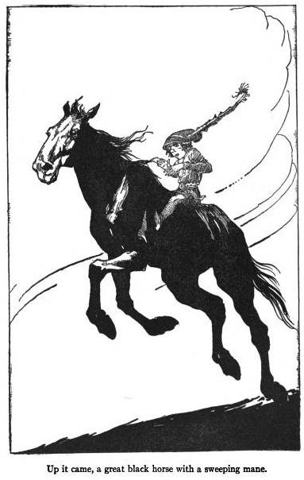
An Irish shapeshifting spirit, usually a wild black horse, who claims a share of the harvest at Samhain and is helpful or frightening depending on the teller.
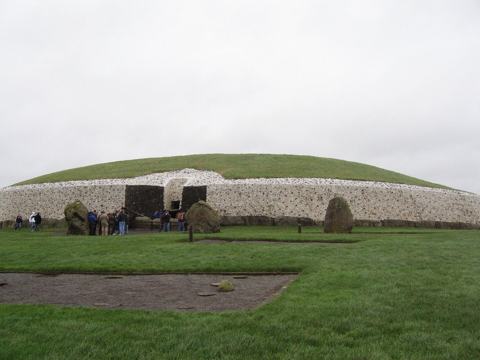
The good god — not morally good but good at everything: the club-bearing, cauldron-owning father figure of the Tuatha De Danann, and their crudest comedian.
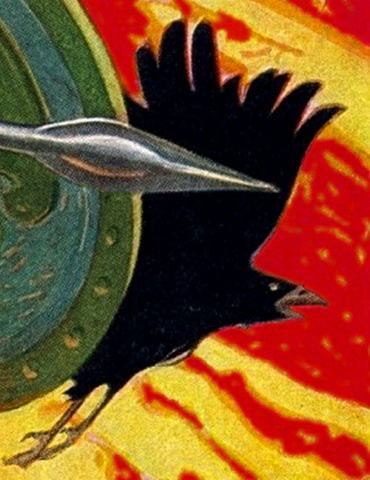
The great queen of war and fate — a shape-shifting Irish goddess who takes crow form above the battlefield and decides its outcome before it is fought.
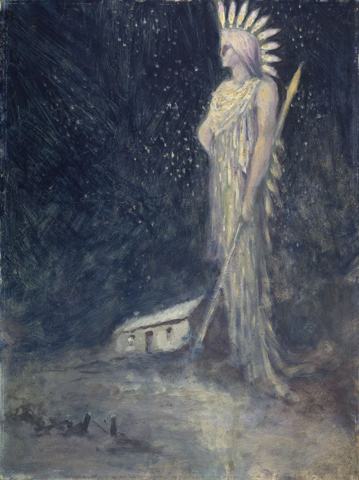
Not an afterlife but a parallel country — the sid mounds, the islands west of the sea, and the aos si who kept Ireland after they lost it.
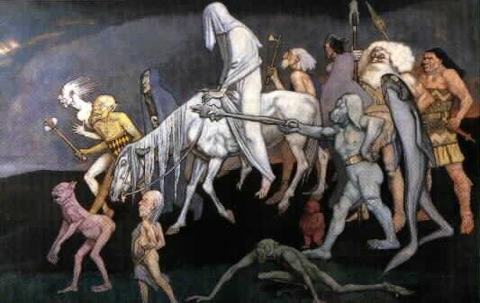
Ireland's monstrous sea-people — raiders, tribute-takers and kin to the gods they fight, led by Balor of the destroying eye.
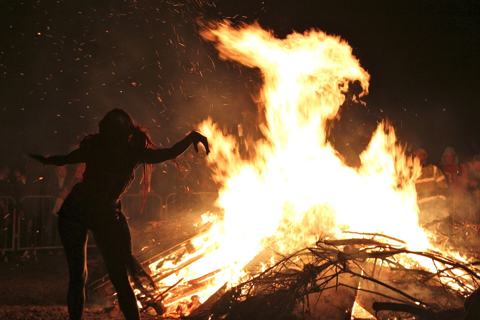
The Gaelic May Day quarter-day, first recorded in a 10th-century glossary as two fires driven between by cattle — not proof of a god named Bel.
Also mentioned inThe Druids
Sources & Further Reading
- 1.Tochmarc Emire (The Wooing of Emer), Old Irish.
- 2.Serglige Con Culainn (The Wasting Sickness of Cu Chulainn), Old/Middle Irish, in the Book of the Dun Cow (Lebor na hUidre).
- 3.Echtra Nerai (The Adventure of Nera), Old Irish.
- 4.Hutton, Ronald. The Stations of the Sun: A History of the Ritual Year in Britain. Oxford University Press, 1996.
- 5.Rogers, Nicholas. Halloween: From Pagan Ritual to Party Night. Oxford University Press, 2002.
- 6.Danaher, Kevin. The Year in Ireland. Mercier Press, 1972.
- 7.MacKillop, James. Dictionary of Celtic Mythology. Oxford University Press, 1998.
Spot an error or have a source to suggest? Write to info@viseterna.com. We cite primary sources and modern scholarship, and we correct fast.