
The Gundestrup Cauldron
A lavishly decorated silver cauldron pulled from a Danish bog in 1891, made by Thracian silversmiths for Celtic patrons and covered in gods no text explains.
The Gundestrup Cauldron, c. 150 BCE-1 CE, photograph by Lennart Larsen, 1977 (National Museum of Denmark) · CC BY-SA 3.0 · source
Found in a Bog
In May 1891, peat cutters working the bog of Raevemosen near the village of Gundestrup, in the Himmerland district of Jutland, turned up fragments of hammered silver 1. What they had found was a large ceremonial cauldron that had been deliberately taken apart before burial: its rim removed, its silver plates stacked inside one another, and the whole assembly laid in the bog rather than lost there 1. Prehistoric Scandinavia has produced a long record of valuable objects placed in bogs as offerings, and the museum that now holds the cauldron treats this as a sacrifice rather than an accident, though who made the offering, and why it ended up so far from where the vessel was made, is not recorded anywhere and cannot be 1.
A Vessel Covered in Strangers
The cauldron is built from silver plates, some gilded, embossed and chased with figures in a technique that has no real parallel in Iron Age Denmark 1,4. Its exterior panels show a procession of warriors carrying long war-trumpets and shields, a seated antlered god gripping a torc and a ram-horned serpent among wild animals, and other divine or heroic figures whose stories, if any Iron Age audience knew them, were never written down 1,7. The antlered figure is the same iconographic type recognized elsewhere as Cernunnos, though the cauldron itself supplies no name for him 7. One inner plate shows an oversized figure lowering a row of human warriors, head-first, into a vat or cauldron while foot-soldiers march toward it, an image scholars have long connected to ideas of ritual death and rebirth, of a kind elsewhere associated with journeys to the Otherworld, and sometimes, cautiously, to the cauldrons of plenty and revival that recur in Irish and Welsh tradition, including the Dagda's own cauldron 4,7.
Whose Hands, Whose Gods
The cauldron is a genuinely awkward object for the field it gets filed under. Its silverworking technique is Thracian, associated with craftsmen working in what is now Bulgaria and Romania, while several of the objects depicted in its scenes, including horned helmets and the carnyx war-trumpet, are unmistakably Celtic 1. The National Museum of Denmark's current assessment, based on repeated technical study, is that the cauldron was made where Celtic and Thracian populations lived in close contact, most likely in southwestern Romania or northwestern Bulgaria, by Thracian silversmiths working to a largely Celtic pictorial program 1,4. Earlier scholarship argued the point differently and less cautiously: Bergquist and Taylor proposed that the Balkan Celtic tribe of the Scordisci commissioned the cauldron from Thracian smiths and that the Cimbri later carried it north into Denmark after clashing with the Scordisci around 118 BCE, while Timothy Taylor's own follow-up account for a general readership leaned toward a more pancultural reading, treating the imagery as drawing on several neighbouring traditions rather than fixing it to one people 2,3. Separately, Olmsted argued for a north-western Gaulish origin on the strength of Armorican coin art, and went further still, claiming the plates narrate a specific, otherwise-lost Gaulish telling of the Tain Bo Cuailnge, an interpretation most specialists treat as far more confident than the evidence allows 5. Kaul's edited volume represents the case for reading the cauldron primarily through Thracian religious art and craft tradition rather than Celtic myth 6.
Dating an Undated Object
No inscription or firm archaeological context fixes the cauldron's date. The most widely cited range, drawn from stylistic comparison and the technical study published by the National Museum's own conservation scientists in 2005, places its manufacture between roughly 150 BCE and the turn of the era 1,4. That leaves centuries of possible transit between manufacture somewhere near the Black Sea and deposition in a Danish peat bog, and no plausible route, trade, gift, or plunder, has been established with any confidence 1,4.
What Can Be Said Honestly
The Gundestrup Cauldron is the single richest surviving image-hoard connected to Celtic religious iconography, and it is also, on its own terms, not a Celtic object: not made by Celts, not found in a Celtic-speaking region, and not accompanied by a single word of explanatory text in any language 1,7. Its antlered god, its animal processions, and its dipping scene have shaped more modern imagination about "Celtic mythology" than almost any surviving literary source, which makes the caution scholars now urge, treating it as evidence of contact and exchange across Iron Age Europe rather than as an illustrated storybook, worth taking seriously 4,7.
Continue Exploring
Four wonder-objects the Tuatha De Danann brought to Ireland: a screaming stone, an unstoppable spear, an inescapable sword, and a cauldron that never runs dry.
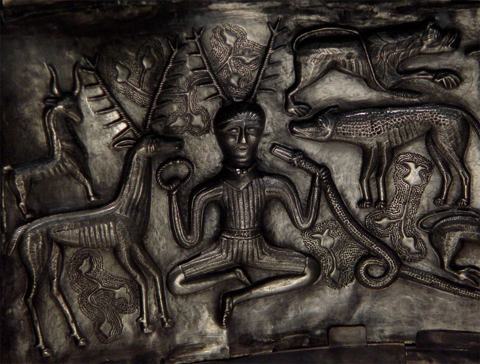
The horned one — an antlered Gaulish god known from images alone, whose name survives on exactly one damaged stone and who has no surviving myth at all.
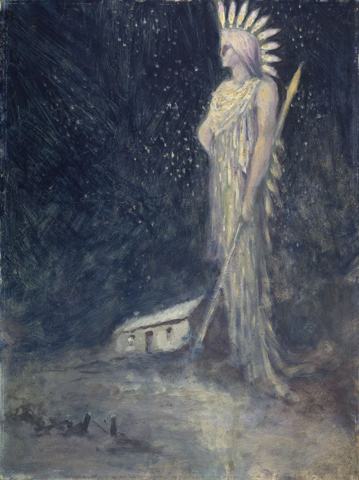
Not an afterlife but a parallel country — the sid mounds, the islands west of the sea, and the aos si who kept Ireland after they lost it.
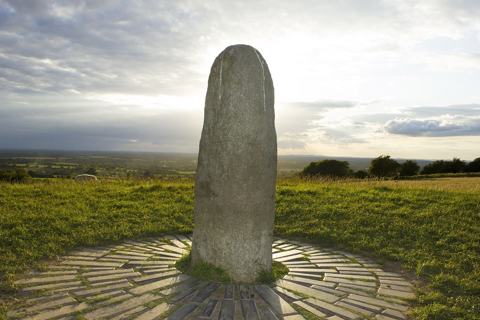
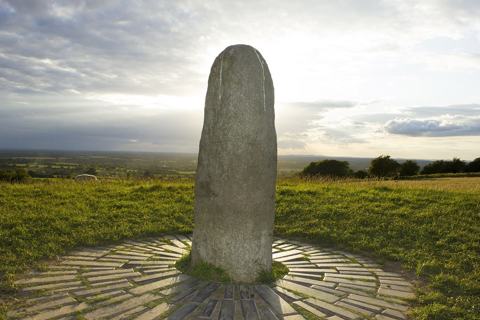
A standing stone on the Hill of Tara said to roar beneath Ireland's rightful king; the rival Scottish claim on it is a much later legend, not medieval fact.
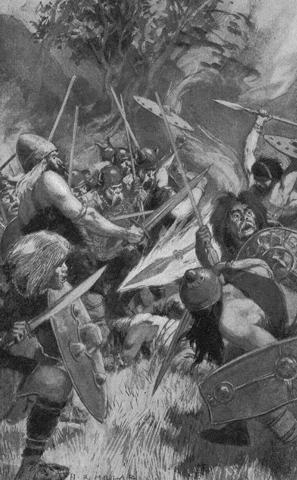
Ireland's race of gods — arriving with four treasures from four lost cities, winning Ireland twice, then losing it once and withdrawing into the mounds.
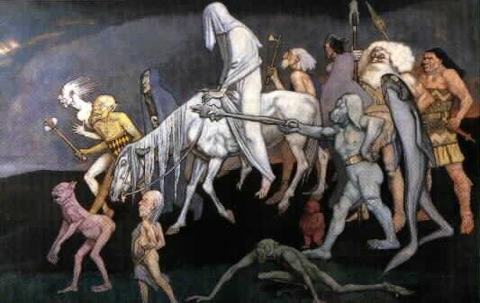
Ireland's monstrous sea-people — raiders, tribute-takers and kin to the gods they fight, led by Balor of the destroying eye.
Sources & Further Reading
- 1.National Museum of Denmark. "The Gundestrup Cauldron."
- 2.Bergquist, A. K. and T. F. Taylor. "The Origin of the Gundestrup Cauldron." Antiquity 61.231 (1987), 10-24.
- 3.Taylor, Timothy. "The Gundestrup Cauldron." Scientific American 266.3 (1992), 84-89.
- 4.Nielsen, Svend, et al. "The Gundestrup Cauldron: New Scientific and Technical Investigations." Acta Archaeologica 76 (2005), 1-58.
- 5.Olmsted, Garrett S. The Gundestrup Cauldron, Its Archaeological Context, the Style and Iconography of Its Portrayed Motifs and Their Narration of a Gaulish Version of Tain Bo Cuailnge. Collection Latomus 162. Latomus, 1979.
- 6.Kaul, Flemming (ed.). Thracian Tales on the Gundestrup Cauldron. Najade Press, 1991.
- 7.Green, Miranda J. The Gods of the Celts. Alan Sutton, 1986.
Spot an error or have a source to suggest? Write to info@viseterna.com. We cite primary sources and modern scholarship, and we correct fast.