
The Salmon of Knowledge
An ordinary salmon that eats hazelnuts of wisdom from an otherworldly well and passes all knowledge on by accident, to the boy Fionn mac Cumhaill.
River Boyne, N Chadwick, 2018 (geograph). A stretch of the Boyne, the river where the legend places the salmon's capture; no salmon or figures are shown · CC BY-SA 2.0 · source
An Otherworldly Well
Irish tradition places, somewhere beyond ordinary geography, a well ringed by nine hazel trees whose nuts hold all the world's wisdom and poetic art. The Metrical Dindshenchas, the medieval verse collection that explains Irish place-names through story, gives this well more than one name and location depending on the poem: Connla's Well at the source of the Boyne in one telling, the Well of Segais at the source of the Shannon in another, each poem serving a different river's origin-legend rather than a single fixed geography 2. In both versions the nuts of the nine hazels fall into the water, and it is a salmon living in the well that eats them, absorbing the wisdom they carry into its own flesh 2,5.
What the Fish Carries
The salmon itself has no name and no biography in the earliest sources; it is defined entirely by what it contains, in the same way the Four Treasures of the Tuatha De Danann are defined by their single guaranteed powers rather than by any personality 4. Eating the nuts is what makes it wise, and the logic of the tradition holds that whoever eats the salmon in turn inherits everything it holds, unless someone else's knowledge intervenes first 2,5. That structure, wisdom as a substance that can be transferred by ingestion rather than earned by effort, recurs across early Irish material and is one of the clearest cases scholars point to of poetic knowledge being imagined as literally edible 3,5.
Finn Eces and the Boy Who Burned His Thumb
The fullest surviving telling of the fish being caught is not really about the fish. Macgnimartha Finn, "The Boyhood Deeds of Finn," describes the poet Finn Eces fishing the Boyne for seven years specifically for this salmon, on a prophecy that he himself would eat it and gain all knowledge 1. When he finally lands it, he sets his young student to cook it with a single order: taste nothing. The boy, not yet called Fionn mac Cumhaill, burns his thumb on the cooking skin, puts it in his mouth without thinking, and the wisdom passes to him instead of to his teacher 1. Finn Eces recognizes what has happened at once and, rather than resenting it, gives the boy the whole fish to eat, apparently accepting that the prophecy was never really about him 1. The text is specific about what Fionn gains: not vague wisdom but teinm laida, imbas forosna, and dichetal di chennaib, three named techniques of poetic divination that appear elsewhere in Irish legal and grammatical tracts as the working equipment of a trained fili, a professional poet 1,3.
Not the Only Wise Salmon
The Salmon of Knowledge should not be confused with a different salmon in Irish tradition, Fintan mac Bochra, a legendary sage who survives the Flood in Lebor Gabala Erenn by shape-changing repeatedly, including into salmon form, and lives on for millennia as Ireland's oldest witness 5. Both figures connect salmon to accumulated wisdom, and popular retellings sometimes blur them together, but they belong to separate textual traditions: one is an origin-legend figure explaining how ancient knowledge survived into historical time, the other is a nameless fish in a well-story explaining how a specific hero got his gift 3,5. Keeping them apart is less pedantry than accuracy about what the medieval texts actually say.
A Motif, Not Just a Story
The image of wisdom gained by accident through a burned finger has a well-known structural cousin in Welsh tradition, where the boy Gwion Bach tastes three drops from Ceridwen's cauldron meant for someone else and is transformed by the knowledge into the poet Taliesin 4,6. Whether this reflects a shared older Celtic motif or a later cross-pollination between Irish and Welsh storytelling traditions is not something the surviving texts can settle, and scholars generally present it as a parallel worth noting rather than proof of a common source 4,6. What the Irish material keeps returning to, in the well, the hazels, and the fish that swims between them, is a consistent idea: that the deepest knowledge belongs first to the Otherworld, and reaches human hands only by leaking through, unevenly and by accident, rather than by being sought and won outright 2,3.
Continue Exploring
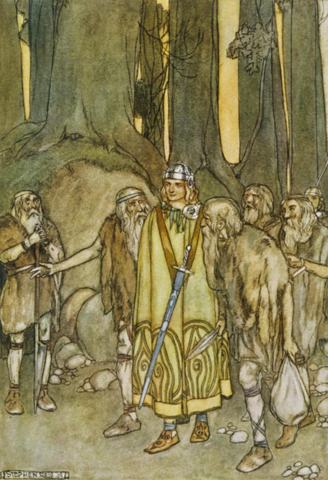
Warrior-poet, leader of the Fianna, and the hero who burned his thumb on the Salmon of Knowledge — Ireland's most widely told legend.
A real sixth-century court poet and a shapeshifting legendary bard reborn from a cauldron share one name, and the tradition never fully separates them.
A medieval synthetic history of Ireland: six waves of settlers, the Tuatha De Danann, and the Gaelic Milesians, engineered to answer to the Bible.
The Welsh enchantress who brewed a year-long potion of pure knowledge, chased the boy who stole it through a chain of animal shapes, and swallowed him whole.
Not an afterlife but a parallel country — the sid mounds, the islands west of the sea, and the aos si who kept Ireland after they lost it.
Ireland's monstrous sea-people — raiders, tribute-takers and kin to the gods they fight, led by Balor of the destroying eye.
Sources & Further Reading
- 1.Macgnimartha Finn (The Boyhood Deeds of Finn), Middle Irish, ed. and trans. Kuno Meyer, Revue Celtique 5, 1882.
- 2.Gwynn, Edward (ed. and trans.). The Metrical Dindshenchas. Royal Irish Academy, Todd Lecture Series, 1903-1935.
- 3.O'Rahilly, Thomas F. Early Irish History and Mythology. Dublin Institute for Advanced Studies, 1946.
- 4.Nagy, Joseph Falaky. The Wisdom of the Outlaw, The Boyhood Deeds of Finn in Gaelic Narrative Tradition. University of California Press, 1985.
- 5.MacKillop, James. Dictionary of Celtic Mythology. Oxford University Press, 1998.
- 6.Koch, John T. (ed.). Celtic Culture: A Historical Encyclopedia. ABC-CLIO, 2006.
Spot an error or have a source to suggest? Write to info@viseterna.com. We cite primary sources and modern scholarship, and we correct fast.