
Banshee
Herald of death — the "woman of the mound," heard rather than seen, whose keening outside a house announces that someone of the family is about to die.
The Banshee Appears, Irish illustration, 1862 · Public domain · source
The Woman of the Mound
Banshee is an anglicisation of Irish bean si, "woman of the sid" — the sid being the fairy mounds, the otherworld dwellings that in Irish tradition are also the ancient burial tumuli scattered across the landscape 5,6. She is therefore, by name, a supernatural woman of the otherworld rather than a ghost, and the distinction matters: she is not the spirit of a dead person, and she is not death itself 4,5.
Her function is announcement. The banshee cries near a house, and within a short time someone belonging to that house, or to the wider family, dies 4. She does not cause the death, cannot be bargained with, and in most testimonies is not seen at all — the belief is overwhelmingly auditory 4. Lysaght's study, built on hundreds of accounts collected by the Irish Folklore Commission and on fieldwork of her own, established that the cry, not the apparition, is the core of the tradition, and that belief in her was still actively reported in the twentieth century 4.
Keening
The banshee's cry is a supernatural version of a real practice. The caoineadh — anglicised "keening" — was the formal lament performed over the dead at Irish wakes and funerals, usually by women, sometimes by professional keeners hired for the purpose, combining wailing with improvised sung poetry in praise of the deceased 4,5. The Church campaigned against it for centuries, and it faded through the nineteenth and twentieth 4.
The banshee keens ahead of the death rather than after it, which makes her a mourner arriving early 4,6. The best-known surviving example of the human art form, the eighteenth-century Caoineadh Airt Ui Laoghaire, is enough on its own to show what the supernatural version was modelled on: a woman's voice, unrestrained, addressing the dead directly 4.
Attached to Families
The strongest structural feature of the belief is that the banshee belongs to particular families. Tradition commonly restricts her to the old Gaelic lineages, those with surnames carrying O or Mac, and sometimes to the "true" families of a district, with Norman and later settler families explicitly excluded — or, in some tellings, acquiring one after enough generations in Ireland 4,5.
Individual families claim named otherworld women. Aibell of Craig Liath is associated with the O'Briens of Thomond and Cliodhna with the MacCarthys of south Munster; both are otherworld queens in earlier literature who take on the death-messenger role in later belief 4,5. The fourteenth-century Cathreim Thoirdhealbhaigh, a chronicle of Anglo-Norman and Irish warfare in Thomond, has a hideous supernatural woman washing severed heads and limbs at a ford and announcing to the leader that she is Bronach of Burren and that the arms are those of his own dead — one of the earliest datable literary instances of the type 2,4.
The Washer and the Badb
Behind the banshee lies an older figure: the woman washing bloodstained clothing or armour at a ford, which the doomed warrior recognises as his own. She appears in Irish saga in connection with The Morrigan and the badb, the war goddess whose name also means "scald crow," and in the account of Cu Chulainn's death he sees a woman weeping and washing at a ford before he goes to his final battle 1,5,7.
Scotland preserves a parallel figure, the bean-nighe, "washer woman," in Gaelic tradition 5,6. Whether the medieval war goddess and the modern family death-messenger form one continuous tradition or two things that converged is a real scholarly question; Lysaght treats the connection as plausible and undemonstrated, and warns against reading the folklore backwards into the sagas 4. The word badhbh itself came in parts of Ireland to mean simply "banshee," which shows the two at least merged in usage 4,5.
What She Looks Like
Where she is described, the accounts diverge on nearly every point except the hair. She may be young and beautiful or old and hideous; she is usually dressed in white, grey, or occasionally red; and she has long hair which she combs 4. The comb is the most persistent physical motif, and it carries its own legend: a person who finds a comb by the road and takes it home is visited that night, and must return it — with tongs, out of the window, never by hand — or lose the hand 4.
Lysaght's regional mapping found that the comb and the visual descriptions cluster geographically and are entangled with literary and print sources, while the plain report of a cry heard at night is distributed everywhere and is much less elaborated 4. That is a useful diagnostic. The parts of the tradition that look most cinematic are the parts most likely to have been shaped by books 4.
After the Wake
Related beliefs cluster around the same idea without being the same figure. The badhbh chaointe, "keening crow," the death coach or coiste bodhar, and various omen animals belong to the wider complex of Irish death-warning lore 4,5. The word "banshee" entered English early enough to be used loosely, and by the nineteenth century it was appearing in Anglo-Irish gothic writing detached from its rules 4,6.
The seventeenth-century Memoirs of Lady Ann Fanshawe records one of the earliest first-person English accounts: staying at an Irish house, she is woken by a voice at her window and sees a woman with red hair and a pale face who cries out three times and vanishes, and is told the next morning that a family member had died in the night and that this always happens before a death in that house 3. Her host's calm explanation is as informative as the vision: to the family, it was not a haunting but an expected part of dying 3,4.
Continue Exploring
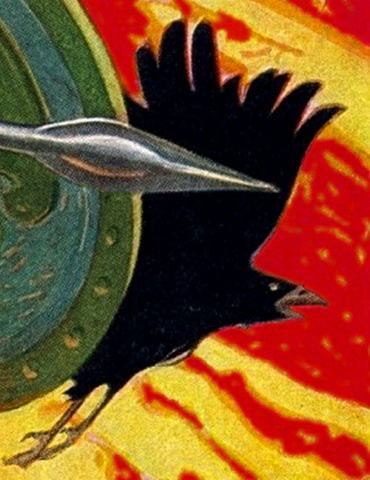
The great queen of war and fate — a shape-shifting Irish goddess who takes crow form above the battlefield and decides its outcome before it is fought.
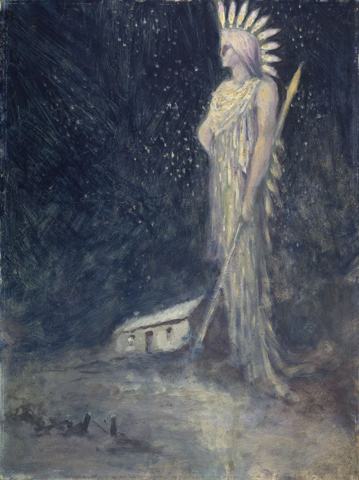
Not an afterlife but a parallel country — the sid mounds, the islands west of the sea, and the aos si who kept Ireland after they lost it.
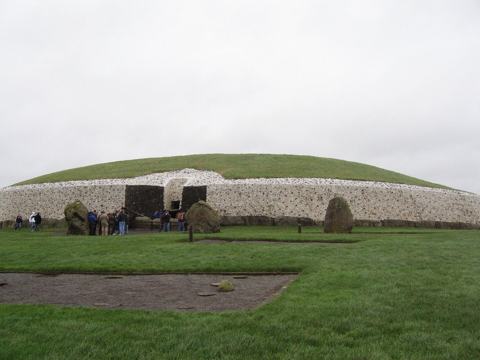
The good god — not morally good but good at everything: the club-bearing, cauldron-owning father figure of the Tuatha De Danann, and their crudest comedian.
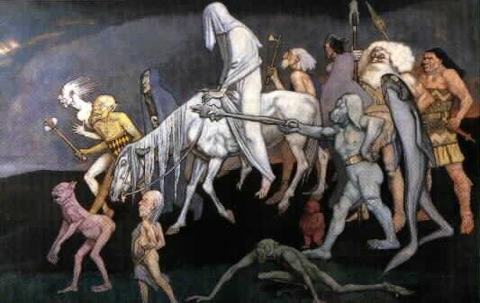
Ireland's monstrous sea-people — raiders, tribute-takers and kin to the gods they fight, led by Balor of the destroying eye.
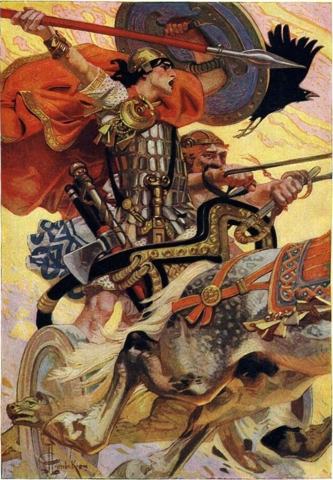
The Hound of Ulster — a boy-hero who holds an entire army at a ford, warps into a monster when he fights, and dies standing up, tied to a stone.
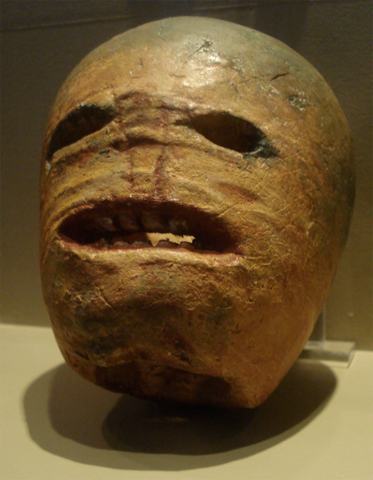
The Gaelic quarter day that opened winter and the Otherworld alike in medieval Irish literature — not, despite a popular myth, the name of a god of the dead.
Sources & Further Reading
- 1.Brislech Mor Maige Muirthemni (The Death of Cu Chulainn), Middle Irish.
- 2.Cathreim Thoirdhealbhaigh (The Triumphs of Turlough), by Sean mac Ruaidhri Mac Craith, c. 1350.
- 3.Memoirs of Lady Ann Fanshawe, written 1676, first published 1829.
- 4.Lysaght, Patricia. The Banshee: The Irish Supernatural Death-Messenger. Glendale Press, 1986.
- 5.MacKillop, James. Dictionary of Celtic Mythology. Oxford University Press, 1998.
- 6.Koch, John T. (ed.). Celtic Culture: A Historical Encyclopedia. ABC-CLIO, 2006.
- 7.Green, Miranda J. Dictionary of Celtic Myth and Legend. Thames & Hudson, 1992.
Spot an error or have a source to suggest? Write to info@viseterna.com. We cite primary sources and modern scholarship, and we correct fast.