
Tuatha De Danann
Ireland's race of gods — arriving with four treasures from four lost cities, winning Ireland twice, then losing it once and withdrawing into the mounds.
Illustration of Lugh's magic spear, Harold Robert Millar, in Charles Squire's Celtic Myth and Legend, 1905 · Public domain · source
The Fifth People to Take Ireland
Lebor Gabala Erenn, the medieval "Book of the Taking of Ireland," tells Irish prehistory as a sequence of peoples who land on the island, hold it for a time, and are displaced by the next arrival. The Tuatha De Danann — "the peoples of the goddess Danu," on one reading of a genuinely contested name — are the fifth wave, and the only one the tradition treats as fully divine 2. The name itself is a knot the manuscripts never fully untie, tangled up with a goddess who may never have had an independent cult under that exact word; that question belongs to Danu's own entry and is set aside here 2,6.
What the Lebor Gabala gives this people instead is a point of departure that is itself otherworldly: not a place on any map but four cities in the north of the world — Falias, Gorias, Findias, and Murias — where they mastered druidry, learning, and every craft before ever landing in Ireland 2,5. They arrive in a mist that blots out the sun for three days and burn their ships behind them, so that retreat is not an option 2.
Four Cities, Four Treasures
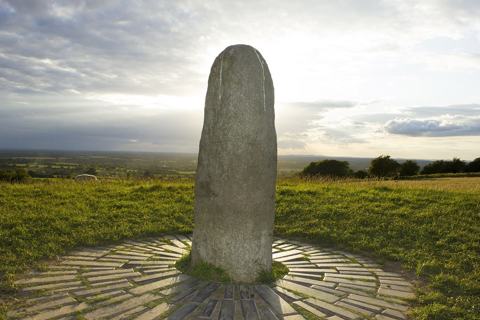
Each city sends them away with one object, and together these are the four treasures of Ireland. From Falias comes the Lia Fail, the Stone of Destiny, said to cry aloud under the foot of Ireland's rightful king; a standing stone answering to that name still stands on the Hill of Tara, though its present position there is largely a nineteenth-century arrangement, and archaeologists do not agree it always stood exactly there 2,5,6. From Gorias comes the spear that will belong to Lugh, never checked once drawn in battle. From Findias comes the sword of Nuada, their first king. From Murias comes the cauldron of the Dagda, the "undry" vessel from which no company goes away unsatisfied 2,5.
The scheme is tidy enough to look invented, and current scholarship generally treats it as exactly that: a piece of learned systematising, imposing a literate, monastic culture's taste for order on material that had not necessarily arrived packaged that way 3,6. That does not make the four objects any less central to the sagas built around them; it means the neat list of four is doing organisational work the underlying stories do not obviously require.
Winning Ireland Twice
The Tuatha De Danann take Ireland from the Fir Bolg at the First Battle of Mag Tuired, a fight remembered mostly for its cost: Nuada, their king, loses an arm to the Fir Bolg champion Sreng, and a rule against a blemished king on the throne costs him the kingship along with the limb 1,5. The result is the disastrous reign of Bres, son of a Fomorian father, whose stinginess is what the central saga of the cycle, Cath Maige Tuired, actually spends most of its length describing 1.
That saga's climax is the Second Battle of Mag Tuired, fought against the Fomorians — who are not, on close reading, an alien race so much as the Tuatha De's own in-laws, intermarried at nearly every generation 1. The Morrigan meets the Dagda at a river ford before the fighting starts and promises him victory; Ogma recovers the sword of the defeated Fomorian king Tethra; and Lugh, newly admitted to Tara because he alone holds every craft at once, kills the Fomorian king Balor with a sling-stone through his destroying eye 1. Nuada, restored to kingship years earlier once physicians had fitted him with a working arm, falls in the same battle, killed by that same eye before Lugh can stop it 1,5.
Losing Ireland Once
The Tuatha De Danann's own tenure ends at the hands of the Milesians, whose arrival closes the Lebor Gabala's sequence of invasions. Irish tradition frames the transfer as part conquest, part negotiation: the poet-judge Amergin is asked to divide Ireland fairly between the newcomers and the defeated gods, and his judgment gives the Milesians the surface of the island and the Tuatha De Danann everything beneath it 2,5.
That division is the hinge the whole later mythology turns on. It is rarely described as an ordinary defeat, because the Lebor Gabala's compilers needed the Tuatha De Danann to survive the transition — so much of later Irish saga needs them still present, only relocated 2,3.
Into the Mounds
"Beneath the surface," in practice, means the side — the prehistoric burial mounds and hills of the Irish landscape, which the literature turns into doorways of the Otherworld 2,5. Tradition credits Manannan mac Lir with fitting the defeated gods out for their new condition: the mist that hides their dwellings, a feast that keeps age away, swine that can be eaten and are alive again the next morning 5,7. From that settlement the Tuatha De Danann become the aes side, "the people of the mounds" — the literary ancestors of the fairies of later Irish and Scottish folklore 5,6,7.
A Pantheon Built by Scribes
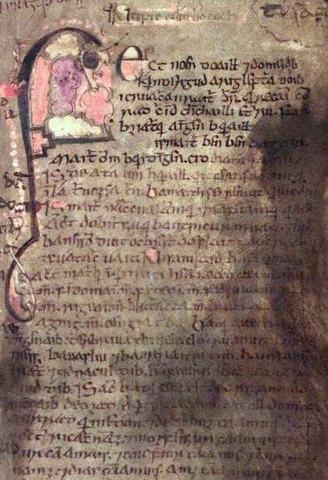
Two honest cautions belong at the end rather than the beginning. First, this material survives only through Christian manuscripts compiled centuries after any pre-Christian practice it might reflect, and John Carey's study of the Lebor Gabala treats the whole invasion-sequence as learned pseudohistory, built to give Ireland a place inside a biblical chronology rather than to preserve an intact pagan king-list 3. Second, Marie-Louise Sjoestedt's still-cited formula of the Tuatha De Danann as simply "the gods of the tribe" needs the caveat that the tribe in question is a literary construction as much as a religious memory — a pantheon whose coherence may owe as much to twelfth-century bookmaking as to anything worshipped before it 4. What survives that caution is still considerable: a divine people with an origin, four objects that recur across the wider mythology, two wars, and a final address, under the hills, that the rest of the Codex keeps returning to 1,2,5.
Continue Exploring
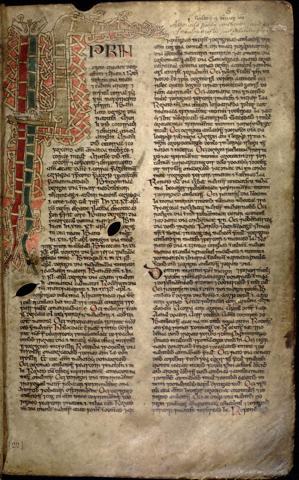
A medieval synthetic history of Ireland: six waves of settlers, the Tuatha De Danann, and the Gaelic Milesians, engineered to answer to the Bible.
Four wonder-objects the Tuatha De Danann brought to Ireland: a screaming stone, an unstoppable spear, an inescapable sword, and a cauldron that never runs dry.
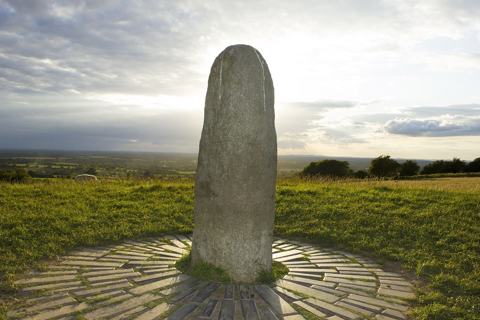
A standing stone on the Hill of Tara said to roar beneath Ireland's rightful king; the rival Scottish claim on it is a much later legend, not medieval fact.
The mother goddess of the Tuatha De Danann — and the most famous Irish deity who may never have existed under that name.
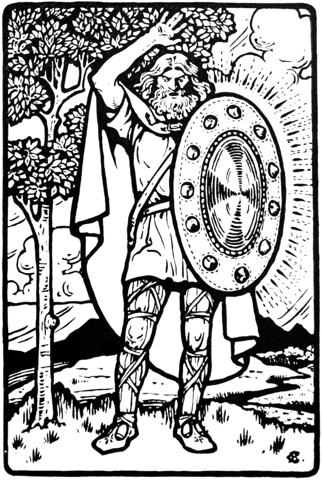
The Irish sea god — ferryman between worlds, master of illusion and the mist of invisibility, and the presiding figure of the Otherworld voyages.
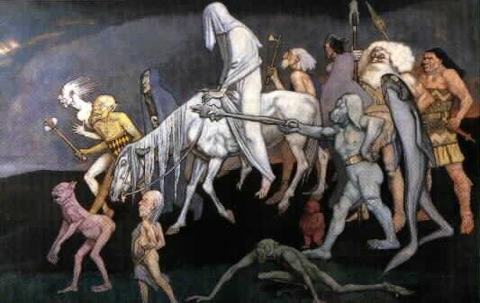
Ireland's monstrous sea-people — raiders, tribute-takers and kin to the gods they fight, led by Balor of the destroying eye.
Sources & Further Reading
- 1.Cath Maige Tuired: The Second Battle of Mag Tuired, ed. and trans. Elizabeth A. Gray. Irish Texts Society vol. 52, 1982 (CELT edition).
- 2.Lebor Gabala Erenn (The Book of the Taking of Ireland), ed. R. A. S. Macalister. Irish Texts Society, 1938-1956.
- 3.Carey, John. The Irish National Origin-Legend: Synthetic Pseudohistory. Department of Anglo-Saxon, Norse and Celtic, University of Cambridge, 1994.
- 4.Sjoestedt, Marie-Louise. Gods and Heroes of the Celts. Trans. Myles Dillon. Methuen, 1949.
- 5.MacKillop, James. Dictionary of Celtic Mythology. Oxford University Press, 1998.
- 6.Koch, John T. (ed.). Celtic Culture: A Historical Encyclopedia. ABC-CLIO, 2006.
- 7.Green, Miranda J. Dictionary of Celtic Myth and Legend. Thames & Hudson, 1992.
Spot an error or have a source to suggest? Write to info@viseterna.com. We cite primary sources and modern scholarship, and we correct fast.