
Susanoo
The raging kami of sea and storm — expelled from heaven for wrecking his sister's fields, then redeemed in Izumo by slaying an eight-headed serpent.
Susanoo-no-Mikoto Slays Yamata-no-Orochi in Izumo, Tsukioka Yoshitoshi, 19th century · Public domain · source
Who Susanoo Is
Susanoo-no-Mikoto (須佐之男命 in the Kojiki, 素戔嗚尊 in the Nihon Shoki) is the kami of storms, the sea, and violent force in Japan's eighth-century chronicles — and the most morally complicated figure in them 1,2. He is the younger brother of the sun goddess Amaterasu and of the moon kami Tsukuyomi, the wrecker of heaven, the killer of a monster, the author of the first Japanese poem, and the ancestral deity of Izumo 1,4.
The chronicles do not resolve him into a villain or a hero. Philippi noted that the same narrative sequence casts him first as a defiling intruder in heaven and then, without apology, as a culture-bringing benefactor on earth 4. Shinto is a living tradition, and Susanoo remains an actively worshipped kami at major shrines today; the sections below distinguish the eighth-century texts from later belief and current practice 6,7.
Born of Purification, Banished for Weeping
In the Kojiki, Izanagi purifies himself after fleeing the land of the dead. Washing his left eye produces Amaterasu, his right eye Tsukuyomi, and his nose Susanoo 1. Izanagi assigns Susanoo rule over the sea plain — and Susanoo refuses it 1.
Instead he weeps and howls until his beard reaches his chest. The green mountains wither to bare hills, the rivers and seas dry up, and the noise of malevolent kami fills the land like summer flies 1,4. Asked why, he answers that he wishes to go to his mother's land, Ne-no-katasu-kuni, the land of roots. Izanagi, enraged, expels him 1. The Nihon Shoki preserves alternative accounts in which he is produced jointly by Izanagi and Izanami and consigned to the netherworld from the start 2,5.
The Oath and the Offence in Heaven
Susanoo climbs to Takamagahara to take leave of his sister, and the mountains and rivers shake at his approach. Amaterasu, expecting invasion, arms herself; he proposes an ukehi, a trial by oath, to prove his sincerity 1,2. She chews his sword and produces three goddesses — the Munakata deities, later worshipped as protectors of the sea lanes; he chews her curved magatama jewels and produces five male kami 1. Susanoo claims victory, and celebrates it by destroying Takamagahara from the inside 1.
He breaks the ridges between the rice paddies, blocks the irrigation channels, defiles the hall of first-fruits, and flays a heavenly piebald colt backwards and hurls it into the sacred weaving hall, killing a weaving maiden 1,2. Amaterasu withdraws into the rock cave and the sun goes out. When she is drawn back, the assembled kami fine Susanoo a thousand tables of restitution, cut off his beard and the nails of his hands and feet, and expel him from heaven 1,4.
Yamata-no-Orochi
He descends at the headwaters of the Hi River in Izumo, where he finds an old couple, Ashinazuchi and Tenazuchi, weeping over their last daughter, Kushinadahime. A serpent with eight heads and eight tails, Yamata-no-Orochi, has taken one daughter a year for seven years 1,2.
Susanoo transforms Kushinadahime into a comb and sets it in his hair, then has the couple brew eight-times-refined sake and set out eight vats behind eight gates. The serpent drinks, sleeps, and Susanoo cuts it apart. In one of the tails his blade strikes something hard: a sword, which he sends up to Amaterasu as a gift of reconciliation 1,2. It is Ame-no-Murakumo-no-Tsurugi, later renamed Kusanagi and counted among the imperial regalia 2.
At Suga he builds a palace, and — seeing clouds rise — utters what the Kojiki presents as the first Japanese poem, on the eightfold fence of eightfold rising clouds of Izumo 1,4.
The Izumo Susanoo
Izumo has its own Susanoo, and he is not the same character. The Izumo no Kuni Fudoki, a provincial gazetteer submitted to the court in 733, records him chiefly as a land-naming ancestral deity who fathers local kami and gives places their names — with no serpent, no rampage in heaven, and none of the pollution imagery 3,7. Scholars read the contrast as evidence that the court chronicles absorbed and reshaped an independent Izumo tradition to fit a heaven-centred imperial narrative 6,7.
In the Kojiki, Susanoo ends up ruling Ne-no-kuni, where his descendant Okuninushi comes seeking his daughter Suseribime and survives a series of lethal trials — snakes, wasps, a burning field — before escaping with the god's own sword, bow, and koto and Susanoo's grudging blessing to build the land 1,4.
Worship, Then and Now
Susanoo is enshrined at Yasaka Jinja in Kyoto, at Hikawa Jinja in Saitama and its many branch shrines across the Kanto plain, and at Kumano and Yaegaki in Izumo 6. Yasaka was long known as Gion-sha, where Susanoo was identified with the Buddhist plague deity Gozu Tenno; its summer rite of pestilence-averting is the origin of Kyoto's Gion Matsuri, still held every July 6,7. The Meiji government's forcible separation of kami and buddhas in 1868 stripped the Gozu Tenno identification away and renamed the shrine, an act Breen and Teeuwen treat as a clear case of a modern state remaking what "Shinto" meant 7.
The result is a deity whose worship today emphasises protection from epidemic and disaster — the storm turned outward, warding rather than wrecking 6,7.
Continue Exploring
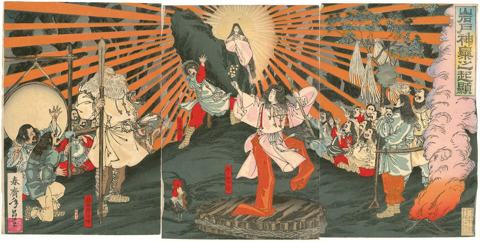
The sun goddess who shines in heaven — ruler of the Plain of High Heaven, ancestor of Japan's imperial line, and the kami enshrined at Ise.
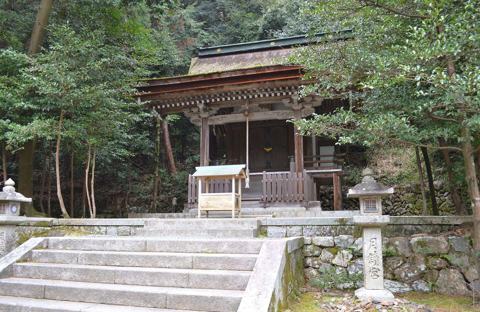
The moon kami born from Izanagi's right eye — ruler of the night, whose single recorded act of violence set the sun and moon forever apart.
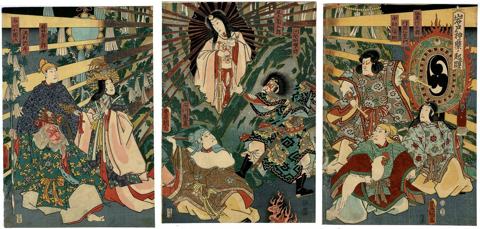
The Plain of High Heaven — where the first kami came into being, where the gods hold council, and from which Amaterasu's line descended to rule the islands.
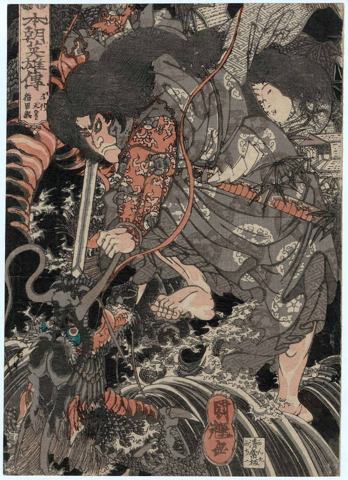
The eight-headed, eight-tailed serpent of Izumo — devourer of maidens, killed drunk by Susanoo, and the source of the imperial sword Kusanagi.
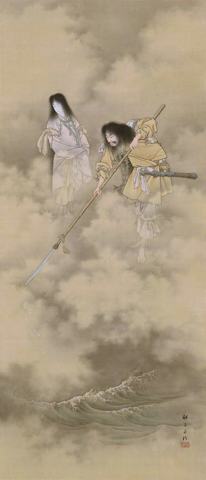
The creator pair of Japanese myth: they stirred the first island out of the sea, bore the land itself, and were parted forever by death.
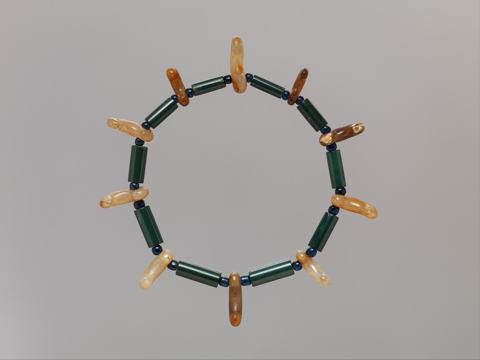
One of Japan's three imperial regalia: a string of curved jewels born at the heavenly rock cave, handed down from Amaterasu, and kept with the emperor unseen.
Also mentioned inAme-no-UzumeInari (Inari Okami)Kusanagi-no-Tsurugi (The Grass-Cutter Sword)Okuninushi (Great Land Master)RaijinRyujin (Japanese Dragon King of the Sea)Shuten-doji (Oni King of Mount Oe)The KojikiYata no Kagami (the Sacred Mirror)Yomi (Yomi-no-Kuni)
Sources & Further Reading
- 1.Kojiki — Records of Ancient Matters (712 CE).
- 2.Nihon Shoki — Chronicles of Japan (720 CE).
- 3.Izumo no Kuni Fudoki — Gazetteer of Izumo Province (733 CE).
- 4.Philippi, Donald L., trans. Kojiki. University of Tokyo Press, 1968.
- 5.Aston, W. G., trans. Nihongi: Chronicles of Japan from the Earliest Times to A.D. 697. Kegan Paul, 1896.
- 6.Hardacre, Helen. Shinto: A History. Oxford University Press, 2017.
- 7.Breen, John & Mark Teeuwen. A New History of Shinto. Wiley-Blackwell, 2010.
Spot an error or have a source to suggest? Write to info@viseterna.com. We cite primary sources and modern scholarship, and we correct fast.