
Kusanagi-no-Tsurugi (The Grass-Cutter Sword)
The sword drawn from a serpent's tail and renamed by a burning field — one of Japan's three imperial regalia, kept at Atsuta Jingu and never shown to anyone.
Yamato Takeru and the Sword Kusanagi-no-Tsurugi, Ogata Gekko, 1887 (Museum of Fine Arts, Boston) · Public domain · source
Out of the Serpent's Tail
The sword begins inside a monster. When Susanoo gets the eight-headed serpent Yamata-no-Orochi drunk on refined sake and cuts it apart, his own blade chips against something hard in the middle tail. He splits the flesh open and finds a great sword, and — recognising it as no ordinary find — sends it up to heaven as a gift of reconciliation to his sister Amaterasu 1,2. Both chronicles name it Ame-no-Murakumo-no-Tsurugi, "the sword of the gathering clouds of heaven," and both place it afterward among the treasures passed down through the heavenly grandson's line 1,2.
It does not become Kusanagi in that scene. The chronicles give it a second, human episode before the new name sticks, and that episode is a near-fatal ambush rather than a triumph 1,2.
A Sword Renamed by Fire
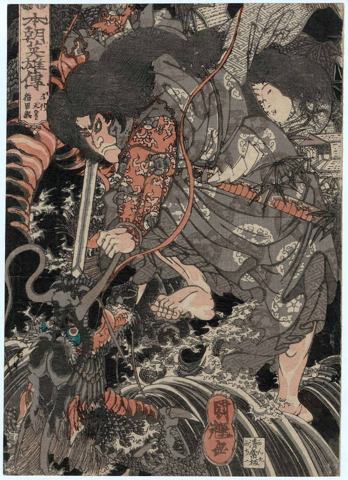
Generations later, the sword is in the keeping of Yamatohime, priestess of the sun goddess at Ise, when her nephew Yamato Takeru passes through on his way to subdue the eastern provinces. She gives it to him along with a fire-striking pouch, and the Kojiki is explicit that she is arming him for danger she already senses 1. The danger comes at Sagamu, where a hostile lord lures him into a wide moor and sets it alight around him. Takeru swings the sword to cut down the grass in a ring at his feet, strikes fire from the flint in Yamatohime's pouch, and sends a counter-blaze outward to burn a path through his enemies' fire 1,2. The sword takes its familiar name from the act: Kusanagi, "grass-mower" or "grass-cutter." The Nihon Shoki tells the same episode with variant place names and phrasing, which is standard for how the two chronicles handle a single shared story 2.
The rest of Takeru's saga turns on the sword's absence rather than its use. Before climbing Mount Ibuki to face a mountain god he underestimates, he leaves Kusanagi behind with his bride Miyazu-hime in Owari, goes up unarmed, and is struck down by hail sent by the god he insulted. He dies without the sword that had already saved him once 1,2. In the Kojiki's telling, that irony is the point: the blade protects the man who carries it and does nothing for the one who sets it down 1.
Kept Among the Three Treasures
Kusanagi is one of the Three Sacred Treasures, the sanshu no jingi, alongside the mirror Yata-no-Kagami, kept at the Ise shrines, and the curved jewels Yasakani-no-Magatama, kept with the emperor in Tokyo 1,2,4. Tradition holds that the sword itself came to rest at Atsuta Jingu in Nagoya, where Miyazu-hime is said to have enshrined it after Takeru's death, and where it remains the shrine's central object of worship 1,4.
None of the three regalia is put on public display, and the sword is the most closed off of all. Hardacre and Breen and Teeuwen both describe the regalia's role in imperial accession rites as ritually significant precisely because they are not seen: at an enthronement, replicas or the wrapped objects themselves are carried between palace and shrine in cloth-covered cases that are not opened even in the ceremony, a practice followed again at the 2019 accession of the current emperor 4,5. Shrine and popular accounts hold that not even Atsuta's own priests have looked inside the sword's container in living memory, a claim that cannot be independently checked and is best treated as devotional testimony rather than documented fact 4.
Lost at Dan-no-ura
The sword's one confirmed disappearance from history is naval. At the Battle of Dan-no-ura in 1185, the Tale of the Heike describes the child emperor Antoku and his grandmother, Taira no Tokiko, going into the sea together as the Taira fleet collapses; Tokiko carries the sword with her, telling the boy that a palace waits for them under the waves 3. The mirror was recovered; the sword was not, and the copy used in imperial ritual since is understood within Shinto practice to be a substitute, an ambiguity the tradition itself does not try to resolve 3,4.
Medieval retellings pushed further than the Heike itself. A supplementary tradition attached to the tale claims that Yamata-no-Orochi, the serpent Susanoo killed centuries before, had taken the infant Antoku's form specifically to reclaim the blade drawn from its own body — a piece of storytelling that folds the sword's whole history into a single circle, from monster to emperor and back to the sea 3. It is a legend layered onto the Heike, not a claim the earlier chronicles make, and it says more about how later audiences wanted the story to end than about anything that happened at Dan-no-ura 3.
Continue Exploring
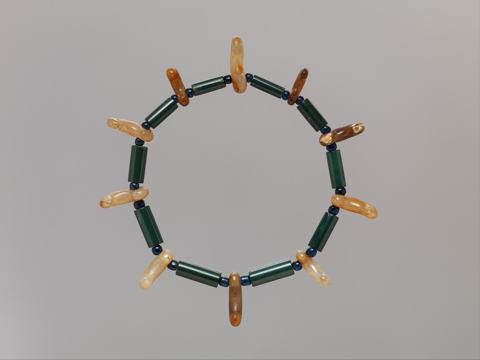
One of Japan's three imperial regalia: a string of curved jewels born at the heavenly rock cave, handed down from Amaterasu, and kept with the emperor unseen.
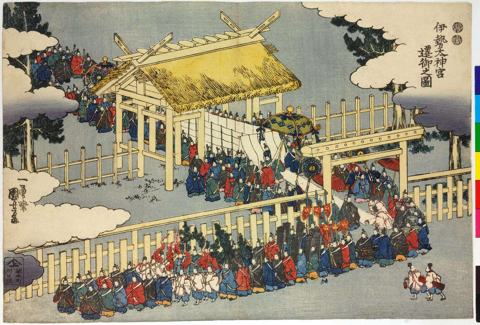
The mirror forged to trick a sun goddess out of hiding, handed down to her earthly heirs, and now kept at Ise, wrapped, unphotographed, and never once unveiled.
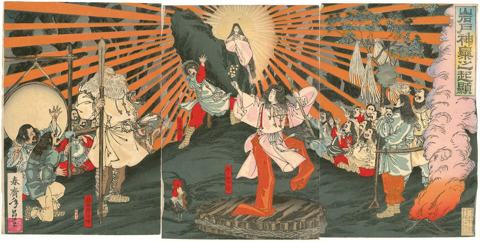
The sun goddess who shines in heaven — ruler of the Plain of High Heaven, ancestor of Japan's imperial line, and the kami enshrined at Ise.
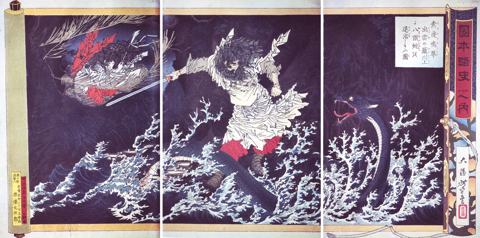
The raging kami of sea and storm — expelled from heaven for wrecking his sister's fields, then redeemed in Izumo by slaying an eight-headed serpent.
The eight-headed, eight-tailed serpent of Izumo — devourer of maidens, killed drunk by Susanoo, and the source of the imperial sword Kusanagi.
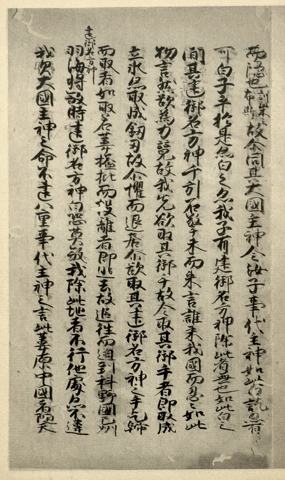
Japan's oldest surviving chronicle, presented to the throne in 712 from one court reciter's memory — the deepest source for the Codex's kami and early emperors.
Also mentioned inIse Grand ShrineThe Nihon Shoki
Sources & Further Reading
- 1.Kojiki (Records of Ancient Matters, 712) — Books One and Two; trans. Donald L. Philippi, University of Tokyo Press, 1968.
- 2.Nihon Shoki (Chronicles of Japan, 720) — Books One and Seven, in W.G. Aston (trans.), Nihongi. Kegan Paul, 1896.
- 3.The Tale of the Heike. Trans. Royall Tyler. Viking, 2012.
- 4.Hardacre, Helen. Shinto: A History. Oxford University Press, 2017.
- 5.Breen, John & Mark Teeuwen. A New History of Shinto. Wiley-Blackwell, 2010.
Spot an error or have a source to suggest? Write to info@viseterna.com. We cite primary sources and modern scholarship, and we correct fast.