
Yasakani no Magatama (the Sacred Jewel)
One of Japan's three imperial regalia: a string of curved jewels born at the heavenly rock cave, handed down from Amaterasu, and kept with the emperor unseen.
Necklace with Claw-Shaped Beads (Magatama), Japan, c. 7th century (The Metropolitan Museum of Art) · CC0 · source
The Third Regalia
Japan's three imperial regalia, the sanshu no jingi, are a sword, a mirror, and a string of curved jewels. The sword Kusanagi has a monster-slaying, sword-losing-at-sea story spread across two chronicles and a war epic; the mirror, Yata-no-Kagami, has an entire shrine city at Ise built around keeping it. The jewel, Yasakani-no-Magatama, is the quiet one of the three: it appears at the right moments, does its work, and is handed on, without ever becoming the subject of its own adventure 1,2.
The name is usually parsed as yasaka — "eight shaku," a traditional unit of length, used here to mean simply "long" or "great" — plus ni, an old word for jewel, and magatama, "curved jewel," the comma-shaped bead form found across the archipelago from the Jomon period onward. Read that way, the name describes a strand of many jewels rather than a single gem, and both the Kojiki and the Nihon Shoki treat it as a string, not a solitary stone 1,2.
The Jewels in the Oath
The jewel's first scene is a trial by oath. When Susanoo comes to heaven and Amaterasu suspects invasion, the two perform an ukehi to test his intentions: she takes his sword, chews it, and breathes out three goddesses; he takes her string of curved magatama jewels, chews them, and produces five male kami 1,2. Both chronicles record the result as contested — Susanoo declares himself vindicated because his half of the exchange produced male offspring — but the episode is the jewel's first appearance in the record, already strung and already Amaterasu's own 1.
Strung Again at the Rock Cave
The jewel matters more the second time. After Susanoo's rampage drives Amaterasu into the heavenly rock cave and the sun goes dark, the assembled kami of Takamagahara devise a plan to draw her out. Ishikoridome forges the mirror that will catch her reflection, and the deity Tamanoya strings a long strand of curved jewels — "five hundred" of them, the Kojiki's way of saying a great many — and hangs it on the branches of a sacred sakaki tree together with the mirror and cloth offerings 1,2. It is this second stringing, made purpose-built for the ruse that finally coaxes the sun goddess back into the world, that later tradition identifies with the regalia jewel 1,4.
Passed Down to Ninigi
When Amaterasu sends her grandson Ninigi-no-Mikoto down to rule the earth, she gives him three objects to carry: the mirror, the jewel, and the sword Susanoo had drawn from the tail of Yamata-no-Orochi and sent to her as a peace offering 1,2. The chronicles are more interested in the mirror at this point — Amaterasu instructs Ninigi to treat it as her own spirit — and say comparatively little about the jewel beyond naming it among the three, which is consistent with its role throughout: present, necessary, and undescribed 1,2,4.
What the Beads Actually Are
Set the myth aside and magatama are a real and long-lived Japanese artifact class. Comma-shaped beads pierced for stringing appear from the Jomon period in soft stone such as talc, and by the Yayoi and Kofun periods they were being cut from jade, agate, and jasper, jade above all sourced from the Itoigawa region of what is now Niigata Prefecture 6. Kofun-period elite burials regularly combine curved jewels with bronze mirrors and iron swords as grave goods — the same three categories of object the chronicles assign to the imperial line two or three centuries later. Mizoguchi and other archaeologists of the period read this as more than coincidence: the regalia narrative, compiled under a court eager to root its authority in the distant past, borrows a set of prestige goods that Kofun elites were already burying with their dead 6.
Kept With the Emperor, Unseen
Tradition holds that Yata-no-Kagami stayed at Ise and Kusanagi came to rest at Atsuta Jingu in Nagoya, but the jewel has always traveled with the sovereign. It is kept today at the Imperial Palace in Tokyo, alongside a sword regarded as Kusanagi's ritual proxy, and neither is put on public display 4,5. Hardacre and Breen and Teeuwen both describe the regalia's place in accession rites as depending on that invisibility: at an enthronement the jewel and sword are carried between palace buildings in cloth-covered boxes that are not opened even during the ceremony, a rite performed again at the 2019 accession of the current emperor 4,5. The Engishiki, the tenth-century compilation of court procedure, codifies the ritual apparatus around such objects in general terms, even where it does not describe the regalia's contents directly — a reminder that Heian-period Japan had already formalized reverence for things it declined to look at 3,4.
Continue Exploring
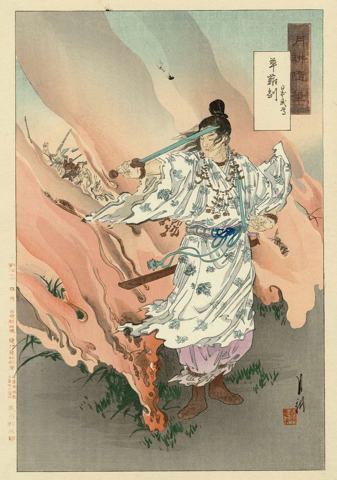
The sword drawn from a serpent's tail and renamed by a burning field — one of Japan's three imperial regalia, kept at Atsuta Jingu and never shown to anyone.
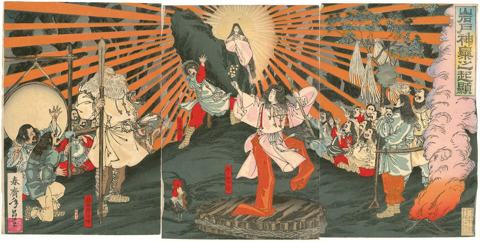
The sun goddess who shines in heaven — ruler of the Plain of High Heaven, ancestor of Japan's imperial line, and the kami enshrined at Ise.
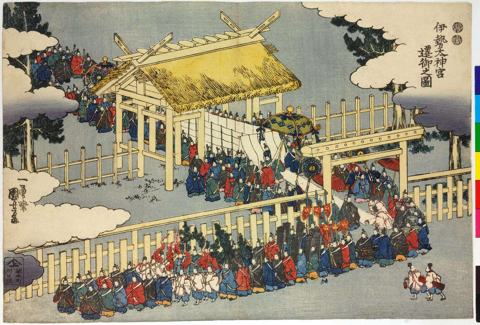
The mirror forged to trick a sun goddess out of hiding, handed down to her earthly heirs, and now kept at Ise, wrapped, unphotographed, and never once unveiled.
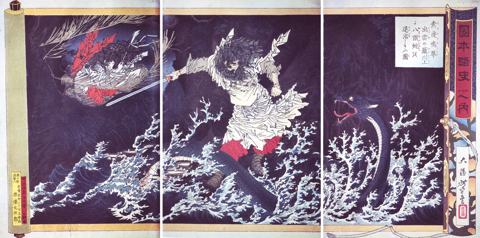
The raging kami of sea and storm — expelled from heaven for wrecking his sister's fields, then redeemed in Izumo by slaying an eight-headed serpent.
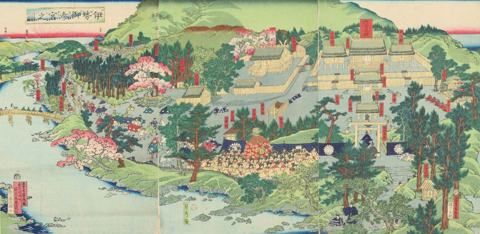
Shinto's holiest site, home to the sun goddess's mirror — rebuilt on an adjacent plot every twenty years so nothing there is ever allowed to age.
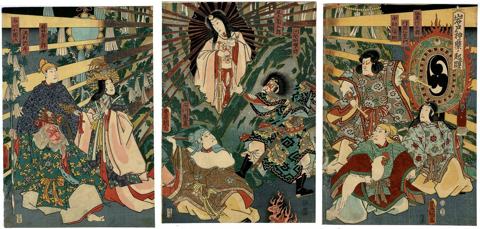
The Plain of High Heaven — where the first kami came into being, where the gods hold council, and from which Amaterasu's line descended to rule the islands.
Also mentioned inAme-no-Uzume
Sources & Further Reading
- 1.Kojiki (Records of Ancient Matters, 712), trans. Donald L. Philippi. University of Tokyo Press, 1968.
- 2.Nihon Shoki (Chronicles of Japan, 720), in W.G. Aston, trans., Nihongi. Kegan Paul, 1896.
- 3.Engishiki (Procedures of the Engi Era, 927).
- 4.Hardacre, Helen. Shinto: A History. Oxford University Press, 2017.
- 5.Breen, John & Mark Teeuwen. A New History of Shinto. Wiley-Blackwell, 2010.
- 6.Mizoguchi, Koji. The Archaeology of Japan: From the Earliest Rice Farming Villages to the Rise of the State. Cambridge University Press, 2013.
Spot an error or have a source to suggest? Write to info@viseterna.com. We cite primary sources and modern scholarship, and we correct fast.