
The Kojiki
Japan's oldest surviving chronicle, presented to the throne in 712 from one court reciter's memory — the deepest source for the Codex's kami and early emperors.
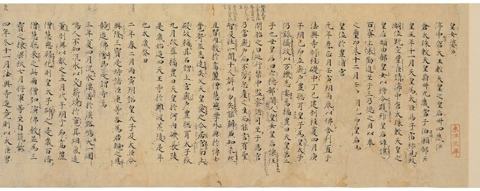
Shinpukuji-bon Kojiki manuscript, copied 1371-1372 (Osaka, Shinpukuji temple) · Public domain · source
A Book Made From Memory
The Kojiki, "Records of Ancient Matters," is the oldest work of history and myth to survive from Japan, presented to the throne in the first month of 712 1,2. Its own preface gives an unusual account of how it came to be written. Emperor Tenmu, troubled that the noble houses were circulating corrupted versions of the imperial genealogies and the old accounts of the gods, had a court attendant named Hieda no Are commit the authorized texts to memory, so error could not creep further into what should have been fixed 1,2. Tenmu died before anything was set down in writing, and a generation later Empress Genmei ordered the courtier O no Yasumaro to transcribe what Are still held in memory. Yasumaro says he finished the work in a few months 1,2.
Are's identity is one of the book's open questions. The preface does not say plainly whether Are was a man or a woman, and later tradition made Are a woman of extraordinary memory, though nothing in the eighth-century record settles the point; some modern scholars read "Are" less as a named individual than as a title for a class of court reciter 5,6. What the preface is clear about is the anxiety behind the whole project: a ruling house that wanted one authorized version of its own past, at a moment when writing had only recently become the tool for keeping it 4,5.
Three Books, One Line of Descent
The text runs to three scrolls. The first, covering the "Age of the Gods," begins before heaven and earth are separate and carries the story down through Izanagi and Izanami, the birth of Amaterasu, Susanoo's expulsion and his killing of Yamata-no-Orochi, and the descent of Amaterasu's grandson Ninigi to rule the earthly land 1,2. The second and third books leave the age of gods behind and follow the human emperors, from the legendary Jimmu through the sovereigns of the sixth century, ending with Empress Suiko 1,2. The whole structure argues a single point without ever stating it as an argument: that the ruling line descends without a break from Amaterasu herself, which is exactly the kind of claim a court under Tenmu and Genmei had reason to want fixed in writing 4,5.
Much of what the Myth Codex tells about the gods of early Japan is drawn, directly or through later retelling, from these pages — the Yata no Kagami forged to lure Amaterasu from her cave, the birth of the storm god Susanoo, the sword later called Kusanagi found in a serpent's tail. The Kojiki is not the only source for these stories, but it is the earliest complete one, and it set much of the sequence and vocabulary that later retellings still use 1,5.
One Script Bent Two Ways
Reading the Kojiki in the original is harder than its age alone would suggest, because Yasumaro was working without a fully settled way to write Japanese. Chinese characters were the only script available, and he used them in a mixture: narrative passages lean toward literary Chinese word order and vocabulary, while poems, songs, and many proper names are rendered phonetically, one character per syllable of spoken Japanese, in the system later called man'yogana 1,5. The result is a text that keeps switching registers within a single line, and it is one reason the Kojiki resisted easy translation for so long after being rediscovered — English versions did not arrive until Chamberlain's pioneering 1882 translation, followed much later by Philippi's 2,1.
The Nihon Shoki, finished only eight years afterward, took the opposite approach: written in more orthodox classical Chinese for an audience that included foreign courts, it is easier to read as prose but further from spoken Japanese, and the two chronicles tell overlapping myths in different words and sometimes different order 3,5. Comparing them is a basic tool of the field, and the Nihon Shoki entry in this Codex covers that companion text and its own textual history in full.
Obscurity, Then Motoori Norinaga
For most of the medieval period the Kojiki was read far less than the Nihon Shoki, which had the prestige of being written in proper Chinese and had served since the Nara period as the state's official history 5,6. The oldest surviving manuscript, the Shinpukuji-bon, was not copied until 1371-1372, six and a half centuries after Yasumaro's original, which is itself a sign of how thin the chain of transmission had become 1.
The Kojiki's modern centrality owes a great deal to one scholar. Over more than three decades in the late eighteenth century, the kokugaku ("national learning") philologist Motoori Norinaga produced the Kojiki-den, a forty-four-volume line-by-line commentary that treated the Kojiki's archaic language as a direct window onto an authentic Japanese antiquity, uncorrupted, in his view, by the Chinese habits of thought he found throughout the more polished Nihon Shoki 4,6. Norinaga's reading was itself an argument, part of a broader eighteenth-century project to define a Japanese identity distinct from Chinese civilization, and Burns's study of the kokugaku movement traces how that argument fed into nineteenth-century nationalism and the modern State Shinto that briefly made the Kojiki's opening chapters part of a state creed 4,6.
Reading the Kojiki Today
Scholars today generally accept Yasumaro's account of the book's compilation as broadly genuine, while treating its contents with more care than Norinaga did. The mythic first scroll is read as a court-shaped synthesis of older oral material rather than transparent reportage, and the later, more historical books grow steadily more reliable the closer they approach Yasumaro's own century, with the early legendary reigns widely regarded as chronological padding rather than history 3,5,6. Hardacre situates the Kojiki within the broader project of eighth-century state-building, alongside law codes and the new capital at Nara, rather than as a document that fell from an unchanging tradition 5.
None of that has diminished its pull. Every full-length retelling of the birth of the kami, the Yata no Kagami's forging, or the descent of the imperial line ultimately answers to these two early eighth-century texts, and the Kojiki, precisely because its language is the harder and stranger of the pair, remains the one scholars return to first 1,2,5.
Continue Exploring
Japan's first official state history, finished in 720 in formal Chinese for a court that wanted its myths and its chronology to impress foreign readers.
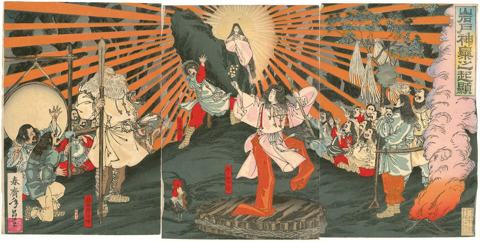
The sun goddess who shines in heaven — ruler of the Plain of High Heaven, ancestor of Japan's imperial line, and the kami enshrined at Ise.
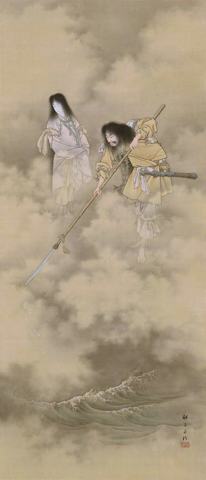
The creator pair of Japanese myth: they stirred the first island out of the sea, bore the land itself, and were parted forever by death.
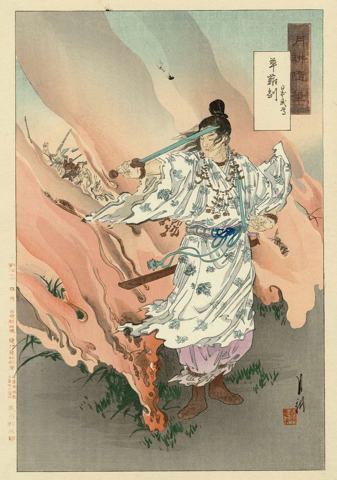
The sword drawn from a serpent's tail and renamed by a burning field — one of Japan's three imperial regalia, kept at Atsuta Jingu and never shown to anyone.
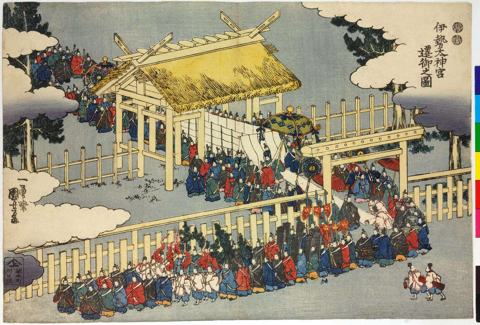
The mirror forged to trick a sun goddess out of hiding, handed down to her earthly heirs, and now kept at Ise, wrapped, unphotographed, and never once unveiled.
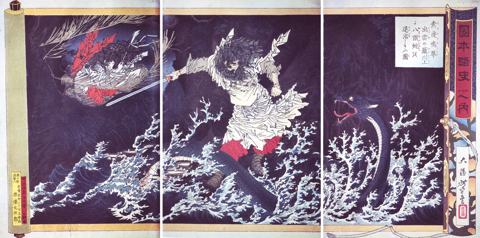
The raging kami of sea and storm — expelled from heaven for wrecking his sister's fields, then redeemed in Izumo by slaying an eight-headed serpent.
Also mentioned inIzumo Taisha
Sources & Further Reading
- 1.Kojiki (Records of Ancient Matters, 712). Trans. Donald L. Philippi. University of Tokyo Press, 1968.
- 2.Chamberlain, Basil Hall, trans. "Ko-ji-ki," or Records of Ancient Matters. Transactions of the Asiatic Society of Japan, vol. X, Supplement, 1882.
- 3.Nihon Shoki (Chronicles of Japan, 720), in W.G. Aston, trans., Nihongi: Chronicles of Japan from the Earliest Times to A.D. 697. Kegan Paul, 1896.
- 4.Burns, Susan L. Before the Nation: Kokugaku and the Imagining of Community in Early Modern Japan. Duke University Press, 2003.
- 5.Hardacre, Helen. Shinto: A History. Oxford University Press, 2017.
- 6.Breen, John & Mark Teeuwen. A New History of Shinto. Wiley-Blackwell, 2010.
Spot an error or have a source to suggest? Write to info@viseterna.com. We cite primary sources and modern scholarship, and we correct fast.