
Izanagi and Izanami
The creator pair of Japanese myth: they stirred the first island out of the sea, bore the land itself, and were parted forever by death.
Izanami and Izanagi Creating the Japanese Islands, Kobayashi Eitaku, 1880s (Museum of Fine Arts, Boston) · Public domain · source
The Last of Seven Generations
Japan's two oldest surviving books, the Kojiki of 712 and the Nihon Shoki of 720, both open with a cosmos that has already begun without anyone deciding to begin it. Heaven and earth separate; a first group of kami come into being in Takamagahara and immediately hide themselves away; then come the "seven generations of the age of the gods", mostly paired abstractions with no stories attached 1,2. Izanagi-no-Mikoto and Izanami-no-Mikoto are the seventh and last of these generations, and they are the first kami in the record who do anything at all. Their names are usually read as "the one who invites" in masculine and feminine form, from the verb izanau, though the derivation is traditional rather than certain 3,6.
The heavenly kami hand them a jewelled spear, Ame-no-nuboko, and charge them to "make firm" the drifting land below. Standing on the floating bridge of heaven, they lower the spear, stir the brine, and lift it out; the drops that fall from the tip pile up into the island Onogoro, "self-curdling" 1,3. It is a creation by accretion rather than by command, and Japanese commentators from Motoori Norinaga onward have made much of the fact that nothing in the account resembles a creation ex nihilo 4,6.
The Pillar, the Leech-Child, and the Birth of the Islands
On Onogoro the pair erect a heavenly pillar and a great hall, then circle the pillar from opposite directions to meet and marry. Izanami speaks the greeting first. The child of that union is Hiruko, the "leech-child", born without bones; they set him adrift in a boat of reeds, and a second failed child, Awashima, is likewise not counted among their offspring 1,2. Returning to heaven for a divination, they are told the birth failed because the woman spoke first. They repeat the circuit, Izanagi speaks first, and the marriage takes 1,3.
What follows is the kuni-umi, the birth of the land: Awaji first, then Shikoku, Kyushu, Iki, Tsushima, Sado and finally Honshu, the eight great islands that give the archipelago its old name Oyashima 1,2. Then come kami of the sea, the wind, the rivers, the mountains, the trees and the plains, until Izanami bears Kagutsuchi, the kami of fire, and is burned fatally in the birth. Even dying she goes on generating: kami spring from her vomit, her urine and her excrement, among them the deities of metal and clay 1. Izanagi beheads the fire child with his ten-span sword, and more kami rise from the blood on the blade and from the dismembered body 1,2. Scholars reading these lists as ritual and technological charters — metal, clay, water and fire arriving together — argue that the genealogies encode the crafts of the early Yamato state and of the immigrant lineages that served it 5.
The Descent into Yomi
Unwilling to lose her, Izanagi follows Izanami down into Yomi, the land of the dead. She answers from behind the closed door of its hall: she has already eaten the food cooked at the hearth of that country, and so belongs to it, but she will go and petition its deities — and he must not look at her 1,3. He waits, then breaks a tooth from the comb in his hair for a torch and looks anyway. Her body is rotten and maggot-ridden, and eight thunder kami sit on it 1.
The flight back is one of the most vivid sequences in either chronicle. Izanagi throws down his black headdress, which becomes grapes, and his comb, which becomes bamboo shoots, to delay the yomotsu-shikome, the hags of Yomi; at the Even Pass of Yomi he pelts his pursuers with three peaches, and blesses the fruit for it 1,3. Finally he seals the pass with a boulder it would take a thousand men to shift. Across it husband and wife speak their divorce, and she vows to strangle a thousand people a day in his country; he answers that he will cause fifteen hundred to be born 1,2. Death enters the world here not as punishment but as an accounting — and the world stays ahead by five hundred.
The Nihon Shoki preserves the same episode in several competing "one writing says" variants, and its main narrative differs from the Kojiki's at several points. The compilers were evidently working from rival court and provincial traditions and chose to record the disagreement rather than smooth it away 2,4.
Purification and the Three Noble Children
Polluted by contact with the dead, Izanagi goes to Awakihara, at the mouth of a river in Himuka in Kyushu, and washes. The rite generates kami at every stage: from the discarded clothing, from the ford, from the water itself. Then, washing his left eye, he produces Amaterasu; from his right eye, Tsukuyomi; from his nose, Susanoo — the "three noble children", sun, moon and storm 1,2. He divides the world between them and, in the Kojiki's telling, retires to a shrine at Taga in Omi; the Nihon Shoki instead has him withdraw to a hidden palace on Awaji 1,2.
Historians of religion treat this scene as the mythic charter for harae, the purification that remains the central act of Shinto ritual practice. Defilement here is a condition contracted by contact, not a moral failing, and water removes it 4,7. That the sun goddess and ancestress of the imperial house should be born from an act of ritual cleansing is not incidental: the Kojiki was compiled at the command of a court with a direct interest in that genealogy 4,5.
Cult and Afterlife
Both deities are widely enshrined today, most prominently at Izanagi Jingu on Awaji and at Taga Taisha in Shiga, and as a married pair they are routinely petitioned for matchmaking and safe childbirth 4,7. Hiruko, the rejected first child, was later reidentified in popular religion with Ebisu, the smiling god of fishermen and merchants — a reabsorption of the discarded that scholars read as a medieval development rather than an ancient one 4,6.
Comparativists have long noted the structural resemblance between Izanagi's failed retrieval and the Orpheus and Persephone stories of Greece, and between the food-of-the-dead motif here and the same taboo in Mesopotamian and Polynesian myth. Whether these reflect diffusion, common inheritance, or independent invention remains genuinely disputed, and Nelly Naumann's insistence on reading the Japanese material on its own terms is a useful corrective to over-eager parallel-hunting 6.
Continue Exploring
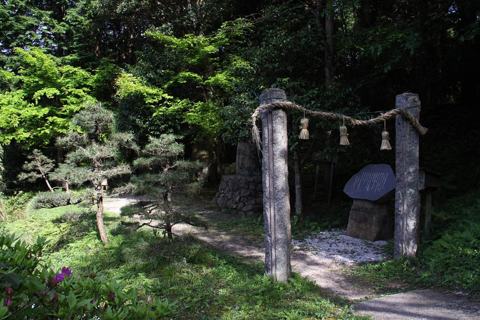
The land of the dead in Japan's oldest myths: a polluted country reached by a slope in Izumo, sealed with a boulder, with no judgment and no return.
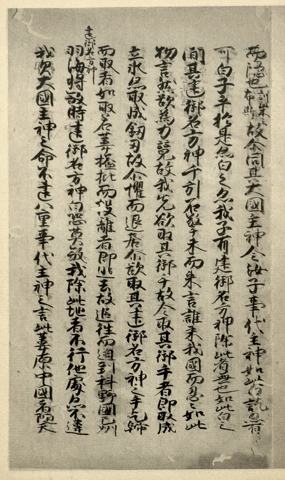
Japan's oldest surviving chronicle, presented to the throne in 712 from one court reciter's memory — the deepest source for the Codex's kami and early emperors.
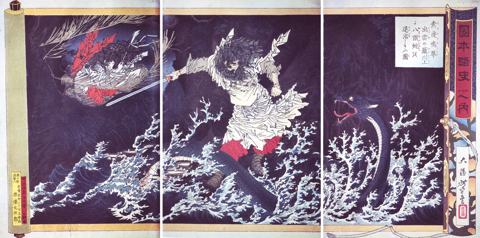
The raging kami of sea and storm — expelled from heaven for wrecking his sister's fields, then redeemed in Izumo by slaying an eight-headed serpent.
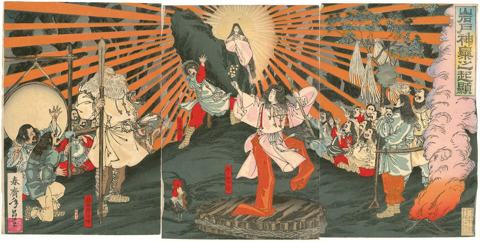
The sun goddess who shines in heaven — ruler of the Plain of High Heaven, ancestor of Japan's imperial line, and the kami enshrined at Ise.
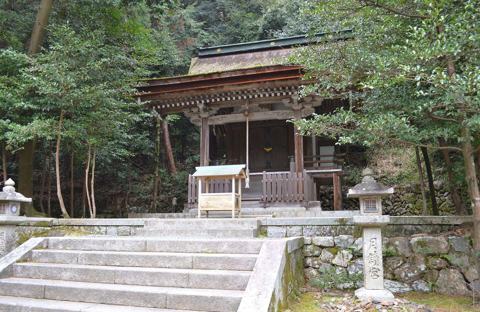
The moon kami born from Izanagi's right eye — ruler of the night, whose single recorded act of violence set the sun and moon forever apart.
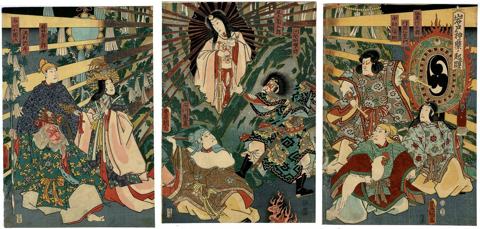
The Plain of High Heaven — where the first kami came into being, where the gods hold council, and from which Amaterasu's line descended to rule the islands.
Also mentioned inRyujin (Japanese Dragon King of the Sea)The Seven Lucky Gods (Shichifukujin)Urashima Taro
Sources & Further Reading
- 1.Kojiki (Records of Ancient Matters, 712) — Book One; trans. Donald L. Philippi, University of Tokyo Press, 1968.
- 2.Nihon Shoki (Chronicles of Japan, 720) — Book One, in W.G. Aston (trans.), Nihongi. Kegan Paul, 1896.
- 3.Basil Hall Chamberlain (trans.), The Kojiki — Records of Ancient Matters. Asiatic Society of Japan, 1882.
- 4.Breen, John, and Mark Teeuwen. A New History of Shinto. Wiley-Blackwell, 2010.
- 5.Como, Michael. Weaving and Binding — Immigrant Gods and Female Immortals in Ancient Japan. University of Hawai'i Press, 2009.
- 6.Naumann, Nelly. Die Mythen des alten Japan. C.H. Beck, 1996.
- 7.Ono, Sokyo. Shinto — The Kami Way. Charles E. Tuttle, 1962.
Spot an error or have a source to suggest? Write to info@viseterna.com. We cite primary sources and modern scholarship, and we correct fast.