
Okuninushi (Great Land Master)
The Izumo kami who healed a skinned hare, survived his own brothers twice, built the land with a tiny god, and ceded it all to Amaterasu's line.
Illustration for The Hare of Inaba, Kakuzo Fujiyama, in Yei Theodora Ozaki, The Japanese Fairy Book, 1908 · Public domain · source
The Brother Who Carried the Bag
Before he is Okuninushi, "Great Land Master," he is Onamuji, youngest of eighty brothers on their way to court a princess, Yagami-hime of Inaba, and given the job of carrying the whole party's luggage 1. Trailing behind, he finds a hare stripped of its fur, crying on the beach. The eighty brothers, passing first, told the hare that seawater and wind would heal it; the salt only cracked its skin further 1. Onamuji tells it the truth instead — wash in fresh water, then roll in the pollen of cattails — and the hare, healed, tells him plainly that he, not any of his brothers, will win the princess 1. The Kojiki gives the hare's speech real weight: this is the moment Onamuji is marked out, by an animal he had no reason to help, as the one who matters 1.
Killed Twice, Revived Twice
His brothers are furious when the prophecy holds. On a mountainside they heat a boulder red and roll it down at him, calling it a wild boar to catch; Onamuji embraces it and burns to death 1. His mother's tearful appeal to heaven brings down two goddesses, Kisagai-hime and Umugai-hime, who scrape shell-powder and mother's milk into a paste and revive him — the Kojiki names the exact ingredients, which is unusual specificity for the text and suggests this detail carried real ritual or medicinal association for its first audience 1. The brothers try again, wedging him into a split tree and letting it snap shut; his mother pulls him free a second time and finally sends him away for his own safety, to Ne-no-kuni, the land of roots, where Susanoo rules in exile 1.
Trials in the Land of Roots
Susanoo's daughter Suseri-bime falls for Onamuji on sight, and her father responds by trying to kill his prospective son-in-law through a run of set tasks: a night in a room of snakes, a night in a room of centipedes and wasps, and a burning field with an arrow Onamuji is told to retrieve. Suseri-bime smuggles him scarves that charm the snakes and insects to sleep; a mouse tells him to stamp the ground, opening a hollow that hides him from the fire and hands back the arrow in its cheek 1. Susanoo, delousing Onamuji's hair afterward, finds it full of centipedes rather than lice and laughs it off — then, while Susanoo sleeps with his hair tied to the rafters, Onamuji takes his sword, bow, and koto and flees with Suseri-bime on his back 1. Susanoo wakes, brings the house down trying to follow, and finally shouts a blessing after them from the pass instead of a curse: with that sword and bow, he says, Onamuji is to defeat his brothers and become Okuninushi, ruler of the visible land 1.
Building the Land with a Tiny God
Ruling it, in the chronicles, means physically building it. A minuscule deity arrives across the sea riding in the hull of a kagami-boat, dressed in moth skin, so small no one can identify him until a toad names him Sukunabikona 1,2. The two travel Japan together making and strengthening the land and its medicine, an unlikely partnership of the vast and the tiny that both chronicles treat as essential rather than comic 1,2. Sukunabikona eventually departs across the sea to the eternal land, Tokoyo, leaving Okuninushi alone until a shining spirit crosses the water asking to be worshipped — his own tranquil spirit, in one reading, later identified with the god enshrined at Mount Miwa — who helps him finish the work 1,2. The Izumo no Kuni Fudoki, a provincial record submitted to the court a few years after the Kojiki, keeps its own, more local version of Okuninushi as a land-naming ancestral god, closer to the earth he is credited with shaping than the heaven-facing figure of the imperial chronicles 3.
The Ceding of the Land
Amaterasu wants the land for her own descendants, and the chronicles spend real space on how hard that is to arrange. Her first two messengers fail outright — one simply stays and marries into Okuninushi's family, the second is shot with his own arrow — before Takemikazuchi is sent down to plant a sword point-up on the waves and demand an answer 1,2. Okuninushi defers to his sons: Kotoshironushi agrees at once and vanishes into the sea; Takeminakata challenges Takemikazuchi to a grip-contest, loses badly, and is chased all the way to Lake Suwa, where he is finally pinned and submits — the origin, tradition holds, of Suwa Taisha's cult 1,2.
Okuninushi himself sets one condition: a palace built as high as the heavenly grandson's own, in exchange for which he will withdraw into the unseen world and leave the visible one to Amaterasu's line 1,2. That palace is Izumo Taisha, and the arrangement it commemorates — visible governance ceded, invisible affairs, including the ties between people, retained — is why Okuninushi is worshipped today above all as the kami of en-musubi, bonds and matchmaking, and why every autumn the kami of Japan are said to gather at Izumo to decide them 4,5,6.
Continue Exploring
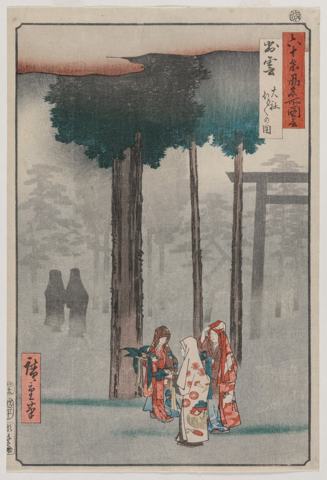
The shrine built, myth says, as the price for the land — where every kami in Japan is believed to gather each autumn, beneath a hall once among Japan's tallest.
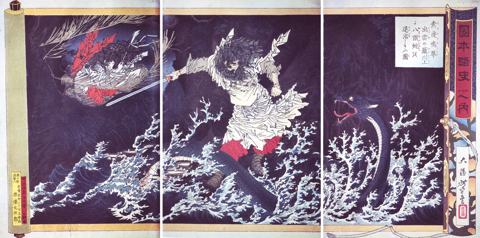
The raging kami of sea and storm — expelled from heaven for wrecking his sister's fields, then redeemed in Izumo by slaying an eight-headed serpent.
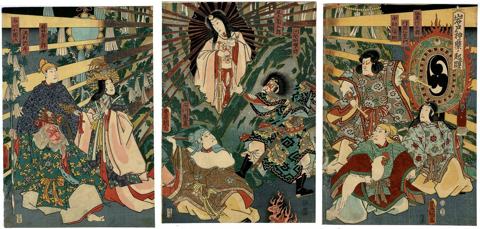
The Plain of High Heaven — where the first kami came into being, where the gods hold council, and from which Amaterasu's line descended to rule the islands.
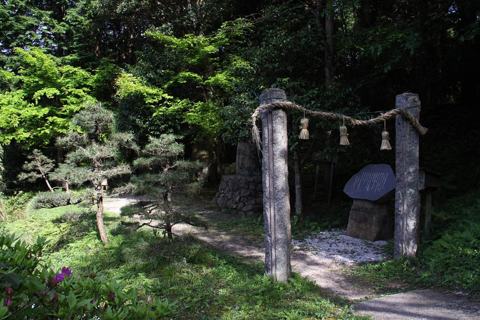
The land of the dead in Japan's oldest myths: a polluted country reached by a slope in Izumo, sealed with a boulder, with no judgment and no return.
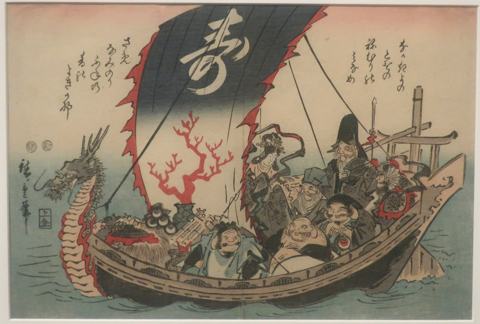
Seven mismatched deities of luck, drawn from native, Buddhist, Hindu and Taoist sources, who ride together on a treasure ship and visit New Year's dreams.
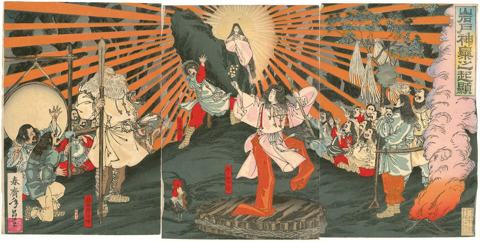
The sun goddess who shines in heaven — ruler of the Plain of High Heaven, ancestor of Japan's imperial line, and the kami enshrined at Ise.
Sources & Further Reading
- 1.Kojiki (Records of Ancient Matters, 712) — Book One; trans. Donald L. Philippi, University of Tokyo Press, 1968.
- 2.Nihon Shoki (Chronicles of Japan, 720) — Book One, in W.G. Aston (trans.), Nihongi. Kegan Paul, 1896.
- 3.Izumo no Kuni Fudoki — Gazetteer of Izumo Province (733 CE).
- 4.Hardacre, Helen. Shinto: A History. Oxford University Press, 2017.
- 5.Breen, John & Mark Teeuwen. A New History of Shinto. Wiley-Blackwell, 2010.
- 6.Ashkenazi, Michael. Handbook of Japanese Mythology. ABC-CLIO, 2003.
Spot an error or have a source to suggest? Write to info@viseterna.com. We cite primary sources and modern scholarship, and we correct fast.