
Yomi (Yomi-no-Kuni)
The land of the dead in Japan's oldest myths: a polluted country reached by a slope in Izumo, sealed with a boulder, with no judgment and no return.
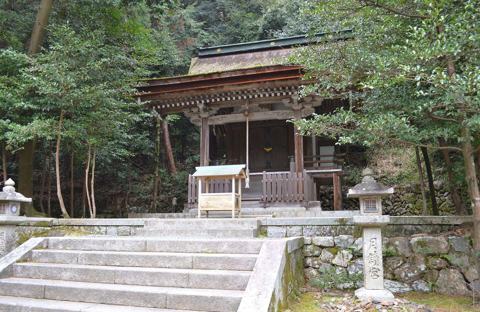
Yomotsu Hirasaka, the traditional site of the slope to Yomi in Izumo, Japan. Photo by ChiefHira, 2010 · CC BY-SA 3.0 · source
A Country, Not a Judgment
Yomi-no-kuni — "the land of Yomi" — is where the dead go in Japan's oldest written mythology, and almost everything modern readers expect of an underworld is missing from it. There is no weighing of deeds, no reward, no torment, no tribunal. It is simply another country, dark and defiling, with a border you can walk to and a household that cooks its own food 1,4. The moral machinery that later attached to the Japanese afterlife arrived with Buddhism, centuries after the Kojiki was compiled in 712 6,7.
The name is written with the Chinese characters 黄泉, huangquan, "the Yellow Springs" — the Chinese underworld beneath the earth. Scholars have long stressed that the graph is a loan and the word is not: yomi is native Japanese, and the writing tells us about the eighth-century compilers' literary toolkit rather than about the concept itself. Proposed derivations (from yo, "night", from yama, "mountain", from a word for a grave-pit) are all contested and none commands assent 4,6.
The Descent of Izanagi
The whole of what we know about Yomi comes from one episode. When Izanami dies bearing the fire kami, her husband Izanagi follows her down to bring her back. She speaks to him from behind the closed door of the hall and gives the reason she cannot simply leave: she has already eaten of the hearth of that land — yomotsuhegui, "the eating of the food of Yomi" — and is therefore of it. She will nevertheless petition the deities of Yomi, on the single condition that he does not look at her 1,5.
He looks. Breaking a tooth from his comb for a torch, he sees her corpse swarming with maggots, with eight thunder kami seated on the head, breast, belly, genitals, hands and feet 1. She sets the hags of Yomi, the yomotsu-shikome, on him, then the eight thunders and fifteen hundred warriors of Yomi. He flings down his headdress, which turns to grapes, and his comb, which turns to bamboo shoots, and the pursuers stop to eat; at the border he throws three peaches, and the peaches drive them back 1,5.
Izanagi then blocks the pass with the Chibiki-no-iwa, a rock so vast that a thousand men would be needed to draw it. Standing on either side of it the pair pronounce the words that end the marriage: she will strangle a thousand of the people of his country each day, and he answers that he will have fifteen hundred born 1,2. The story is, among other things, an aetiology of mortality that keeps the ledger positive.
The Even Pass of Yomi
The border itself is Yomotsu-hirasaka, usually rendered "the Even Pass of Yomi" or "the flat slope of Yomi". The Kojiki locates it geographically rather than cosmologically: it is, the text says, the Ifuya Pass in the land of Izumo 1,5. The Izumo no Kuni Fudoki of 733, an official provincial gazetteer with no mythological axe to grind, independently records a Yomi cave and a Yomi slope on the coast at Uka, and notes that people who dream of approaching it die 3. Local tradition in the Iya district of present-day Matsue still identifies a spot as the entrance, and the sealing boulder is pointed out there 3,7.
That Yomi has a postcode has consequences for how it should be read. It lies at the end of a road, not beneath the world, and Konoshi Takamitsu has argued influentially that the Kojiki's cosmos is horizontal in exactly this way — heaven, the reed-plain middle country and Yomi arranged as adjacent territories rather than stacked levels — and that the Nihon Shoki, working from different sources, presents a different world picture that later commentators wrongly harmonised with it 4. The Nihon Shoki preserves several variant accounts of the same episode side by side, some of which say very little about the land itself 2.
Pollution, Not Sin
What Izanagi brings back from Yomi is kegare, defilement. His response is not repentance but washing: he goes down to the river mouth at Awakihara in Himuka and bathes, and the rite generates a long series of kami, culminating in Amaterasu, Tsukuyomi and Susanoo 1,2. This is the mythic charter for harae, the purification rite that remains the operative centre of Shinto practice; death is contagious rather than culpable, and water removes it 6,7.
The same logic explains Yomi's later social afterlife. Contact with corpses, blood and mourning is handled in Japanese ritual life as a temporary condition of impurity to be lifted, which is why funerary work in Japan drifted almost entirely to Buddhist institutions while shrines kept their distance from death 7. Izanami, meanwhile, does not disappear: she is titled Yomotsu-Okami, the Great Kami of Yomi, and the boulder that seals the pass is itself deified 1,5.
Yomi, Ne-no-Kuni and Tokoyo
Early Japanese texts also speak of Ne-no-katasu-kuni, the "firm root country" to which Susanoo is banished and where the hero Okuninushi later undergoes his trials, and of Tokoyo-no-kuni, an "eternal land" across the sea from which good things and occasional immortals arrive 1,2. Whether these are three names for one place, three genuinely distinct realms, or the residue of separate regional traditions stitched together by the Yamato compilers is one of the standing debates in the field; Nelly Naumann and Konoshi, among others, resist the older habit of collapsing them into a single systematic afterlife 4,6.
Buddhist cosmology arrived with a fully staffed hell — Enma's court, the ox-headed and horse-faced wardens, the sixteen jigoku — and by the medieval period that imagery had largely taken over the popular imagination of what waits after death, with oni as its jailers 6,7. Yomi survived anyway, in three places: in the shrine liturgies of purification, in the topography of Izumo, and in ordinary Japanese vocabulary. The everyday word for coming back to life, yomigaeri, is literally "the return from Yomi" 4,6.
Continue Exploring
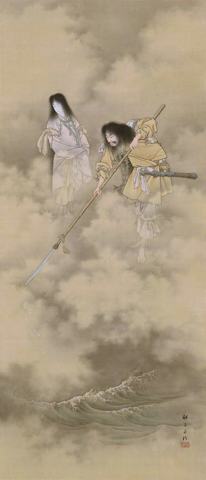
The creator pair of Japanese myth: they stirred the first island out of the sea, bore the land itself, and were parted forever by death.
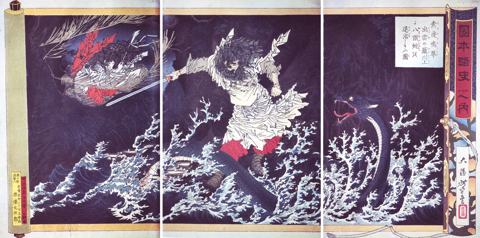
The raging kami of sea and storm — expelled from heaven for wrecking his sister's fields, then redeemed in Izumo by slaying an eight-headed serpent.
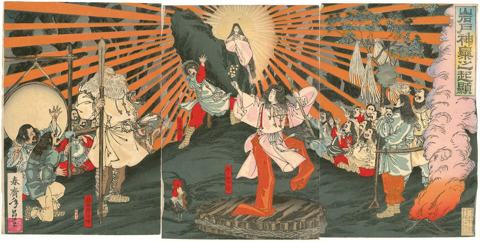
The sun goddess who shines in heaven — ruler of the Plain of High Heaven, ancestor of Japan's imperial line, and the kami enshrined at Ise.
The moon kami born from Izanagi's right eye — ruler of the night, whose single recorded act of violence set the sun and moon forever apart.
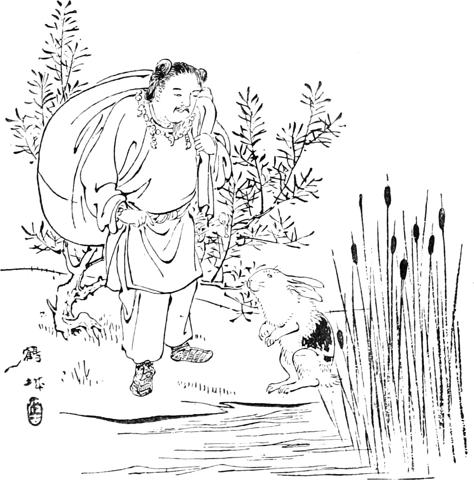
The Izumo kami who healed a skinned hare, survived his own brothers twice, built the land with a tiny god, and ceded it all to Amaterasu's line.
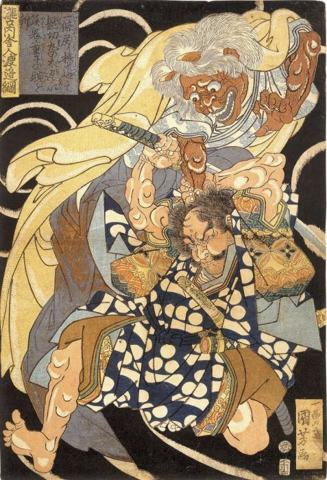
Horned, fanged ogres of Japanese folklore: hell's wardens, mountain bandits and village guardians, driven out with beans every February.
Also mentioned inObon (Festival of the Dead)
Sources & Further Reading
- 1.Kojiki (Records of Ancient Matters, 712) — Book One; trans. Donald L. Philippi, University of Tokyo Press, 1968.
- 2.Nihon Shoki (Chronicles of Japan, 720) — Book One, in W.G. Aston (trans.), Nihongi. Kegan Paul, 1896.
- 3.Izumo no Kuni Fudoki (Gazetteer of Izumo Province, 733) — the cave and slope of Yomi at Uka.
- 4.Konoshi Takamitsu. "The Land of Yomi — On the Mythical World of the Kojiki." Japanese Journal of Religious Studies 11, no. 1 (1984), 57-76.
- 5.Basil Hall Chamberlain (trans.), The Kojiki — Records of Ancient Matters. Asiatic Society of Japan, 1882.
- 6.Naumann, Nelly. Die Mythen des alten Japan. C.H. Beck, 1996.
- 7.Breen, John, and Mark Teeuwen. A New History of Shinto. Wiley-Blackwell, 2010.
Spot an error or have a source to suggest? Write to info@viseterna.com. We cite primary sources and modern scholarship, and we correct fast.