
Ame-no-Uzume
The kami whose bawdy trance dance drew the sun goddess out of hiding, and whose fearless meeting with a road-god gave Japan its oldest ritual dance.
Ame-no-Uzume, Totoya Hokkei, 1825 · Public domain · source
The Goddess Who Made the Kami Laugh
Ame-no-Uzume-no-Mikoto owes her place in Japan's chronicles to a single scene, but it is one of the strangest and most consequential in either text. When Amaterasu shuts herself inside the heavenly rock cave and the world goes dark, it is not force or argument that gets her out — it is a joke good enough to make eight hundred myriad gods laugh at once, and Uzume is the one who tells it 1,2. Later tradition remembers her as a goddess of dawn, mirth, and the performing arts, but the chronicles themselves define her almost entirely by what she does in this one episode and the one that follows it 1,2.
The Dance at the Rock Cave
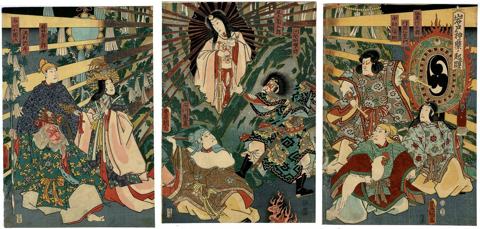
With the sun gone and Takamagahara in crisis after Susanoo's rampage drove his sister into hiding, the assembled kami set the Yata-no-Kagami mirror and the Yasakani no Magatama jewels on a sacred tree outside the cave as bait, and then Uzume takes the stage. She binds a vine of heavenly spindle-tree leaves around her head, wraps bamboo grass around a spear as a wand, overturns a bucket, and stamps on it until it booms like a drum — working herself, in the text's own terms, into kamugakari, a state of divine possession 1. In that state she pulls her robe open, exposing her breasts and genitals, and the assembled gods erupt in laughter loud enough to shake the plain of heaven 1,2. Amaterasu, unable to understand how anyone could be merry in total darkness, opens the cave door a crack to ask — and is caught by her own reflection in the waiting mirror, long enough for the strong-armed Ame-no-Tajikarao to pull her the rest of the way out 1,2.
What the Text Actually Describes
It is worth being plain about what the Kojiki records here, because later retellings often soften it: this is not a modest dance but a deliberately obscene one, and the humor is the mechanism, not an accident of translation 1. Philippi's rendering keeps the scene's bluntness rather than euphemizing it, and scholars of early Shinto generally read the episode as a serious statement about the ritual power of laughter and sexual display to counter cosmic crisis, not as folk comedy tacked onto a solemn myth 1,3. Amaterasu's own withdrawal is itself framed as a response to violation and grief; Uzume's answer is the opposite register entirely, and the text lets both sit side by side without resolving the tonal whiplash 1,2.
Meeting Sarutahiko
Uzume's second major scene comes generations later, when Amaterasu sends her grandson Ninigi down to rule the earthly islands. A strange kami blocks the crossroads of heaven, described as having a nose seven hand-spans long, a back seven feet long, and eyes that shine like mirrors — frightening enough that the assembled heavenly host cannot agree on who should approach him 1,2. Uzume volunteers, precisely because she has already proven, at the rock cave, that she does not flinch from exposure; she confronts the figure bare-breasted and demands to know his business. He identifies himself as Sarutahiko-no-kami, a local deity of the earthly realm who has come to guide the heavenly grandson's descent, and the two continue on together 1,2. Later tradition holds that Uzume escorted Sarutahiko home to Ise afterward and that the two married, taking on the god's territory as her own new home as well 1,4.
Ancestress of the Sarume
That marriage gave her name a second life. Her descendants, or the ritual lineage that claimed descent from her, took the clan name Sarume, built from Sarutahiko's name plus me, "woman," and the Sarume-no-kimi supplied female ritual performers to the imperial court across the classical period, serving in dance, in the court's spirit-pacification rites, and in other ceremonial functions tied to Uzume's own mythic role 3,4. Hardacre situates this clan among the hereditary ritual specialists of ancient and classical Shinto, a system in which a mythic ancestress's actions were understood to license her human descendants' ongoing ritual duties rather than remaining a story about the distant past 3.
The Mythic Charter of Kagura
Uzume's rock-cave performance is traditionally treated as the founding act of kagura, "god-entertainment," the broad family of ritual dance still performed at shrines and festivals across Japan in forms ranging from elaborate court mikagura to the mountain-ascetic traditions of the Tohoku region that Averbuch documents in close ethnographic detail 5. Performers and shrine traditions invoking kagura's origin routinely point back to this single scene: a dance performed in trance, aimed not at entertainment for its own sake but at drawing something essential back into the world 3,5. Whether or not any specific living kagura form descends in an unbroken line from an eighth-century text, the chronicles themselves treat Uzume's dance as the first time dancing did anything — and Japanese ritual performance has claimed her as its patron ever since 3,5.
Continue Exploring
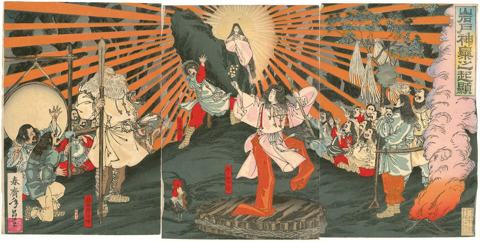
The sun goddess who shines in heaven — ruler of the Plain of High Heaven, ancestor of Japan's imperial line, and the kami enshrined at Ise.
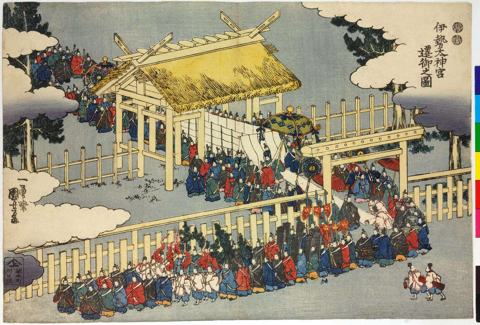
The mirror forged to trick a sun goddess out of hiding, handed down to her earthly heirs, and now kept at Ise, wrapped, unphotographed, and never once unveiled.
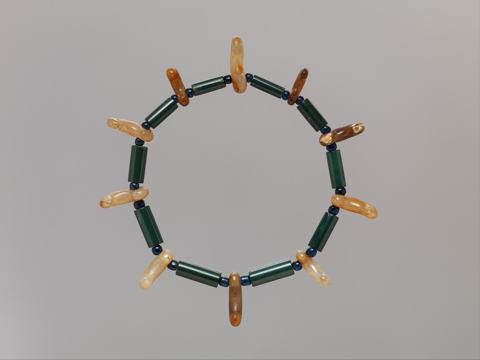
One of Japan's three imperial regalia: a string of curved jewels born at the heavenly rock cave, handed down from Amaterasu, and kept with the emperor unseen.
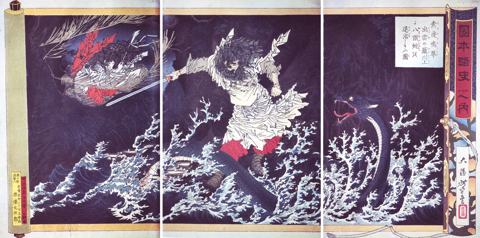
The raging kami of sea and storm — expelled from heaven for wrecking his sister's fields, then redeemed in Izumo by slaying an eight-headed serpent.
The Plain of High Heaven — where the first kami came into being, where the gods hold council, and from which Amaterasu's line descended to rule the islands.
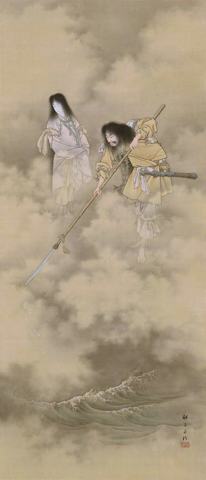
The creator pair of Japanese myth: they stirred the first island out of the sea, bore the land itself, and were parted forever by death.
Sources & Further Reading
- 1.Kojiki (Records of Ancient Matters, 712), trans. Donald L. Philippi. University of Tokyo Press, 1968.
- 2.Nihon Shoki (Chronicles of Japan, 720), in W.G. Aston, trans., Nihongi. Kegan Paul, 1896.
- 3.Hardacre, Helen. Shinto: A History. Oxford University Press, 2017.
- 4.Breen, John & Mark Teeuwen. A New History of Shinto. Wiley-Blackwell, 2010.
- 5.Averbuch, Irit. The Gods Come Dancing: A Study of the Japanese Ritual Dance of Yamabushi Kagura. Cornell University East Asia Program, 1995.
Spot an error or have a source to suggest? Write to info@viseterna.com. We cite primary sources and modern scholarship, and we correct fast.