
Tsukuyomi
The moon kami born from Izanagi's right eye — ruler of the night, whose single recorded act of violence set the sun and moon forever apart.
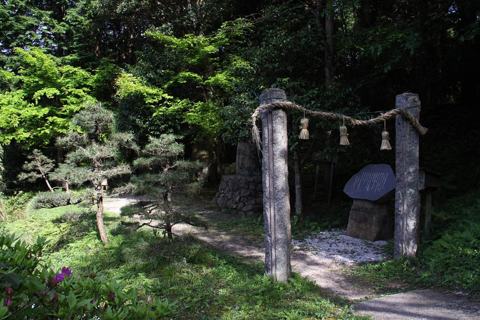
Honden of Tsukiyomi-jinja, Matsuo, Kyoto (photograph by Saigen Jiro, 2014) · CC0 · source
Who Tsukuyomi Is
Tsukuyomi-no-Mikoto (月読命), also read Tsukiyomi, is the moon kami of Japan's earliest chronicles and one of the "three noble children" born in the same moment as the sun and the storm 1,2. The name is usually parsed as tsuki ("moon") plus yomi ("reading" or "reckoning"), suggesting a deity of the counting of months rather than simply of moonlight — a reading Philippi treats as the most defensible of several proposals 5.
Tsukuyomi is the least narrated of the three siblings. Where Amaterasu fills chapters and Susanoo drives the plot, the moon kami appears, acts once, and vanishes from the record 1,2,5. That silence is itself the most interesting thing about the figure, and scholarship has more to say about it than the chronicles do.
Born from the Right Eye
In the Kojiki, Izanagi returns from the land of the dead and purifies himself in a river. Washing his left eye brings forth Amaterasu; washing his right eye brings forth Tsukuyomi; washing his nose brings forth Susanoo 1. Izanagi rejoices at obtaining three noble children, and divides the world: Amaterasu is given Takamagahara, the Plain of High Heaven; Tsukuyomi is given the realm of the night; Susanoo the sea plain 1,5.
The Nihon Shoki, characteristically, records the assignment several ways across its variant accounts. In one, Izanagi sends Tsukuyomi to heaven to rule beside the sun as a companion luminary; in another the moon deity is given the ocean 2,6. The chronicle's willingness to lay incompatible versions side by side is a reminder that no single authorised myth existed — only a court's collection of what was told 2,7.
The Killing of Ukemochi
The one story in which Tsukuyomi acts belongs to the Nihon Shoki, not the Kojiki 2. Amaterasu, hearing of a kami named Ukemochi-no-Kami in the Central Land of Reed Plains, sends her brother down to visit her. Ukemochi turns her face toward the land and boiled rice comes from her mouth; toward the sea, and fish come; toward the mountains, and game comes. She sets it all out on a hundred tables as a feast 2,6.
Tsukuyomi is revolted at being fed from a mouth, calls the offering filthy, and kills her 2. From her corpse the staple foods arise: cattle and horses from her head, millet from her forehead, silkworms from her eyebrows, rice from her belly, wheat and beans from her genitals — a food-origin pattern found widely across the Pacific and Southeast Asia 2,6.
Amaterasu's reaction is the point of the story. She declares her brother a wicked deity and refuses to meet him face to face, and from that day the sun and the moon dwell one day's distance apart, alternating and never together 2,6. The Kojiki tells a version of the same food-origin episode but assigns it to Susanoo and the goddess Ohogetsuhime, with Tsukuyomi nowhere in it — a straightforward demonstration that the two chronicles distributed the same inherited material differently 1,5.
Why the Record Is So Thin
Beyond that episode Tsukuyomi has almost no narrative. No consort, no offspring, no descent to earth, no role in the transfer of the land or the imperial descent 1,2,5. Gender is not stated in any way that settles the question, though the deity is conventionally treated as male, and the Man'yoshu refers to Tsukuyomi-otoko, "the moon man" 3.
The most economical explanation offered by scholars is that the chronicles were court projects built around a solar ancestral deity and an unbroken heavenly lineage, and that material not serving that argument was preserved only in outline 7. The moon's calendar function survived in ritual practice and in poetry without needing a mythology attached; the Man'yoshu also preserves a motif of the moon holding ochimizu, a water of rejuvenation that restores youth, which has no counterpart in the chronicles at all 3.
Shrines and Ritual
Tsukuyomi is enshrined, and prominently. Two auxiliary shrines of Ise Jingu are dedicated to the moon kami: Tsukuyomi-no-miya at the Inner Shrine and Tsukiyomi-no-miya at the Outer Shrine, both included in the tenth-century Engishiki registers of shrines receiving court offerings 4,7. A Tsukiyomi shrine on the island of Iki, off Kyushu, is traditionally claimed as an origin point for the cult, and a related shrine stands under Matsuo Taisha in Kyoto 4,7.
The pattern is worth noting: an officially ranked, court-supported cult attached to a deity with almost no surviving myth. Ritual standing and narrative prominence are separate things, and Tsukuyomi is the clearest Japanese example of the gap 7.
The Moon Japan Tells Stories About
Later Japanese moon lore is largely not Tsukuyomi's. The rabbit pounding in the moon, the autumn tsukimi moon-viewing gatherings with offerings of dumplings and pampas grass, and the tenth-century Tale of the Bamboo Cutter with its moon princess Kaguya-hime all draw on continental Buddhist and Chinese material rather than on the chronicles 7. When modern fiction gives Tsukuyomi a personality and a rivalry with the sun, it is elaborating a few lines of an eighth-century text — which is worth knowing before treating any of it as ancient 7.
Continue Exploring
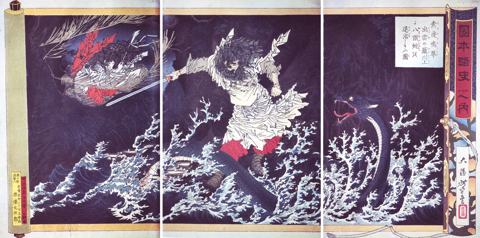
The raging kami of sea and storm — expelled from heaven for wrecking his sister's fields, then redeemed in Izumo by slaying an eight-headed serpent.
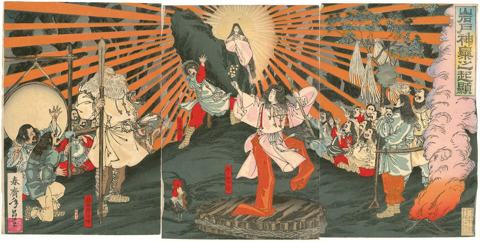
The sun goddess who shines in heaven — ruler of the Plain of High Heaven, ancestor of Japan's imperial line, and the kami enshrined at Ise.
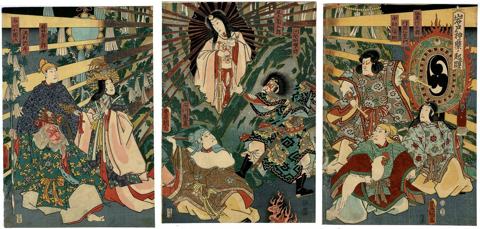
The Plain of High Heaven — where the first kami came into being, where the gods hold council, and from which Amaterasu's line descended to rule the islands.
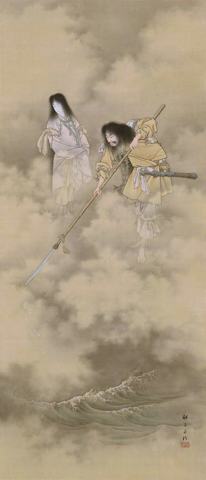
The creator pair of Japanese myth: they stirred the first island out of the sea, bore the land itself, and were parted forever by death.
The land of the dead in Japan's oldest myths: a polluted country reached by a slope in Izumo, sealed with a boulder, with no judgment and no return.
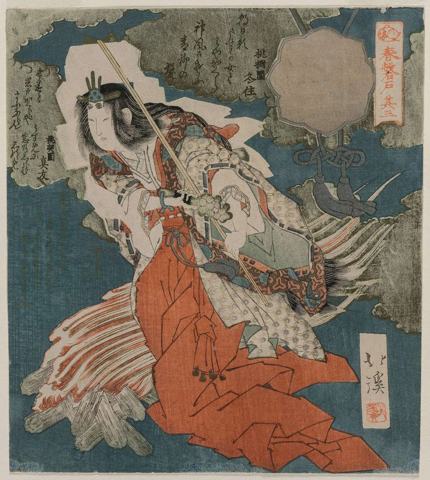
The kami whose bawdy trance dance drew the sun goddess out of hiding, and whose fearless meeting with a road-god gave Japan its oldest ritual dance.
Sources & Further Reading
- 1.Kojiki — Records of Ancient Matters (712 CE).
- 2.Nihon Shoki — Chronicles of Japan (720 CE).
- 3.Man'yoshu — Collection of Ten Thousand Leaves (compiled after 759 CE).
- 4.Engishiki — Procedures of the Engi Era (927 CE), shrine registers.
- 5.Philippi, Donald L., trans. Kojiki. University of Tokyo Press, 1968.
- 6.Aston, W. G., trans. Nihongi: Chronicles of Japan from the Earliest Times to A.D. 697. Kegan Paul, 1896.
- 7.Hardacre, Helen. Shinto: A History. Oxford University Press, 2017.
Spot an error or have a source to suggest? Write to info@viseterna.com. We cite primary sources and modern scholarship, and we correct fast.