
Raijin
The thunder kami who drums the storm into being — oni-faced, ringed with taiko, and paired in Japanese art with the wind god Fujin.
God of Thunder (Raijin), Tawaraya Sotatsu school, 17th century (Cleveland Museum of Art) · CC0 · source
Who Raijin Is
Raijin (雷神), "thunder kami," is less a single character than a name that gathers a whole family of Japanese thunder deities — ikazuchi, kaminari, narukami, Raiden-sama, Kaminari-sama 1,5,7. The common word for thunder, kaminari, is generally understood as kami nari, "the sounding of a kami," which puts the deity inside the everyday vocabulary of weather 7.
Raijin is not a chronicle protagonist in the way Susanoo is. He is instead a figure who accumulates: a cluster of nameless thunder spirits in the eighth-century texts, a demon-bodied drummer in Buddhist painting and sculpture, a folk-tale trickster caught in a bucket, and — through one furious historical ghost — a state-recognised shrine deity 4,5,7.
Thunder in the Oldest Texts
The Kojiki gives thunder a birth, and it is a grim one. When Izanagi disobeys his wife and looks at Izanami's body in Yomi, the land of the dead, he finds it maggot-ridden and, seated on it, eight thunder deities — one in her head, one in her breast, one in her belly, one in her genitals, one in each hand and each foot, each with its own epithet: great, fire, black, rending, young, earth, rumbling, reclining 1. Izanagi flees, and Izanami sets these eight thunders and the hags of Yomi after him 1. Thunder, in the oldest surviving telling, is a product of decay and pursuit rather than of storm.
The Nihon Shoki also treats thunder as a plural, ambient power rather than a portrait deity, and it records court concern with lightning striking palace buildings 2. Neither chronicle gives the drum-ringed figure later Japanese art would make famous 5,7.
The Drums and the Demon Body
The Raijin recognisable today — wild-haired, muscled, red or green-skinned, treading on cloud with a ring of taiko drums arced behind him and mallets in both hands — comes out of Buddhist iconography rather than the chronicles 5,6. He and the wind god Fujin, who carries a bag of winds over his shoulders, appear together among the deity-guardians of Buddhist temples; the pair stand among the twenty-eight attendants of Kannon at Sanjusangen-do in Kyoto 6,7.
Their most famous image is the seventeenth-century pair of folding screens, Fujin Raijin-zu, by Tawaraya Sotatsu, held at Kennin-ji in Kyoto and copied by later Rinpa painters including Ogata Korin 5. The gods occupy the top corners of otherwise empty gold ground, blown in from off-screen. That composition is why the two are inseparable in the modern imagination, and it is an art-historical fact rather than a mythological one 5.
Raijin's body is drawn on the oni pattern — horns, claws, fanged grin, tiger-skin loincloth — and Reider notes how readily the categories of demon and deity overlap in Japanese tradition, where a terrifying form signals overwhelming power rather than moral evil 6.
Thunder Caught, Thunder Bargained With
Japanese folk narrative treats the thunder god as something that can be handled. The Nihon Ryoiki, a Buddhist tale collection compiled around 822, opens with the story of Chisakobe no Sugaru, a retainer commanded by the emperor to go and summon the thunder; Sugaru rides out proclaiming the imperial order, lightning falls at Mount Mimuro, and he brings the thunder back to the palace in a palanquin 4. Another tale in the same collection has a man shelter a fallen thunder deity, which repays him with a child of prodigious strength 4.
Later folk belief keeps the same domestic register. Children are told to cover their navels in a storm because Raijin will take them, and the raiju, a "thunder beast" that falls with lightning and is said to sleep in human navels, appears in Edo-period accounts as the god's companion animal 5. Foster reads the raiju as a characteristic yokai solution: an unexplained physical event — the scorch mark, the split tree — given an animal body and a habit 5.
The Angry Ghost Who Became a Thunder God
The most consequential Japanese thunder deity began as a man. Sugawara no Michizane, a scholar-official exiled through court intrigue, died in disgrace in 903. In the years that followed, plague, deaths among his rivals, and a lightning strike on the Seiryoden hall of the imperial palace in 930 were read as his vengeful spirit at work 7. The court responded by placating him: he was enshrined at Kitano Tenmangu in Kyoto and deified as Tenjin, a deity explicitly associated with thunder 7.
Hardacre treats this as a defining example of the goryo pattern, in which the spirits of the wronged are pacified by elevation to divine status and given a permanent cult 7. Tenjin is today petitioned above all by students before examinations — a thunder-ghost turned patron of scholarship 7.
Shrines, Rice, and Practice
Thunder cults are old and officially recognised. Kamigamo Jinja in Kyoto enshrines Kamowakeikazuchi, "the thunder of Kamo," and appears in the tenth-century Engishiki registers among the shrines receiving court offerings; its Aoi Matsuri remains one of Kyoto's three great festivals 3,7.
Agricultural belief runs underneath all of it. Lightning was understood to quicken the rice, and the ordinary Japanese word for a lightning flash, inazuma, is written with the characters for "rice plant" and "spouse" 7. Raijin's drums frighten, but the storm they announce is also the one that feeds the fields — which is why the god who steals navels is also, in the same villages, a god you want to visit 5,7.
Continue Exploring
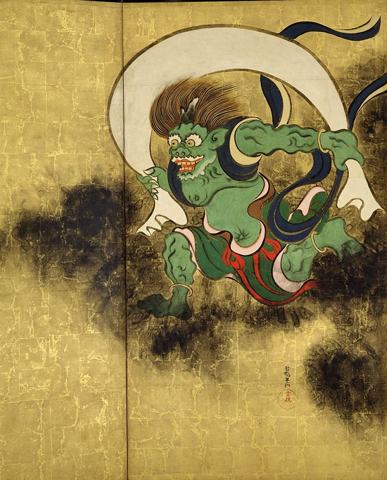
Japan's wind kami — a demon-bodied figure who races across temple screens with a bag of winds over his shoulders, paired with but distinct from Raijin.
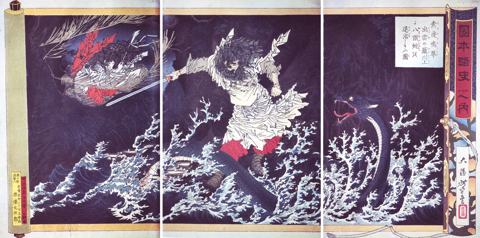
The raging kami of sea and storm — expelled from heaven for wrecking his sister's fields, then redeemed in Izumo by slaying an eight-headed serpent.
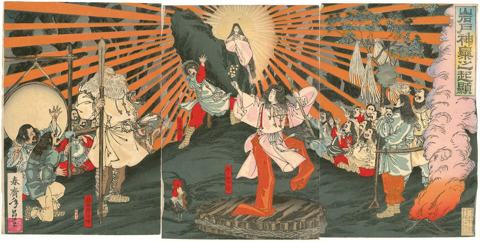
The sun goddess who shines in heaven — ruler of the Plain of High Heaven, ancestor of Japan's imperial line, and the kami enshrined at Ise.
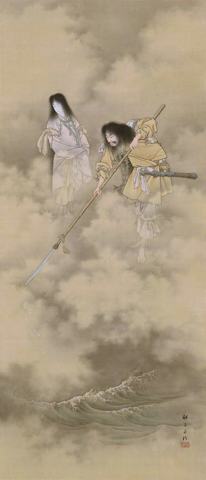
The creator pair of Japanese myth: they stirred the first island out of the sea, bore the land itself, and were parted forever by death.
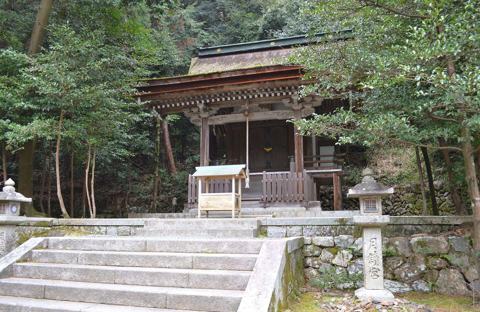
The moon kami born from Izanagi's right eye — ruler of the night, whose single recorded act of violence set the sun and moon forever apart.
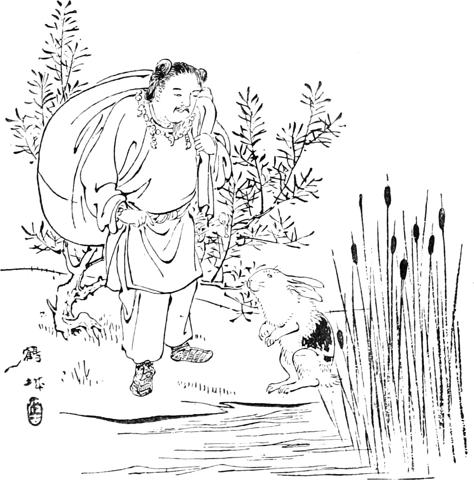
The Izumo kami who healed a skinned hare, survived his own brothers twice, built the land with a tiny god, and ceded it all to Amaterasu's line.
Sources & Further Reading
- 1.Kojiki — Records of Ancient Matters (712 CE).
- 2.Nihon Shoki — Chronicles of Japan (720 CE).
- 3.Engishiki — Procedures of the Engi Era (927 CE), shrine registers.
- 4.Nakamura, Kyoko Motomochi, trans. Miraculous Stories from the Japanese Buddhist Tradition: The Nihon ryoiki of the Monk Kyokai. Harvard University Press, 1973.
- 5.Foster, Michael Dylan. The Book of Yokai: Mysterious Creatures of Japanese Folklore. University of California Press, 2015.
- 6.Reider, Noriko T. Japanese Demon Lore: Oni from Ancient Times to the Present. Utah State University Press, 2010.
- 7.Hardacre, Helen. Shinto: A History. Oxford University Press, 2017.
Spot an error or have a source to suggest? Write to info@viseterna.com. We cite primary sources and modern scholarship, and we correct fast.