
Amaterasu
The sun goddess who shines in heaven — ruler of the Plain of High Heaven, ancestor of Japan's imperial line, and the kami enshrined at Ise.
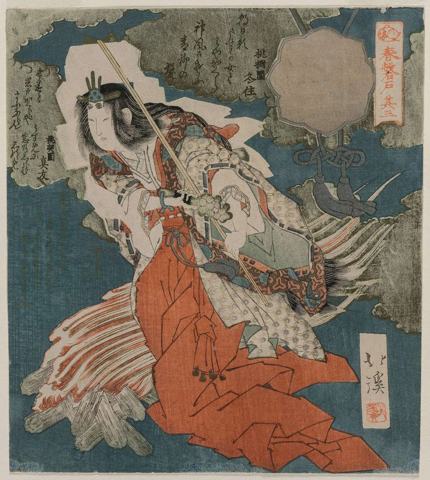
Origin of the Cave Door Dance (Amaterasu), Shunsai Toshimasa, 1889 (colour woodblock triptych) · Public domain · source
Who Amaterasu Is
Amaterasu Ōmikami (天照大御神), "the great august kami who shines in heaven," is the sun deity of Japan's oldest surviving chronicles and the ruler of Takamagahara, the Plain of High Heaven 1,2. She is a kami — a term better translated as "divinity" or "awesome presence" than "god" in the Western sense — and she is unusual among world sun deities in being female and in being claimed as the direct ancestor of a ruling dynasty 4.
She is also, importantly, a figure of living religion. Shinto is practised today by millions of people, and the shrine that houses her is an active site of worship, not a ruin. What follows separates the eighth-century mythic narratives from later belief and from present-day practice, because they are not the same thing 4,5.
Born from a Purification
In the Kojiki, Amaterasu is born when Izanagi, having fled the land of the dead, purifies himself in a river. As he washes his left eye, Amaterasu comes into being; from his right eye comes Tsukuyomi, the moon; from his nose, Susanoo, kami of storms and the sea 1. Izanagi assigns her the rule of the heavens 1.
The Nihon Shoki, compiled eight years later, records this alongside several competing versions — in one, Izanagi and Izanami produce her jointly as their finest child; in another she is born from a bronze mirror held in Izanagi's left hand 2. The chronicle's habit of listing variants side by side is a useful reminder that there was never a single authorised myth, only a court's attempt to gather what was told 2,5.
The Contest with Susanoo
Before his banishment, Susanoo ascends to heaven. Amaterasu, suspecting invasion, binds up her hair in male fashion, straps on a thousand-arrow quiver, and stamps the ground to meet him 1. To prove his intentions he proposes an ukehi — a trial by oath. She takes his sword, chews it, and blows out three goddesses; he takes her string of curved magatama jewels, chews them, and produces five male kami. Each claims the outcome as vindication, and Susanoo declares himself the winner 1,2.
His victory celebration turns destructive. He breaks down the ridges between her rice paddies, fills in the irrigation ditches, fouls the hall where the first-fruits are offered, and finally flays a heavenly piebald colt backwards and hurls it through the roof of the sacred weaving hall — an act that kills one of the weaving maidens outright 1. In a Nihon Shoki variant, Amaterasu herself is injured 2.
The Rock Cave
Amaterasu withdraws into Ama-no-Iwato, the heavenly rock cave, and seals the entrance. The sun goes out. Darkness covers the Plain of High Heaven and the reed plains below, and every kind of calamity breaks loose 1,2.
The eight hundred myriad kami assemble in the dry bed of the Heavenly River, and Omoikane, the deity of thought, devises the plan. Long-crowing birds are set to call. Ishikoridome forges the eight-hand mirror; Tamanoya strings the great curved jewels; both are hung with cloth offerings on a sacred sakaki tree 1. Then Ame-no-Uzume overturns a tub, stamps on it until it booms, falls into a trance, and dances — pulling open her clothing until the assembled kami roar with laughter 1,2.
Amaterasu, unable to understand how anyone can be merry in the dark, opens the door a crack to ask. The kami tell her a deity greater than herself has appeared, and hold up the mirror. Caught by her own reflection, she leans out, and the strong-armed Ame-no-Tajikarao seizes her hand and pulls her clear while Futotama stretches a rope across the entrance behind her 1. The light returns; Susanoo is fined, has his beard and nails cut, and is expelled from heaven 1,2. That rope survives in practice as the shimenawa, the twisted straw boundary marker seen at shrines today 4.
The Heavenly Descent
Amaterasu later sends her grandson Ninigi-no-Mikoto down to rule the islands, giving him three objects that become the imperial regalia: the mirror Yata no Kagami, the jewel Yasakani no Magatama, and the sword Kusanagi, which Susanoo had taken from the tail of the monster Yamata-no-Orochi 1,2. She instructs him to treat the mirror as her own spirit. Ninigi's descendant Jimmu is presented in the chronicles as the first emperor, and this passage is the charter on which the imperial line's claim of divine descent rested 2,4.
Ise, and What Scholars Say
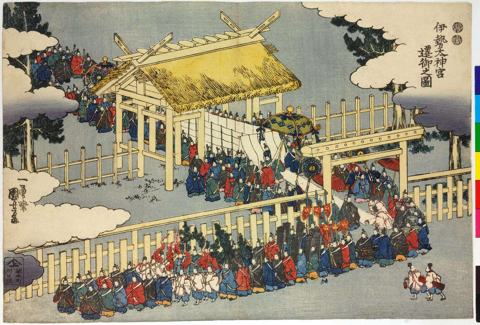
Amaterasu's principal shrine is the Inner Shrine (Naikū) of Ise Jingū, where the mirror is enshrined as her shintai, the object in which her presence dwells 3,4. The Engishiki codifies the court rites owed to her, including the office of the saiō, an unmarried imperial princess who served at Ise 3. The shrine's buildings are still rebuilt to identical plan roughly every twenty years in the shikinen sengū, and Ise remains one of Japan's great pilgrimage destinations 4,5.
Modern scholarship treats her supremacy as historically formed rather than primordial. The Kojiki and Nihon Shoki were court projects of the late seventh and early eighth centuries, compiled under rulers with an interest in a single unbroken heavenly lineage, and the elevation of the Ise sun deity to head of the pantheon belongs to that political moment 4,5. Breen and Teeuwen argue further that "Shinto" as a single coherent tradition is largely a construction of much later centuries, assembled out of local shrine cults, Buddhist theology, and eventually Meiji-era state policy 5. State Shinto and the doctrine of imperial divinity were dismantled after 1945; Amaterasu's worship continues as shrine practice, which is a different thing entirely 4.
Continue Exploring
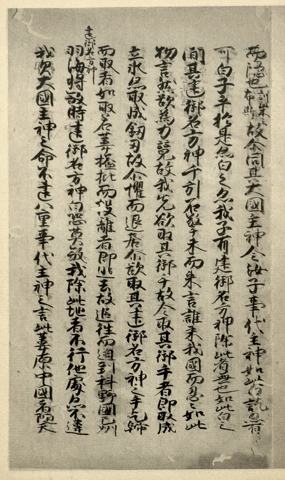
Japan's oldest surviving chronicle, presented to the throne in 712 from one court reciter's memory — the deepest source for the Codex's kami and early emperors.
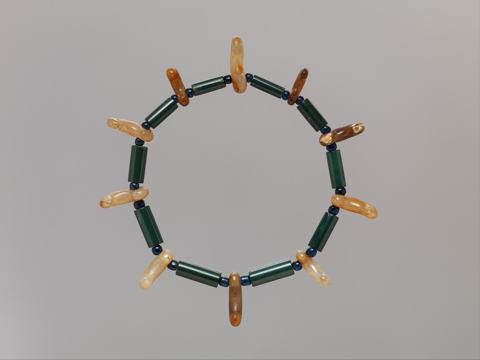
One of Japan's three imperial regalia: a string of curved jewels born at the heavenly rock cave, handed down from Amaterasu, and kept with the emperor unseen.
The kami whose bawdy trance dance drew the sun goddess out of hiding, and whose fearless meeting with a road-god gave Japan its oldest ritual dance.
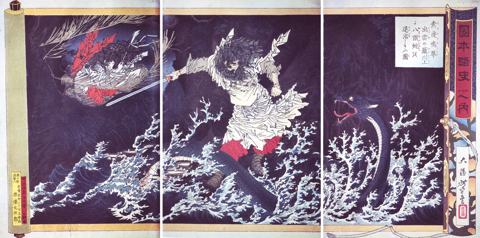
The raging kami of sea and storm — expelled from heaven for wrecking his sister's fields, then redeemed in Izumo by slaying an eight-headed serpent.
The mirror forged to trick a sun goddess out of hiding, handed down to her earthly heirs, and now kept at Ise, wrapped, unphotographed, and never once unveiled.
Japan's first official state history, finished in 720 in formal Chinese for a court that wanted its myths and its chronology to impress foreign readers.
Also mentioned inInari (Inari Okami)Ise Grand ShrineIzanagi and IzanamiIzumo TaishaKusanagi-no-Tsurugi (The Grass-Cutter Sword)TakamagaharaTsukuyomiYamata-no-OrochiYomi (Yomi-no-Kuni)
Sources & Further Reading
- 1.Kojiki — Records of Ancient Matters (712 CE).
- 2.Nihon Shoki — Chronicles of Japan (720 CE).
- 3.Engishiki — Procedures of the Engi Era (927 CE), Books 1–10 on shrine ritual.
- 4.Hardacre, Helen. Shinto: A History. Oxford University Press, 2017.
- 5.Breen, John & Mark Teeuwen. A New History of Shinto. Wiley-Blackwell, 2010.
Spot an error or have a source to suggest? Write to info@viseterna.com. We cite primary sources and modern scholarship, and we correct fast.