
Shuten-doji (Oni King of Mount Oe)
Japan's most famous oni — a demon king who ruled Mount Oe from a stolen palace, until Minamoto no Raiko brought him down with poisoned sake and a sword.
Raiko Oeyama iri no zu (Raiko Enters Mount Oe), Utagawa Kuniyoshi, 1853 · Public domain · source
The Demon of Mount Oe
Shuten-doji, "the drunken boy" or "drunken demon," is the most famous oni in Japanese legend: a demon king who held court on Mount Oe (Oeyama), northwest of the Heian capital, at the head of a band of lesser oni including his lieutenant Ibaraki-doji 2,4. The story that made him famous is a rescue. Women of the capital, including the daughters of nobles, begin disappearing; a diviner traces the abductions to Oeyama, and the emperor orders the warrior Minamoto no Yorimitsu — better known by his other name, Raiko — to destroy the demon at the head of a small, hand-picked company 1,4. Noriko Reider, whose work is the standard English-language study of the tale, reads it as a story about the Heian court imagining the wild, unregulated margins of its own territory as literally monstrous, with Shuten-doji standing for everything outside the capital's authority 4,5.
Who Was Shuten-doji?
The otogizoshi tradition does not agree on where he came from, and the surviving manuscripts preserve genuinely competing origin stories rather than one settled backstory 1,4. One line has him begin as a gifted, resentful acolyte on Mount Hiei who is driven out after Dengyo Daishi's Enryaku-ji construction displaces his own dwelling, and who falls into drink and violence before an oni mask, worn once too often, fuses to his face. Another gives him a wondrous birth, as the son of a mountain god of Mount Ibuki and a noblewoman, under the name Ibuki-doji. A third has him begin as a beautiful, much-loved youth of Echigo province who is transformed into a demon by the smoke of burned love letters he refused to answer 1,4. Reider treats this instability as characteristic of the otogizoshi genre as a whole — short, often anonymous fourteenth- to seventeenth-century tales that circulated in multiple, freely diverging copies rather than as a fixed canonical text 4.
Raiko's Ascent in Disguise
Whatever his origin, the assault on Oeyama follows a fairly stable plot across versions. Raiko and his retainers — the four warriors later known as his Shitenno, or Four Guardian Kings: Watanabe no Tsuna, Sakata no Kintoki, Urabe no Suetake, and Usui Sadamitsu, joined in most versions by the courtier Fujiwara no Yasumasa — disguise themselves as yamabushi, wandering mountain ascetics, to reach the demon's stronghold without raising alarm 1,4. On the mountain road they meet three old men who are in fact the gods Sumiyoshi, Hachiman, and Kumano in disguise, come to help the imperial cause; the gods give the party a sake, jinben kidoku-shu, that acts as medicine to a human but poison to an oni, and set them on the path to the demon's hidden palace 1,4.
The Poisoned Feast
Inside, Shuten-doji receives his guests as fellow travelers and, in an oddly hospitable turn common to the genre, tells them his own life story over drink before the trap is sprung 1,4. Raiko offers the divine sake in return; the demon and his band drink deep, lose the strength and the flight that make them dangerous, and fall into a stupor. Raiko beheads Shuten-doji as he sleeps — and in the story's most repeated image, the severed head leaps into the air and snaps at Raiko's helmet before finally falling still 1,2,4. The company frees the captive women held in the mountain stronghold and returns to the capital in triumph, the same ending oni.md gives for the tale in brief, and which this article treats at length 4.
Picture Scrolls and Puppet Stages
Shuten-doji's story belongs as much to painting as to text. Illustrated emaki versions were copied and recopied from the Muromachi period onward, making Oeyama Shuten Doji one of the most frequently pictured narratives in the whole otogizoshi corpus, and the tale kept a hold on printmakers long after the genre itself had faded 1,4. Toriyama Sekien gave the demon a place in his 1779 Konjaku Gazu Zoku Hyakki, drawn not as a monster in mid-rampage but as a boyish, almost melancholy figure leaning on his sword 2. Nineteenth-century ukiyo-e artists preferred the battle itself: Utagawa Kuniyoshi's 1853 triptych, reproduced above, shows Raiko and his retainers with swords raised as the demon's enormous severed head fills the sky behind them, one of many such prints produced across the Edo period as the story kept its place in kabuki and popular art alike 3,4.
An Enemy Worth Remembering
Reider's broader history of the oni treats Shuten-doji as the figure against which almost every later Japanese demon is implicitly measured — the standard by which a monster on the margins of the map earns a name, a stronghold, and a court-sanctioned death 5. The same sake-based trick that undoes him — get the monster drunk before the sword comes out — is used a world away in the story of Susanoo and the eight-headed serpent Yamata-no-Orochi, a coincidence of plot that later audiences, familiar with both tales, would have been unlikely to miss 1.
Continue Exploring
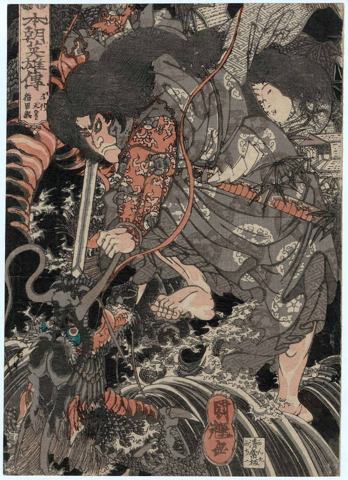
The eight-headed, eight-tailed serpent of Izumo — devourer of maidens, killed drunk by Susanoo, and the source of the imperial sword Kusanagi.
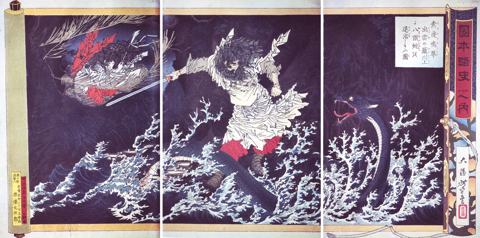
The raging kami of sea and storm — expelled from heaven for wrecking his sister's fields, then redeemed in Izumo by slaying an eight-headed serpent.
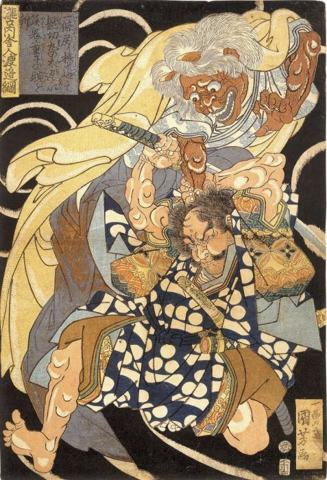
Horned, fanged ogres of Japanese folklore: hell's wardens, mountain bandits and village guardians, driven out with beans every February.
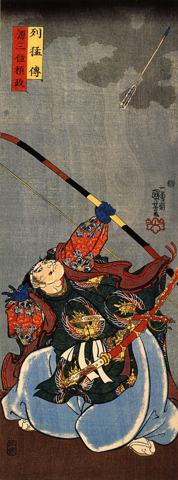
A chimera of monkey, tiger, snake and tanuki that darkened Emperor Konoe's nights in the Tale of the Heike, until archer Minamoto no Yorimasa brought it down.
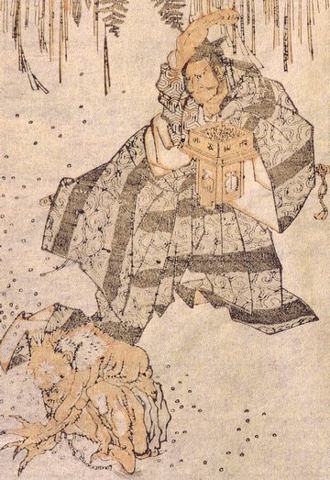
The eve of spring in the old calendar: roasted beans thrown at oni while households shout "demons out, fortune in," descended from a Heian court exorcism.
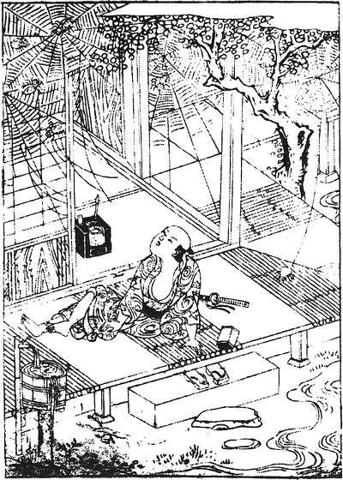
A giant spider of Japanese folklore that takes the shape of a beautiful woman to lure victims into her web, haunting Edo ghost stories and mountain waterfalls.
Sources & Further Reading
- 1.Oeyama Shuten Doji, Muromachi-period otogizoshi, in Ichiko Teiji, ed., Otogizoshi. Nihon Koten Bungaku Taikei, vol. 38. Iwanami Shoten, 1958.
- 2.Toriyama Sekien. Konjaku Gazu Zoku Hyakki (1779), in Sekien Toriyama's Japandemonium Illustrated — The Yokai Encyclopedias of Toriyama Sekien. Translated by Hiroko Yoda and Matt Alt. Dover Publications, 2016.
- 3.Utagawa Kuniyoshi. Raiko Oeyama iri no zu (woodblock triptych, 1853).
- 4.Reider, Noriko T. "Shuten Doji — 'Drunken Demon.'" Asian Folklore Studies 64, no. 2 (2005), 207-231.
- 5.Reider, Noriko T. Japanese Demon Lore — Oni from Ancient Times to the Present. Utah State University Press, 2010.
Spot an error or have a source to suggest? Write to info@viseterna.com. We cite primary sources and modern scholarship, and we correct fast.