
Takamagahara
The Plain of High Heaven — where the first kami came into being, where the gods hold council, and from which Amaterasu's line descended to rule the islands.
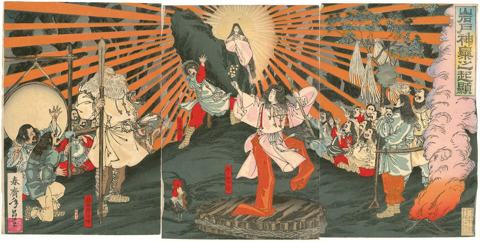
Origin of the Iwato Kagura Dance, Utagawa Kunisada (Toyokuni III), 1856 · Public domain · source
What Takamagahara Is
Takamagahara (高天原), also read Takama-no-hara, is the "Plain of High Heaven" — the dwelling of the heavenly kami in Japan's eighth-century chronicles and the place from which the imperial line is said to descend 1,2. It is the first named location in the Kojiki, appearing in the opening sentence of the text, before earth exists in any settled form 1,4.
It is not a paradise and not an afterlife. Nobody goes there when they die. It is a working heaven: a plain with a river, a mountain, rice fields, a weaving hall, and a cave, occupied by deities who farm, argue, hold councils, and send envoys downward 1,4. The chronicles set it against Ashihara-no-Nakatsukuni, the Central Land of Reed Plains — the human world, meaning Japan — and against Yomi, the polluted land of the dead 1,2.
The First Kami
The Kojiki begins: at the beginning of heaven and earth, three deities come into being in Takamagahara — Ame-no-Minakanushi, the Master of the August Centre of Heaven, followed by Takamimusuhi and Kamimusuhi, the two "growth" or "generative" kami 1,4. All three are described as hitorigami, single deities without partners, and all three conceal their persons immediately after appearing 1. Two more solitary kami follow, completing what later commentators grouped as the "separate heavenly deities" 4.
Then come seven generations of paired deities, ending with Izanagi and Izanami, who stand on the floating bridge of heaven, stir the brine below with a jewelled spear, and make the first island from the drops that fall from its tip 1,2. Everything that follows — the birth of the islands, the death of Izanami in fire, the purification that produces Amaterasu, Tsukuyomi, and Susanoo — proceeds from that heavenly beginning 1.
Ame-no-Minakanushi, notably, does nothing else in the entire narrative. Philippi observes that the abstract, unengaged high deity at the head of the genealogy sits awkwardly with the vividly personal kami who follow, and may represent a later systematising addition to the front of an older tradition 4.
The Geography of Heaven
Takamagahara has furniture, and it matters to the stories. The Ame-no-Yasu-no-Kawara, the dry riverbed of the Tranquil River of Heaven, is where the eight hundred myriad kami assemble in council — the setting for the deliberation over the darkened sun and for the planning of the conquest of the earth 1,2. Ame-no-Kaguyama, the heavenly Mount Kagu, supplies the sakaki trees, the deer shoulder-blades used for divination, and the metal for the mirror 1.
There are heavenly rice paddies with ridges and irrigation channels, a hall where first-fruits are offered, and a sacred weaving hall where heavenly garments are made — precisely the four things Susanoo destroys in his rampage, which is why the offence registers as agricultural and ritual sacrilege rather than random violence 1,4. Ama-no-Iwato, the heavenly rock cave, is where Amaterasu withdraws, taking the light with her 1,2.
Read together, heaven looks like an idealised eighth-century Japanese estate: wet-rice cultivation, weaving, divination, and a court that meets to decide things 4,5.
Ruling the Land from Heaven
The chronicles' central political sequence is the kuniyuzuri, the transfer of the land. Amaterasu and Takamimusuhi determine that the Central Land of Reed Plains should be ruled by her descendants and send envoys down to negotiate with Okuninushi, who has been building and ordering it 1,2. The first envoy goes native; the second, Ame-no-Wakahiko, marries into the earthly side and is killed by his own returned arrow. Only the third mission, led by the sword-kami Takemikazuchi, succeeds 1.
Okuninushi yields, on the condition that a great palace be raised for him — the mythic charter of Izumo Taisha 1,5. Then Ninigi-no-Mikoto, Amaterasu's grandson, descends to the peak of Takachiho carrying the mirror, the jewels, and the sword, and the line that leads to the first emperor begins on earth 1,2.
The chronicles also draw a hard line between amatsukami, heavenly kami, and kunitsukami, earthly kami. Scholars generally read that distinction as a mythic rendering of a political one: the Yamato court's deities set above the deities of the regions it absorbed 5,6.
How Scholars Read It
Where Takamagahara was is a question with a long and revealing history. The eighteenth-century nativist scholar Motoori Norinaga, in his monumental Kojiki-den, insisted it was a real place literally located in the sky and rejected rationalising readings as failures of faith 5. Others, before and after him, proposed euhemeristic identifications with actual districts of Kyushu, Yamato, or the east — attempts to locate heaven on a map 5.
Modern academic treatment sets the question aside. The Kojiki and Nihon Shoki were court projects of the late seventh and early eighth centuries, and the function of Takamagahara within them is to supply the imperial house with an origin above and prior to every rival lineage in the archipelago 5,6. Breen and Teeuwen extend the argument to "Shinto" itself, which they treat as a coherent tradition assembled much later out of local shrine cults, Buddhist theology, and eventually modern state policy 6.
Heaven in Ritual
Takamagahara is not only narrative. It appears in liturgy: the great purification prayer preserved in the Engishiki invokes the heavenly kami, the pushing open of the heavenly rock door, and the carrying away of offences down through the river to the sea — a text still recited in Shinto purification rites today 3,5.
That is the honest state of things. The imperial-divinity doctrine built on these passages was dismantled after 1945, but Takamagahara remains a living ritual reference in shrine practice, spoken over people who are asking to be made clean, not to be ruled 5,6.
Continue Exploring
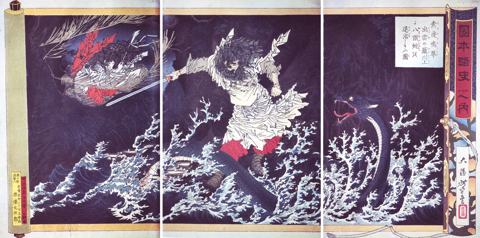
The raging kami of sea and storm — expelled from heaven for wrecking his sister's fields, then redeemed in Izumo by slaying an eight-headed serpent.
The moon kami born from Izanagi's right eye — ruler of the night, whose single recorded act of violence set the sun and moon forever apart.
The sun goddess who shines in heaven — ruler of the Plain of High Heaven, ancestor of Japan's imperial line, and the kami enshrined at Ise.
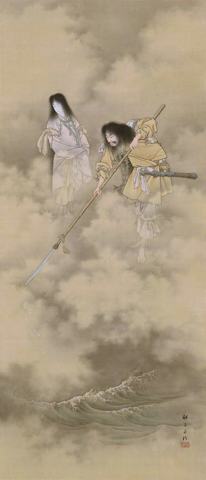
The creator pair of Japanese myth: they stirred the first island out of the sea, bore the land itself, and were parted forever by death.
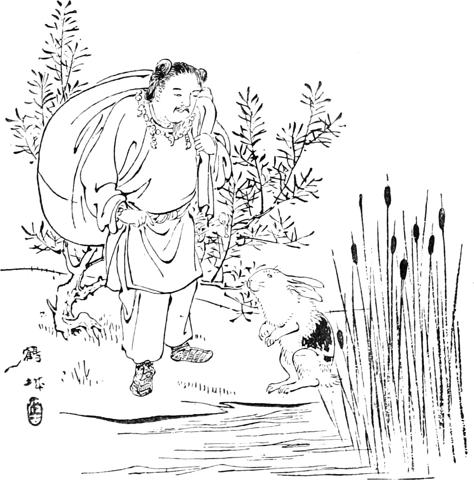
The Izumo kami who healed a skinned hare, survived his own brothers twice, built the land with a tiny god, and ceded it all to Amaterasu's line.
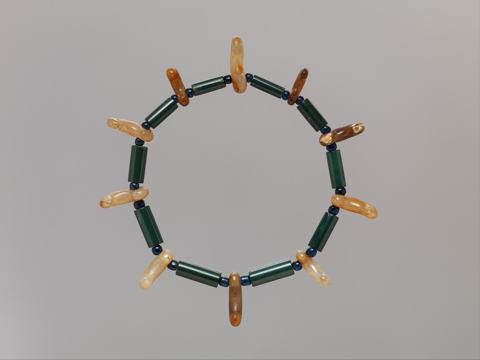
One of Japan's three imperial regalia: a string of curved jewels born at the heavenly rock cave, handed down from Amaterasu, and kept with the emperor unseen.
Also mentioned inAme-no-UzumeKonohanasakuya-himeMount Fuji (Sacred Mountain)
Sources & Further Reading
- 1.Kojiki — Records of Ancient Matters (712 CE).
- 2.Nihon Shoki — Chronicles of Japan (720 CE).
- 3.Engishiki — Procedures of the Engi Era (927 CE), Books 1–10, including the norito.
- 4.Philippi, Donald L., trans. Kojiki. University of Tokyo Press, 1968.
- 5.Hardacre, Helen. Shinto: A History. Oxford University Press, 2017.
- 6.Breen, John & Mark Teeuwen. A New History of Shinto. Wiley-Blackwell, 2010.
Spot an error or have a source to suggest? Write to info@viseterna.com. We cite primary sources and modern scholarship, and we correct fast.