
Yamata-no-Orochi
The eight-headed, eight-tailed serpent of Izumo — devourer of maidens, killed drunk by Susanoo, and the source of the imperial sword Kusanagi.
Susanoo and Yamata-no-Orochi, Utagawa Kuniteru I, 19th century (Museum of Fine Arts, Boston) · Public domain · source
The Shape of the Monster
Yamata-no-Orochi (八岐大蛇), the "eight-forked great serpent," is the most vividly described creature in Japan's earliest chronicles, and the Kojiki spends more words on its body than on most gods 1. It has eight heads and eight tails on a single trunk. Its eyes are red like winter-cherry fruit. Moss grows on its back, along with cypress and cryptomeria trees, as though it were a range of hills. It is long enough to span eight valleys and eight ridges, and its belly is permanently raw and oozing blood 1,3.
The Nihon Shoki gives a compatible account with its usual variant readings, and both texts place the creature in the province of Izumo, on the upper reaches of the Hi River 2,4. "Eight" here is best read as the standard Japanese figure for "many" rather than a literal count, a convention Philippi flags throughout the Kojiki 3.
The Bargain at the River
Susanoo, freshly expelled from heaven for wrecking his sister's fields, comes down at the headwaters of the Hi and finds an old couple weeping between them over a girl 1. They are Ashinazuchi and Tenazuchi — names Philippi renders as the foot-stroking and hand-stroking elders — earthly kami who had eight daughters 1,3. The serpent has come once a year and taken one. The last, Kushinadahime, is the one they are holding 1,2.
Susanoo asks for her, is asked in turn who he is, and answers that he is the elder brother of the sun goddess Amaterasu, lately descended from heaven. The couple give their consent at once 1. It is worth noticing what the chronicle is doing: the banished defiler of heaven acquires, in one scene, a bride, allies, and a purpose 3.
The Killing
The plan is domestic rather than heroic. Susanoo transforms Kushinadahime into a close-toothed comb and sets her in his hair, out of reach 1,3. He has the old couple brew yashiori no sake, sake refined eight times over, and build a fence with eight gates; behind each gate they set a platform, and on each platform a vat of the sake 1,2.
The serpent arrives, puts one head into each vat, drinks, and falls asleep 1. Susanoo draws his ten-hand sword and cuts it to pieces. The Hi River runs with blood 1,2.
Afterward he goes looking for a place to build his palace and settles at Suga, where clouds rise as he arrives. The Kojiki gives him a verse on the eightfold clouds and the eightfold fence of Izumo, presented as the first Japanese poem, and Kushinadahime — restored from the comb — becomes his wife 1,3.
The Sword in the Tail
Cutting through the middle tail, Susanoo's blade chips. He splits the tail open and finds a great sword inside 1,2. Recognising it as no ordinary object, he sends it up to Amaterasu — the reconciliation gift that closes the quarrel that had darkened the sun 1,3.
The sword is Ame-no-Murakumo-no-Tsurugi, "the sword of the gathering clouds of heaven." In the chronicles' later narrative it is given by Amaterasu to her grandson Ninigi at the heavenly descent, becomes one of the three imperial regalia alongside the mirror and the curved jewels, and is handed by the priestess Yamatohime to the hero Yamato Takeru at Ise 1,2,5. Trapped in a burning grass plain, he cuts the grass around him and turns the fire back, and from that the blade takes its familiar name, Kusanagi, the grass-cutter 2,4. It is traditionally held to reside at Atsuta Jingu in Nagoya, where it is not displayed 5.
What the Serpent Might Be
The chronicles offer no explanation, so readers have supplied several. The most common naturalistic reading takes the eight forks as the braided distributaries of the Hi River, and the annual devouring of a daughter as its seasonal flooding of the rice land — with Susanoo's victory standing for the taming of a river valley 3,5. A second widely repeated reading connects the serpent to the iron industry of Izumo, whose tatara smelting of iron sand stained the rivers red and produced blades; on this account the raw red belly is the ore-fouled water, and the sword drawn from the tail is metallurgy itself 5.
Both are interpretations rather than findings, and neither is stated in the texts. What can be said more securely is structural: the story belongs to a very widespread narrative type in which a monster exacts a maiden as tribute until a wandering outsider kills it and marries her 3,5. Hardacre's broader point about the chronicles applies here too — they were compiled at court out of regional traditions, and Izumo material entered them already shaped by other hands 5.
The Orochi Since
The serpent did not stay in the eighth century. It is the signature piece of Iwami Kagura, the sacred dance-drama of western Shimane, where multiple performers work long cloth-and-bamboo serpent bodies through a smoke-filled stage — a performance tradition still central to local festivals and one of the most-watched pieces of living Japanese folk theatre 6. Shrines linked to the episode, including Yaegaki in Matsue, remain active sites tied to Susanoo and Kushinadahime 5.
Foster's observation about Japanese monsters holds neatly for the Orochi: creatures survive by being performed and depicted, not only by being written down, and each retelling is free to reshape the body while keeping the count of heads 6.
Continue Exploring
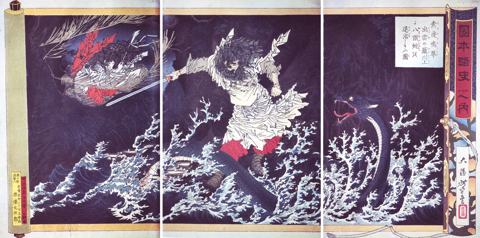
The raging kami of sea and storm — expelled from heaven for wrecking his sister's fields, then redeemed in Izumo by slaying an eight-headed serpent.
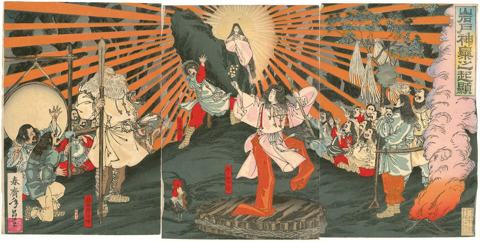
The sun goddess who shines in heaven — ruler of the Plain of High Heaven, ancestor of Japan's imperial line, and the kami enshrined at Ise.
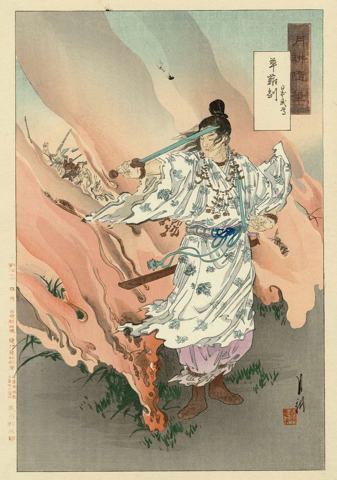
The sword drawn from a serpent's tail and renamed by a burning field — one of Japan's three imperial regalia, kept at Atsuta Jingu and never shown to anyone.
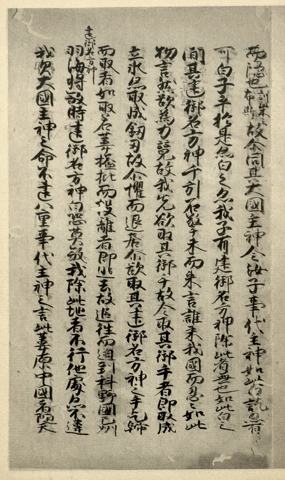
Japan's oldest surviving chronicle, presented to the throne in 712 from one court reciter's memory — the deepest source for the Codex's kami and early emperors.
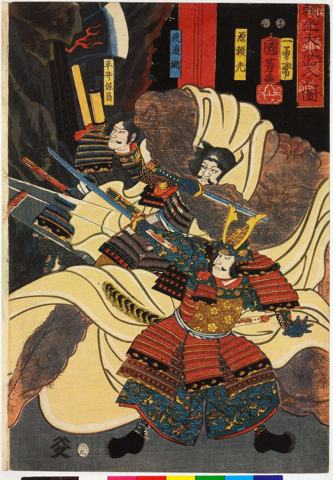
Japan's most famous oni — a demon king who ruled Mount Oe from a stolen palace, until Minamoto no Raiko brought him down with poisoned sake and a sword.
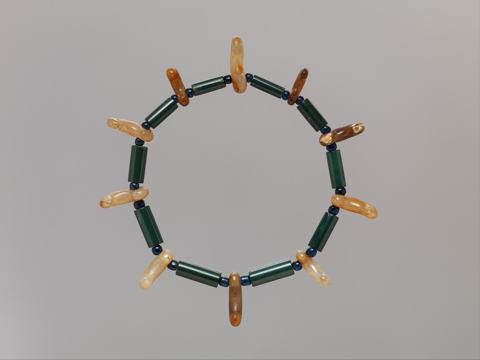
One of Japan's three imperial regalia: a string of curved jewels born at the heavenly rock cave, handed down from Amaterasu, and kept with the emperor unseen.
Also mentioned inThe Nihon Shoki
Sources & Further Reading
- 1.Kojiki — Records of Ancient Matters (712 CE).
- 2.Nihon Shoki — Chronicles of Japan (720 CE).
- 3.Philippi, Donald L., trans. Kojiki. University of Tokyo Press, 1968.
- 4.Aston, W. G., trans. Nihongi: Chronicles of Japan from the Earliest Times to A.D. 697. Kegan Paul, 1896.
- 5.Hardacre, Helen. Shinto: A History. Oxford University Press, 2017.
- 6.Foster, Michael Dylan. The Book of Yokai: Mysterious Creatures of Japanese Folklore. University of California Press, 2015.
Spot an error or have a source to suggest? Write to info@viseterna.com. We cite primary sources and modern scholarship, and we correct fast.