
Yata no Kagami (the Sacred Mirror)
The mirror forged to trick a sun goddess out of hiding, handed down to her earthly heirs, and now kept at Ise, wrapped, unphotographed, and never once unveiled.
Depiction of the Relocation of the Grand Shrine of Ise, Utagawa Kuniyoshi, c. 1847-1852 (British Museum) · Public domain · source
Forged to Catch a Goddess
The Yata no Kagami, the "eight-hand mirror," begins as a piece of bait. When Amaterasu seals herself inside the heavenly cave after Susanoo's rampage, plunging the world into darkness, the assembled gods devise a plan to draw her out: the smith-deity Ishikoridome forges a great mirror, the jewel-maker Tama-no-oya strings curved beads, and both are hung on a sacred sakaki tree set before the cave mouth, while the dancer Ame-no-Uzume performs on an overturned tub until the watching gods roar with laughter 1,2. Amaterasu, curious what could cause celebration in her absence, opens the cave a crack — and is met by her own reflection blazing back at her from the mirror, bright enough that she leans out to look closer, believing for a moment that a greater god has appeared. The strongman Ame-no-Tajikarao seizes the opening and pulls her fully into the light 1,2. Both chronicles agree on the mirror's role in the scene, though they differ, in their usual way, on smaller details of order and phrasing between the two tellings 1,2.
Passed Down From Heaven
The mirror's second appearance comes at the tenson korin, the descent of Amaterasu's grandson Ninigi to rule the earthly land. Amaterasu gives him the mirror, together with the curved jewels and the sword that would later be called Kusanagi, and instructs him to treat the mirror exactly as he would treat her own presence — to venerate it, in effect, as herself 1,2. That instruction is the theological hinge the whole later tradition hangs on: the mirror is not merely a memento of the goddess but a vessel she is understood to inhabit, which is why, unlike an ordinary relic, it has never been treated as safe to display 4,5.
Moved Out of the Palace
For several reigns the mirror stayed in the palace itself, alongside the sword and the jewels, kept close to the sovereign as a direct extension of royal authority 1,2. The Nihon Shoki records that under Emperor Suinin, the mirror's power and the sovereign's ordinary life were judged too dangerous to keep under one roof, and the princess Yamatohime-no-mikoto was sent to find it a separate home, a search that ended at Ise, where the mirror is still said to reside at the heart of the Naiku 1,2. A substitute was made for the palace's own rites, later kept in what is called the Kashikodokoro, so that the imperial household would never again be without a version of the goddess's presence even after the true mirror left 2,4.
One of Three
The mirror is the first of the three imperial regalia, alongside Kusanagi and the jewels, and a long interpretive tradition, developed by medieval court scholars including the fourteenth-century historian Kitabatake Chikafusa, reads the three objects as a set of virtues rather than merely as treasures: the mirror standing for wisdom or honesty, the jewel for compassion, the sword for valor 4,5. Whether that triad reflects an ancient scheme or a later, retrospective piece of court philosophy is not something the myths themselves settle, and Breen and Teeuwen treat it as characteristic of how each era of Japanese thought has re-read the regalia to fit its own concerns 5.
Lost, Then Recovered, at Dan-no-ura
The mirror's one recorded brush with destruction comes at the Battle of Dan-no-ura in 1185, the naval battle that ended the Genpei War. The Tale of the Heike describes the child emperor Antoku's grandmother, Taira no Tokiko, taking both the sword and a chest holding the mirror into the sea with her as the Taira fleet collapsed around them, rather than let the regalia fall into enemy hands 3. Unlike the sword, which sank and was never recovered, the mirror's box is recorded as having been retrieved from the water essentially undamaged, and it was returned to ceremonial use afterward — one of the few moments in the mirror's whole history where the tradition claims it was ever physically at risk, and one it is said to have survived intact 3,4.
Never Seen, Always Present
No photograph, drawing, or eyewitness description of the Yata no Kagami's actual surface is treated by Shinto authorities as legitimate, and shrine practice holds that even Ise's own priests do not unwrap it; when the mirror's container needs renewal, by tradition it is handled and rewrapped without the mirror itself being exposed to view 4. That claim, like similar ones made about Kusanagi, cannot be independently verified and is best understood as devotional testimony about how the object ought to be treated rather than a checkable fact 4,5. What is documented is the mirror's continuous ceremonial role: it traveled to the new Naiku building at every Shikinen Sengu rebuilding, and a version of it was carried, still wrapped, through the accession rites of the current emperor in 2019, exactly as its predecessors were carried through such rites for centuries before 4,5. Three thousand years of story, by the tradition's own reckoning, rest on an object nobody now living has been allowed to see.
Continue Exploring
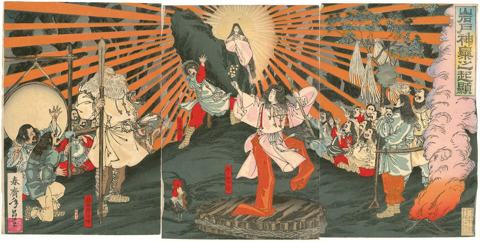
The sun goddess who shines in heaven — ruler of the Plain of High Heaven, ancestor of Japan's imperial line, and the kami enshrined at Ise.
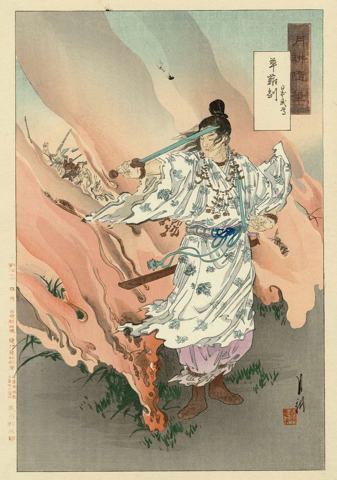
The sword drawn from a serpent's tail and renamed by a burning field — one of Japan's three imperial regalia, kept at Atsuta Jingu and never shown to anyone.
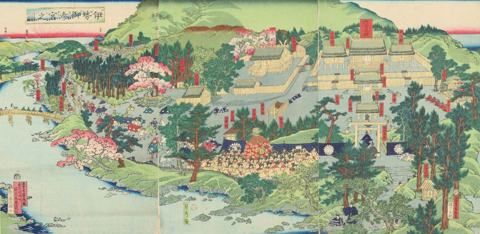
Shinto's holiest site, home to the sun goddess's mirror — rebuilt on an adjacent plot every twenty years so nothing there is ever allowed to age.
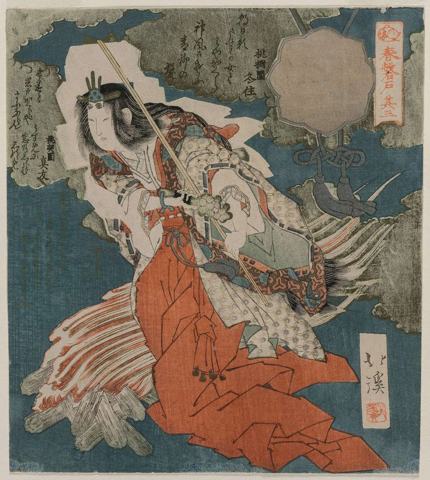
The kami whose bawdy trance dance drew the sun goddess out of hiding, and whose fearless meeting with a road-god gave Japan its oldest ritual dance.
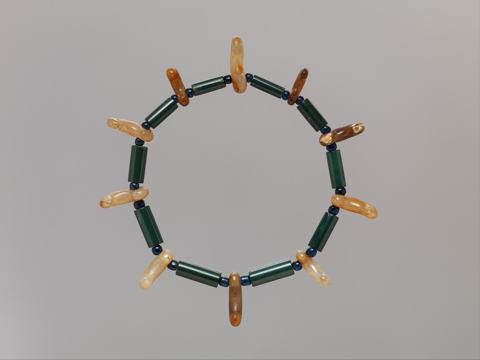
One of Japan's three imperial regalia: a string of curved jewels born at the heavenly rock cave, handed down from Amaterasu, and kept with the emperor unseen.
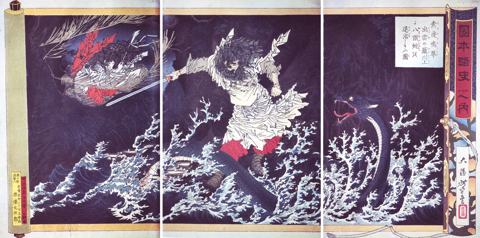
The raging kami of sea and storm — expelled from heaven for wrecking his sister's fields, then redeemed in Izumo by slaying an eight-headed serpent.
Also mentioned inThe KojikiThe Nihon Shoki
Sources & Further Reading
- 1.Kojiki (Records of Ancient Matters, 712). Trans. Donald L. Philippi. University of Tokyo Press, 1968.
- 2.Nihon Shoki (Chronicles of Japan, 720), in W.G. Aston, trans., Nihongi: Chronicles of Japan from the Earliest Times to A.D. 697. Kegan Paul, 1896.
- 3.The Tale of the Heike. Trans. Royall Tyler. Viking, 2012.
- 4.Hardacre, Helen. Shinto: A History. Oxford University Press, 2017.
- 5.Breen, John & Mark Teeuwen. A New History of Shinto. Wiley-Blackwell, 2010.
Spot an error or have a source to suggest? Write to info@viseterna.com. We cite primary sources and modern scholarship, and we correct fast.