
Ryujin (Japanese Dragon King of the Sea)
Japan's dragon king of the sea, ruling the palace Ryugu-jo with tide-jewels that command the ocean and a daughter who nearly kept the imperial line undersea.
Princess Toyotama, from Azuma Nishiki Chuya Kurabe, Toyohara Chikanobu, 1886 · Public domain · source
Owatatsumi, Not Quite Ryujin
The oldest Japanese chronicles do not use the name most people reach for today. In the Kojiki and Nihon Shoki, the god who rules the sea is Owatatsumi-no-kami, "the great sea-possessing kami," and his undersea hall is simply Watatsumi's palace 1,2. Ryujin (龍神), "dragon kami," is the name Japanese popular religion settled on later, after centuries of contact with the Chinese image of the long, the dragon-king who governs rain and tide from a palace under the waves 3. De Visser's exhaustive survey of dragon lore treats this as a fusion rather than a replacement: an indigenous sea deity, imagined in the chronicles as ambiguous in shape, absorbed the fully draconic, crowned, palace-dwelling dragon-king imported with Buddhism and Chinese cosmology, until the two were effectively the same figure in shrine practice and popular art 3,6.
That ambiguity is already present in the eighth-century texts. Owatatsumi is never drawn in detail; he is known by his undersea hall, his daughters, and his command of the tides, and later commentary and art — including the print illustrating this entry — simply render him and his line as dragons outright 1,3. Modern reference works now use Ryujin as the working name for the whole tradition, while noting that the identification with a literal dragon body hardens only over time 4.
The Lost Fishhook
The god's story enters Japanese myth through his daughter and a quarrel between two brothers. Hoderi, "Fire-Shine," is a fisherman; Hoori, "Fire-Fade," is a hunter. On a day they agree to trade tools, Hoori loses his brother's fishhook in the sea and cannot recover it, even after breaking his own sword into five hundred replacement hooks 1,2. Hoderi refuses every substitute and demands the original back.
Weeping on the shore, Hoori meets the old tide-god Shiotsuchi-no-kami, who weaves him a basket-boat without mesh gaps and tells him to ride it down into the sea: he will reach Watatsumi's palace, marked by a cassia tree beside a well, and there his troubles will be resolved 1,2.
The Palace Under the Waves
Ryugu-jo, as later tradition names it, is built of fish scales, glittering like a hall of gems, and Hoori climbs the cassia at its gate to wait 1,3. A maidservant drawing water sees his reflection; her mistress, Toyotama-hime, "Luxuriant Jewel Princess," daughter of the sea god, comes to look and the two fall for each other on sight 1,2. Owatatsumi recognises Hoori as heaven's grandson, seats him on layered cushions of sea-lion skins, and holds a wedding feast; Hoori stays three years 1.
Homesick at last, he tells his father-in-law why he came. The sea god summons every fish in the ocean and finds the lost hook lodged in the throat of a tai, a red sea bream — a detail folk custom still gestures at, since sea bream are auspicious festival fish in Japan today 1,2. Owatatsumi hands Hoori the hook along with two treasures: shiomitsu-tama, the jewel that raises the tide, and shiohiru-tama, the jewel that lowers it, and instructs him exactly how to use each one against his brother 1.
The Tide Jewels and the Birth on the Shore
Riding home on the back of a one-fathom crocodile-shark, a wani, Hoori returns the hook with a curse attached, as his father-in-law taught him, so that Hoderi's fortune sours whatever he tries 1,2. When Hoderi attacks in fury, Hoori raises the tide-jewel and floods him; when he begs for mercy, Hoori lowers it and lets him live, subdued and submissive from then on — the Kojiki frames this as the mythic origin of a rival lineage's subordination to Hoori's own 1.
Toyotama-hime follows her husband to land, pregnant, and asks him to build her a parturition hut thatched with cormorant feathers, and on no account to watch her give birth 1,2. He looks anyway. What he sees — a huge sea-creature coiling where his wife had been, a wani by the Kojiki's word, rendered as a full dragon in the later pictorial tradition this entry's print belongs to — shames her so badly that she seals the border between sea and land behind her and returns to her father's palace forever, leaving their son to be raised by her sister 1,3. That son, Ugayafukiaezu, becomes the father of Jimmu, traditionally Japan's first emperor: the imperial line, by the chronicles' own account, descends from the sea god's daughter 1,2.
Ryujin in Later Tradition
Later Buddhist-influenced storytelling keeps expanding the dragon king's household and court — multiple dragon daughters, a treasury of jewels, guardian dragons coiling around anyone who tries to steal from it — material de Visser traces motif by motif back through Chinese and Indian naga lore as it layered onto the native god 3,6. Shrines describing themselves as Ryugu or Watatsumi jinja are scattered along the coast, and dragon-king rites for rain and safe fishing remain part of maritime folk religion, a continuity Hardacre situates within Shinto's long habit of absorbing rather than discarding earlier cult layers 5,6.
The same undersea court reappears, centuries later, as the destination of a mortal fisherman in Urashima Taro, where Ryujin's palace becomes a place a human visits and loses everything by leaving 3,6. It is worth noticing, too, what this god is not: when Izanagi divided the world among his children, it was Susanoo who was assigned the sea plain — and refused it. Owatatsumi is the deity who actually keeps that realm, tide, palace, and daughters intact, while the chronicles' more famous storm god was busy elsewhere 1.
Continue Exploring
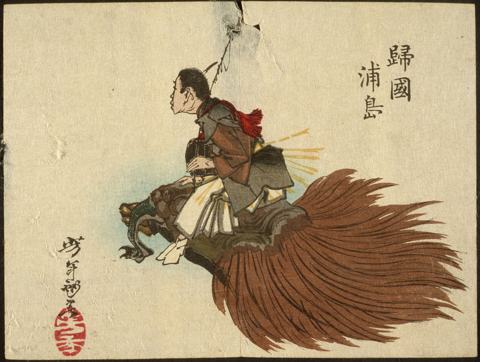
A fisherman rewarded with a journey to a timeless undersea land, who returns home to find centuries have passed and opens the one box he was told to leave shut.
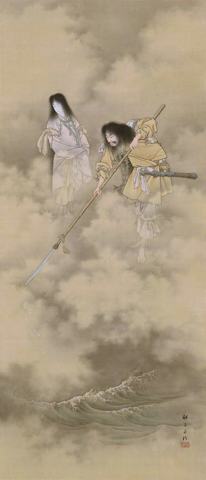
The creator pair of Japanese myth: they stirred the first island out of the sea, bore the land itself, and were parted forever by death.
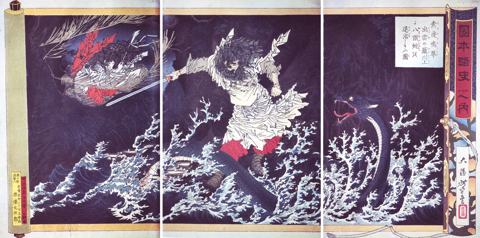
The raging kami of sea and storm — expelled from heaven for wrecking his sister's fields, then redeemed in Izumo by slaying an eight-headed serpent.
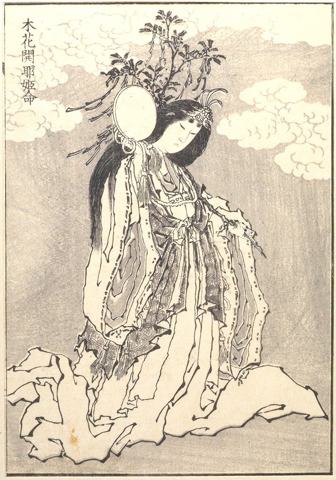
The cherry-blossom princess who married the heavenly grandson, proved her sons' birth by fire, and became the kami worshipped on Mount Fuji.
The sun goddess who shines in heaven — ruler of the Plain of High Heaven, ancestor of Japan's imperial line, and the kami enshrined at Ise.
The moon kami born from Izanagi's right eye — ruler of the night, whose single recorded act of violence set the sun and moon forever apart.
Sources & Further Reading
- 1.Kojiki (Records of Ancient Matters, 712) — Book One; trans. Donald L. Philippi, University of Tokyo Press, 1968.
- 2.Nihon Shoki (Chronicles of Japan, 720) — Book One, in W.G. Aston (trans.), Nihongi. Kegan Paul, 1896.
- 3.de Visser, Marinus Willem. The Dragon in China and Japan. Johannes Müller, 1913.
- 4.Ashkenazi, Michael. Handbook of Japanese Mythology. ABC-CLIO, 2003.
- 5.Hardacre, Helen. Shinto: A History. Oxford University Press, 2017.
- 6.Foster, Michael Dylan. The Book of Yokai: Mysterious Creatures of Japanese Folklore. University of California Press, 2015.
Spot an error or have a source to suggest? Write to info@viseterna.com. We cite primary sources and modern scholarship, and we correct fast.