
Veles
Lord of the cattle and the world below — the second god the Rus' swore by, whose name survived as a curse, a saint's herd, and a beard of grain in the field.
Saint Blaise with the Herds, Russian icon, 17th century · Public domain · source
What the Chronicles Actually Say
Two sentences carry almost the entire weight of Veles. In the Primary Chronicle, under the year 907, the pagan Rus' ratify a treaty with Byzantium by swearing on their weapons, on Perun their god, and on Volos, the god of cattle 1. Under 971 the formula recurs in Svyatoslav's treaty: if the oath is broken, may they be accursed by the god they believe in, by Perun and by Volos the cattle god 1.
That is the contemporary evidence. Everything else about him is later, indirect, or reconstructed 6. Note also the name in those passages: Volos, not Veles. The form Veles appears elsewhere — in the Tale of Igor's Campaign, in South Slavic material, and in late medieval Czech, where "go to Veles" functions as a curse meaning roughly "go to the devil" 2,6. Whether Volos and Veles are one god under two forms, as is usually assumed, or two things later merged, is disputed 6.
Not on the Hill
Veles is conspicuously absent from the one pantheon list we have. When Vladimir set up idols outside his palace in 980, the Chronicle names Perun, Khors, Dazhbog, Stribog, Simargl, and Mokosh — and not Volos 1. Later hagiographical tradition places a Volos idol not on the prince's hill but down in the Podil, the merchants' and craftsmen's lower town by the water, and the Life of St. Avraamii of Rostov describes the saint destroying a stone Volos idol at Rostov, in the Finno-Ugric north 1,3.
If those later reports preserve anything real, they suggest a god of the commons rather than of the retinue: wealth measured in livestock and trade, worshipped at the bottom of the hill while the war god stood at the top 4,5. The Old Russian word skot means both "cattle" and "money," so "cattle god" and "god of wealth" are the same phrase 4,6.
Boyan, Grandson of Veles
The Tale of Igor's Campaign, a poem of about 1185, opens by invoking Boyan, the legendary singer, and calls him Velesov vnuk — Veles's grandson 2. It is a single epithet with no explanation, and it is the only line in medieval East Slavic literature that connects the name to anything beyond oath-taking 2.
From it, scholars have inferred that Veles was patron of poets, seers, and inspired speech — an attractive idea, since a god of the dead and of wealth who also owns poetry has good comparative parallels 4. It is inference from four words in a poem whose own authenticity was debated for two centuries, and it should be held loosely 2,6.
Blaise, and the Beard in the Field
The clearest afterlife is agricultural. Saint Blaise — Russian Vlasii, a name close enough to Volos to invite the transfer — became the patron of cattle across the Russian countryside, with his icon kept in byres, his feast marking a cattle blessing, and his name invoked over sick animals 5. The functional overlap with a "cattle god" is exact, and the substitution is the standard example in discussions of Russian dvoeverie, the layering of Christian and pre-Christian practice 5.
In nineteenth-century Russian harvest custom, the last stalks of grain in a field were left uncut and tied or plaited into a "beard," dedicated in different regions to Nicholas, to Elijah, or to Volos 5. Ivanits records the practice as living ethnography without treating the Volos dedications as proof of an unbroken pagan cult, and that is the right level of confidence: the name persisted in a rural formula, which is not the same thing as the god persisting 5.
Kalik and Uchitel go further and question the direction of influence altogether, suggesting that some supposed Slavic deities may be back-formations from Christian saints' cults rather than their ancestors 6.
The Reconstructed Duel
The most repeated Slavic myth involves Veles, and it is not written down anywhere before the twentieth century. In the reconstruction assembled by Vyacheslav Ivanov and Vladimir Toporov, Perun the thunderer pursues his serpentine adversary, who has stolen cattle or water or a wife; the adversary hides successively beneath a tree, a stone, an animal, and a man; Perun's lightning splits each hiding place; and when the serpent is finally driven into the waters, the rain falls and the cattle are released 4.
Ivanov and Toporov built this from folk songs, charms, riddles, place-names, and comparison with Baltic and Vedic material, and their work is genuinely learned and enormously influential 4. It is also a hypothesis. The chronicle evidence gives us Perun and Volos standing side by side in an oath, which is a partnership, not a war 1,6. Kalik and Uchitel treat the whole reconstructed "basic myth" as a chain of inference rather than a recovered text, and their scepticism is a useful counterweight to how confidently the duel is retold online 6.
The Book of Veles Is a Forgery
Any search for this god will produce the Book of Veles (Velesova kniga), presented as a ninth-century pagan chronicle written on wooden boards, discovered in 1919, and published from copies in the 1950s. It is a modern forgery 6. Its language mixes grammatical features from different Slavic languages and centuries in ways no genuine ninth-century text could, the boards were never produced for examination, and the scholarly consensus against it is essentially unanimous 6.
It matters here because it is the source of a great deal of confident-sounding detail about Veles, and about a Slavic cosmology of "Yav, Prav and Nav," that circulates as if it were ancient 6. It is not evidence, and nothing in this article rests on it.
What Is Actually Known
A god called Volos, associated with cattle and therefore with wealth, was sworn by alongside Perun in tenth-century Rus' treaties; a name Veles was known across a wider Slavic area and survives in a Czech curse and one Russian poetic epithet; and his functions were absorbed after Christianisation by Saint Blaise 1,2,5,6.
The serpent, the underworld throne, the theft of cattle, and the duel under the oak are reconstruction and folklore, some of it well argued and some of it invented outright 4,6. Both halves are worth knowing, and keeping them separate is the whole discipline of the subject.
Continue Exploring
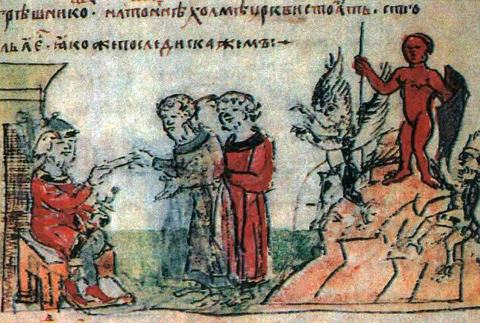
God of thunder and the striking bolt — the oak-crowned sky lord of the early Slavs, sworn by in treaties and thrown into the Dnieper at Rus' baptism.
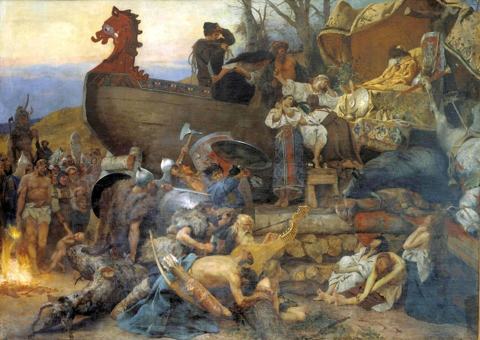
The land of the dead — an old Slavic word for a corpse and for the dead who come back, and the least documented otherworld in European mythology.
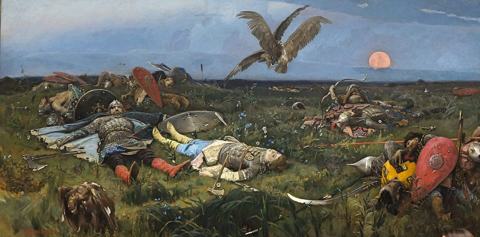
A 12th-century epic of a failed raid, its only manuscript burned in Moscow in 1812, and the two-century forgery debate that followed it.
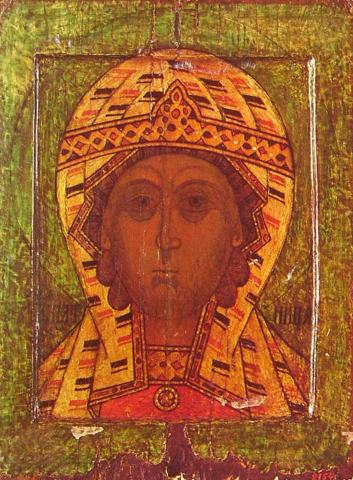
Mother of the damp earth and the spun thread — the only goddess on Vladimir's hill, who outlived her own cult as a night spirit and as Saint Friday.
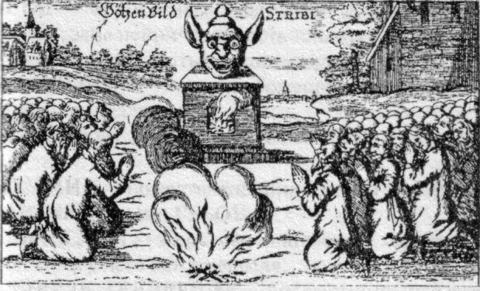
Wind god of the pagan Kyivan pantheon, remembered in the Tale of Igor's Campaign as the ancestor whose grandsons are the winds themselves.
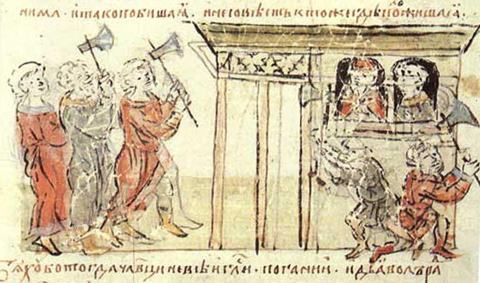
The founding chronicle of Kyivan Rus', c. 1113 - the only narrative source for Vladimir's pagan pantheon of 980 and its fall eight years later.
Also mentioned inChernobog and Belobog (Black God and White God)Jarilo (Yarilo)Koschei the DeathlessLada (Slavic Goddess)Likho (One-Eyed Misfortune)Rod and the RozhanitsyThe Zbruch IdolVyraj (Iriy, the Slavic Otherworld Paradise)Zmey, the Slavic Dragon
Sources & Further Reading
- 1.The Russian Primary Chronicle (Povest' vremennykh let, c. 1113) — the Rus'-Byzantine treaty oaths under the years 907 and 971.
- 2.The Tale of Igor's Campaign (Slovo o polku Igoreve, c. 1185).
- 3.The Life of St. Avraamii of Rostov (Old Russian hagiography, late medieval).
- 4.Ivanov, V. V. & V. N. Toporov. Issledovaniia v oblasti slavianskikh drevnostei. Nauka, Moscow, 1974.
- 5.Ivanits, Linda J. Russian Folk Belief. M.E. Sharpe, 1989.
- 6.Kalik, Judith & Alexander Uchitel. Slavic Gods and Heroes. Routledge, 2019.
Spot an error or have a source to suggest? Write to info@viseterna.com. We cite primary sources and modern scholarship, and we correct fast.