
Nav
The land of the dead — an old Slavic word for a corpse and for the dead who come back, and the least documented otherworld in European mythology.
Funeral of a Noble Rus in Bolghar (Ibn Fadlan's ship-burial account), Henryk Siemiradzki, 1883. A 19th-century imagining of a funeral, not a depiction of Nav itself · Public domain · source
A Word Before a Place
Nav is first of all a noun, not a country. Proto-Slavic navь means a corpse or a dead person, and it survives across the family: Old East Slavic navĭ, Old Czech náv for a grave or the world of the dead, Slovene nav, Ukrainian nav' 5,6. It has solid Indo-European cognates in Latvian nāve, "death," and Gothic naus, "corpse," which puts the word among the older layers of the Slavic lexicon 6.
The extension from "corpse" to "the place where corpses are" is attested mainly in the West and South Slavic branches, where náv can mean the underworld 5,6. In East Slavic sources the word overwhelmingly means the dead themselves — and specifically the dead who are still active, which is a different concept from a realm 1,4.
There is no Slavic text describing the land of the dead. Not one. Everything below is inference from a handful of words, from burial archaeology, and from folklore recorded eight centuries after Christianisation 5.
The Dead of Polotsk
The one memorable East Slavic passage is a horror story. Under the year 1092 the Primary Chronicle records a portent at Polotsk: at night there was a clattering in the streets, as of demons riding about, and anyone who went out to look was wounded by an invisible blow and died 1. People stopped leaving their houses by night, and then the riders appeared by day as well, visible only as horses' hooves 1. The chronicler reports what the townspeople said about it: that navi — the dead — were beating the people of Polotsk 1.
The entry is a Christian chronicler recording a plague and a piece of popular explanation he does not endorse, and that is exactly what makes it valuable 1,5. It shows the word in live use, meaning hostile dead who come among the living, in Rus' a century after baptism 1.
What Burial Says, and Does Not
Archaeology supplies practices without doctrine. Early Slavic cremation, urn burial, and the later shift to barrow inhumation imply belief in some continuation after death, but they do not tell us what anyone thought the destination was 5.
The written descriptions of Slavic-area funerals are foreign and complicated. Ibn Fadlan's famous account of a ship burial on the Volga in 922 — the slave girl lifted above the doorframe to see, in her words, her master in a green and beautiful place, and the explanation that burning sends him to paradise at once rather than leaving him to rot — is the most vivid funerary text from the region 3. It describes the Rus', who at that date were very probably Scandinavian, and it cannot be treated as Slavic belief without argument 3,5.
Procopius, writing in the sixth century, gives the earliest description of Slavic religion and is notably empty on this point: the Slavs and Antes worship one god who makes lightning, sacrifice cattle to him, revere rivers and water-spirits, and do not believe in fate. He records no underworld, no judgement, and no journey of the soul 2.
The Unclean Dead
Where nav becomes rich is in folklore, and there it stays close to its original meaning. Russian and Ukrainian tradition divides the dead in two: the ancestors, who died in their proper time and are fed at their graves, and the unclean or "pledged" dead — suicides, the drowned, the murdered, witches, and unbaptised infants — who died wrongly and remain dangerous 4.
The second group is where the word goes. Ukrainian mavky or navky are the spirits of unbaptised or stillborn children, sometimes appearing as girls who look whole from the front and are hollow behind, luring travellers and demanding baptism 4,5. They overlap with the rusalki, the water and field spirits associated with drowned girls, who come out for Rusalia week in early summer and must be seen off with ritual at its end 4. Ivanits stresses how practical the complex was: the unclean dead caused drought, hail, and illness, and specific measures existed for handling their graves 4.
Nav in the Calendar
Commemoration of the dead had fixed dates and survived the conversion under Christian names. The main Russian one is Radunitsa, in the second week after Easter, when families go to the cemetery, eat at the graves, leave eggs and food, and address the dead directly; similar rites cluster at Trinity Saturday and in autumn 4.
Among the South Slavs, the corresponding day carries the old word: Bulgarian tradition knows a Navi Den or Nav'ski Velikden, "the Easter of the dead," in Easter week, when the dead are believed to be abroad and food is set out for them 5. It is one of the few places where nav survives as a live term in ritual language rather than in a dictionary 5.
The Yav-Prav-Nav Triad Is Modern
Almost every popular account of Slavic mythology presents a three-tier cosmos: Yav, the visible world; Prav, the world of divine order and rule; and Nav, the world of the dead. It is a tidy scheme, and it comes from the Book of Veles, a text presented as a ninth-century pagan chronicle on wooden boards, published from the 1950s by émigré enthusiasts, and rejected by essentially every specialist who has examined it 5,7.
The linguistic evidence against it is decisive: it mixes features from different Slavic languages and different centuries, and the boards were never made available for examination 5,7. Yav and prav in that arrangement are not attested in any medieval source, and the triad has no standing as ancient cosmology 5. It is included here only because anyone researching Nav will meet it within a page or two, presented as fact 7.
What Little Can Be Said
A Proto-Slavic word for the dead existed, is well attested linguistically, and in some branches came to mean the place of the dead 5,6. In eleventh-century Rus' people used it for dangerous returning dead 1. In modern East and South Slavic folklore it survives in the names of a class of restless spirits and in one calendar term for the day the dead come back 4,5.
Beyond that, the Slavic underworld is a blank. Ivanov and Toporov's reconstructions place a serpentine Veles at the bottom of a vertical cosmos opposite the thunderer Perun at the top, and the model has shaped nearly everything written on the subject since 6. Kalik and Uchitel's response is worth repeating: the confidence of the reconstruction should not be mistaken for the quality of the evidence 5.
Continue Exploring
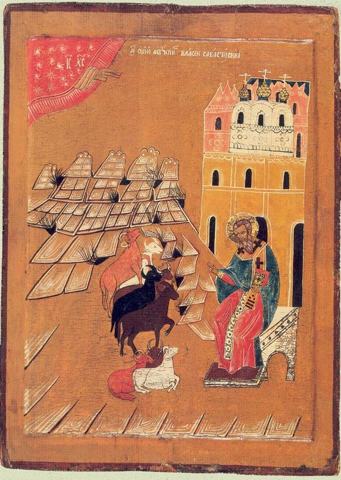
Lord of the cattle and the world below — the second god the Rus' swore by, whose name survived as a curse, a saint's herd, and a beard of grain in the field.
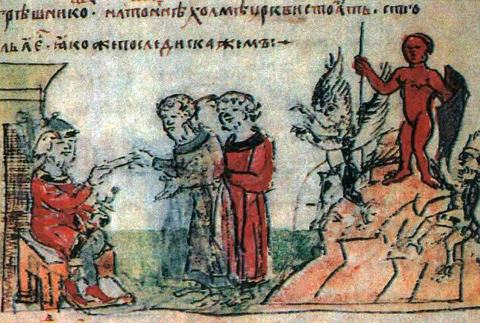
God of thunder and the striking bolt — the oak-crowned sky lord of the early Slavs, sworn by in treaties and thrown into the Dnieper at Rus' baptism.
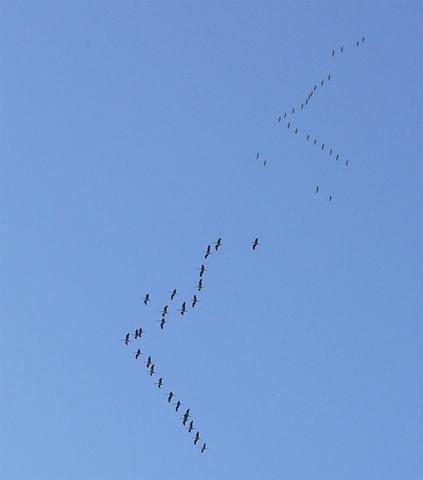
A warm otherworld at the earth's edge where migratory birds winter and, per some folklore, the dead go too - modern ethnography only, no medieval attestation.
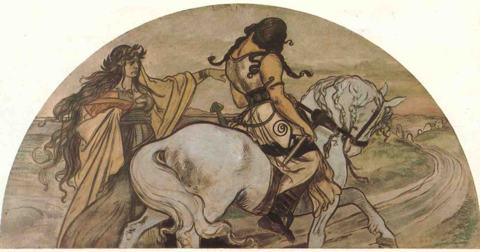
Slavic winter-and-death figure, drowned in effigy every spring. The rite is documented from 1420; whether a real goddess stood behind it is debated.
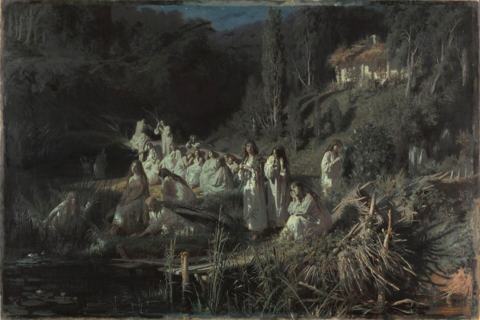
Slavic water spirit of the restless dead: a drowned or unbaptised girl who leaves the river for one week each summer to walk the fields and the woods.
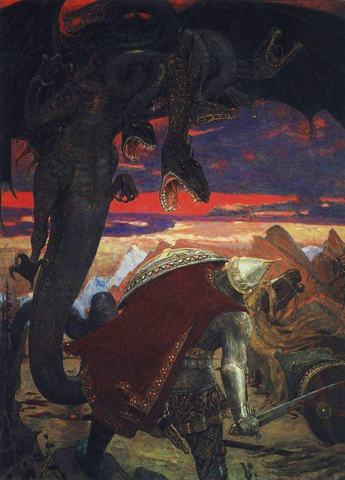
The many-headed dragon — the fire-breathing serpent of Russian epic song, met at a river crossing, and beaten only by a hero who refuses to stop swinging.
Sources & Further Reading
- 1.The Russian Primary Chronicle (Povest' vremennykh let, c. 1113), s.a. 1092 — the navi at Polotsk.
- 2.Procopius of Caesarea, History of the Wars VII.14 (6th century).
- 3.Ibn Fadlan, Risala — account of a Rus' funeral on the Volga, 922.
- 4.Ivanits, Linda J. Russian Folk Belief. M.E. Sharpe, 1989.
- 5.Kalik, Judith & Alexander Uchitel. Slavic Gods and Heroes. Routledge, 2019.
- 6.Ivanov, V. V. & V. N. Toporov. Issledovaniia v oblasti slavianskikh drevnostei. Nauka, Moscow, 1974.
- 7.The Book of Veles (Velesova kniga), published from 1957 — a modern forgery, cited here only as the source of the Yav-Prav-Nav scheme.
Spot an error or have a source to suggest? Write to info@viseterna.com. We cite primary sources and modern scholarship, and we correct fast.