
Rod and the Rozhanitsy
A name condemned in medieval Russian sermons alongside birth-spirits called the rozhanitsy - read by some as a supreme creator god, by others as no god at all.
Nativity of the Virgin, Russian icon, 19th century · Public domain · source
Two Words in a List
Rod and the rozhanitsy appear only in a narrow, hostile kind of source: Old Russian sermons written to stamp out pagan survivals among a nominally Christian peasantry, dated from the eleventh to the fourteenth century 1. These homilies list the things good Christians must stop doing, and among the vily (fate spirits), Mokosh, and offerings left for the dead, several name sacrifices "to Rod and the rozhanitsy" — bread, cheese, honey, porridge, set out at a table or a feast, sometimes explicitly linked to childbirth 1,4. No chronicle places either name among the idols Prince Vladimir raised in Kyiv in 980, and no treaty oath invokes them the way the Rus swore by Perun and Veles, under his other name Volos. Everything about them is filtered through clergy telling their flock to stop, which is a real kind of evidence and also a genuinely limited one 1,5.
What the Words Mean
Rod is a common Slavic noun before it is possibly a god's name: it means clan, lineage, birth, kind, or generation, and it sits at the root of ordinary modern words like rodina ("homeland"), priroda ("nature," literally "toward-birth"), and narod ("people") 2,6. The rozhanitsy are grammatically feminine and plural, "those who give birth" or "birth-givers," and later ethnography associates them with the fate and welfare of a newborn child, a role with an obvious surface resemblance to the Greek Fates, though that comparison is a modern scholarly analogy rather than anything the medieval sources draw themselves 1,4,6. Whether Rod in these sermons names a single personal god, a class of ancestral or household spirits, or simply the abstract idea of birth and lineage being wrongly venerated, is exactly what the debate below turns on 1,5.
Rybakov's Supreme God
The boldest reading is Boris Rybakov's. In his 1981 study of ancient Slavic paganism, Rybakov argued that Rod was not a minor household spirit but the old supreme god of the Slavs, a sky-and-creation deity who predates and outranks Perun, linked by etymology to the whole semantic field of birth, nature, and homeland and reconstructed as a "single god of the universe" behind the visible pantheon of the chronicles 2. It is an attractive thesis — it gives Slavic religion the kind of high god other Indo-European systems have, and it makes sense of why rod-words are so productive in the modern language — and it is built overwhelmingly from etymology and comparative inference rather than from any source that describes Rod as a worshipped person with a cult, an idol, or a temple 2,5.
The Word "Before"
Much of the argument hangs on a single preposition. The Word of St. Gregory states that the pagans offered to Rod and the rozhanitsy prezhde Peruna — "before Perun." Read one way, prezhde is chronological: Rod worship is older than Perun's, a surviving trace of an earlier, deeper layer of Slavic religion. Read the other way, it describes the order of a single ritual meal: the rozhanitsy's portion was set out first, before the toast to Perun, with no claim about which cult is historically older 1,5. The homily itself does not disambiguate, and which reading a scholar prefers tends to predict which side of the larger Rod debate they land on 1,5.
The Critics
Rybakov's reconstruction has been challenged repeatedly by specialists in both Slavic archaeology and philology. Leo Klejn's study of East Slavic paganism argues at length that the sermon evidence supports, at most, a demigod or a personification of fate and lineage, not a supreme creator standing above the gods of the Kyivan pantheon, and other scholars working independently have reached similarly skeptical conclusions about whether Rod was ever a personal god in the sense Perun or Volos clearly were 3,5. Kalik and Uchitel's survey of the reconstructed Slavic pantheon treats Rod as one of the clearest cases where a chain of etymological inference has been dressed up with the confidence of a recovered myth, and they note that the same slender sermon evidence has supported flatly contradictory theories for over a century 5. Ivanov and Toporov's structuralist reconstruction, by contrast, keeps Rod within a wider mythological scheme tied to fate and destiny, without going as far as Rybakov's claim of supremacy 6.
The Rozhanitsy in Living Custom
Set the "supreme god" question aside, and the rozhanitsy have a steadier, humbler afterlife. Ethnographers recorded commemorative meals in their honor surviving into the nineteenth century in Russian villages, often folded into Christian feasts connected with the Virgin's birth or a child's nativity, with dishes of grain, honey, and cheese laid out much as the medieval sermons describe 1,4. Ivanits treats this continuity cautiously: a genuine popular practice persisted under a genuinely old name, but the straight line back to a fully formed pre-Christian goddess-cult is inference, not documentation 4. What can be said honestly is smaller than either the maximalist or the skeptical extreme: two words condemned in medieval sermons, one preposition scholars still argue over, and a household custom that outlived the argument entirely 1,4,5.
Continue Exploring
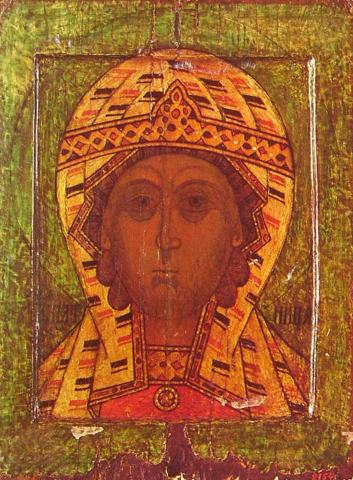
Mother of the damp earth and the spun thread — the only goddess on Vladimir's hill, who outlived her own cult as a night spirit and as Saint Friday.
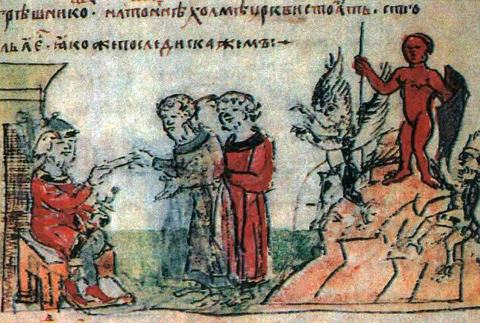
God of thunder and the striking bolt — the oak-crowned sky lord of the early Slavs, sworn by in treaties and thrown into the Dnieper at Rus' baptism.
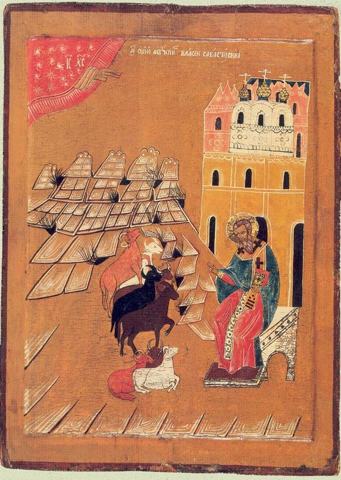
Lord of the cattle and the world below — the second god the Rus' swore by, whose name survived as a curse, a saint's herd, and a beard of grain in the field.

A warm otherworld at the earth's edge where migratory birds winter and, per some folklore, the dead go too - modern ethnography only, no medieval attestation.
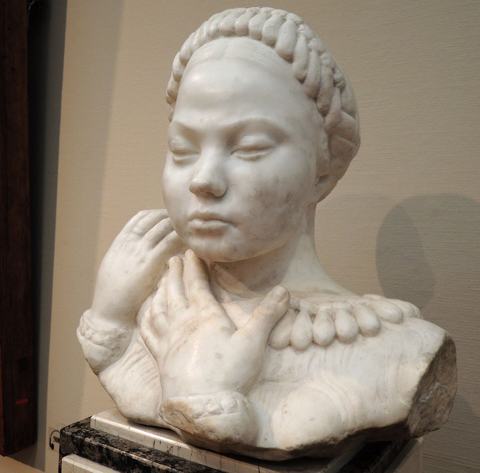
Popularly the Slavic goddess of love, spring and marriage. Most Slavists think she began as a song refrain misread as a divine name.
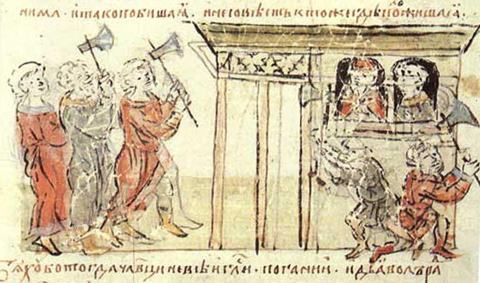
The founding chronicle of Kyivan Rus', c. 1113 - the only narrative source for Vladimir's pagan pantheon of 980 and its fall eight years later.
Sources & Further Reading
- 1.Old Russian anti-pagan homilies, including the Slovo svyatogo Grigoriya (Word of St. Gregory) and the Slovo nekoego khristoliubtsa (Sermon of a Certain Christ-Lover), 11th-14th centuries.
- 2.Rybakov, Boris. Yazychestvo drevnikh slavyan (The Paganism of the Ancient Slavs). Nauka, 1981.
- 3.Klejn, Leo. Voskreshenie Peruna - K rekonstruktsii vostochnoslavyanskogo yazychestva (The Resurrection of Perun - Toward a Reconstruction of East Slavic Paganism). Evraziya, 2004.
- 4.Ivanits, Linda J. Russian Folk Belief. M.E. Sharpe, 1989.
- 5.Kalik, Judith & Alexander Uchitel. Slavic Gods and Heroes. Routledge, 2019.
- 6.Ivanov, V. V. & V. N. Toporov. Issledovaniia v oblasti slavianskikh drevnostei. Nauka, Moscow, 1974.
Spot an error or have a source to suggest? Write to info@viseterna.com. We cite primary sources and modern scholarship, and we correct fast.