
Koschei the Deathless
The undying sorcerer of Russian folktale who hid his death in a needle, inside an egg, inside a duck, inside a hare, inside a chest, beneath an oak.
Koshchey the Deathless, Ivan Bilibin, 1901 · Public domain · source
Who He Is
Koschei — also spelled Kashchei, Koshchei or Kaschey, and almost always given the epithet Bessmertny, "the Deathless" or "the Immortal" — is the archetypal villain of the East Slavic wondertale. He is not a god and appears in no cult, temple or chronicle. He belongs entirely to the folktale tradition, first written down in bulk by Alexander Afanasyev in the mid-nineteenth century and represented in the international tale-type index as the antagonist of ATU 302, "The Ogre's Heart in the Egg" 1,5,6.
The portrait is consistent: an old, gaunt, sometimes skeletal sorcerer of enormous age, immensely rich, living alone in a fortress or a palace at the far edge of the world. He abducts the hero's bride, rides a horse no ordinary mount can catch, and cannot be killed by any weapon 1,2,7. His name is usually connected either to a Slavic root for bone, kost — the withered, bony one — or to a Turkic word for captive or slave, košči, which some scholars link to steppe-raider memories; both etymologies have supporters and neither is settled 6,7,8.
The Death in the Egg
Koschei's defining feature is that his death exists as an object, kept outside his body. The formula recited in the tales is a nesting sequence: his death is at the point of a needle; the needle is in an egg; the egg is in a duck; the duck is in a hare; the hare is in an iron chest; the chest is buried beneath the roots of a great oak; and the oak stands on the island of Buyan, in the middle of the ocean-sea 1,2,5.
The hero therefore does not fight Koschei — he dismantles him. Reaching the island, he is helped by animals he spared earlier in the story: a wolf runs down the hare, a crow or hawk catches the duck as it flies, a pike or crayfish recovers the egg from the sea floor. Squeezing the egg makes Koschei sicken; breaking it, or snapping the needle, kills him outright 1,2,3. Vladimir Propp used exactly this pattern to illustrate how the wondertale distributes a single function — the villain's defeat — across a chain of earlier, apparently unrelated episodes, and later argued that the external soul reflects genuinely archaic ideas about life-force held in an object rather than a body 3,4.
Buyan itself is worth noting: an island that appears in Russian charms and incantations as the place where the world's powers are stored, complete with a stone called Alatyr. Koschei has hidden his death in the one place folk cosmology treats as the source of everything 4,7.
Marya Morevna
The best-known tale is Afanasyev's "Marya Morevna", sometimes titled "The Death of Koschei the Deathless". Prince Ivan marries the warrior queen Marya Morevna, who rides off to war leaving him one instruction: do not open the door of the storeroom. He opens it, and finds Koschei hanging in twelve chains, starved to a husk after ten years of imprisonment. Ivan gives him water; Koschei drinks, bursts his chains, and carries Marya off 1,2.
Ivan pursues him three times. Twice Koschei catches him and, invoking the water Ivan gave him, lets him live. The third time he cuts Ivan to pieces and throws the barrel into the sea. Ivan's three brothers-in-law — a falcon, an eagle and a raven who had married his sisters — recover the body and revive it with the waters of death and life. Ivan then learns that only a foal from Baba Yaga's herd can outrun Koschei's horse, wins one by herding her mares with the help of animals he has fed, escapes across a river of fire, and finally kills Koschei; the body is burned and the ashes scattered 1,2,7. Baba Yaga appears here in her characteristic role as a dangerous helper on the far side of the world, and the tale is one of the clearest illustrations of how the two figures divide the labour of the Russian tale: she tests, he takes 6,7.
Other tales place a princess in Koschei's palace who coaxes the secret of his death out of him over three nights, a motif shared with a wide family of European and Asian stories about the hidden soul 2,5.
Reading the Figure
Scholars have offered several frames. Propp's historical reading connects the external soul to initiation and to older beliefs about a separable life-force, and treats Koschei's kingdom as a version of the land of the dead 4. Others emphasise his sterility: he holds women he cannot marry and gold he never spends, and in that sense he is the opposite of the fertility the tale ultimately restores 6,7. Jack Haney cautions against reading any single folktale villain as the survivor of a lost pagan deity, since the wondertale is an international form and its personnel travel 6.
There is no medieval text that makes Koschei a god, and the widespread modern claim that he was a Slavic death deity demoted by Christianity is a twentieth-century interpretation rather than an attested tradition 6,7,8. What the sources support is more modest and more interesting: a folktale antagonist built around one brilliant idea — that immortality is a hiding place, and that anything hidden can be found 3,5.
Kin in Slavic Story
Within the Slavic material Koschei stands alongside the other great tale-antagonists: Baba Yaga, and the many-headed dragon Zmey, with whom he sometimes swaps roles as the abductor in variant tellings 7,8. Where the older mythological layer of Slavic religion runs to Perun and Veles, Koschei belongs to the later narrative layer that the peasantry actually told, and he outlasted the gods by a wide margin 7,8.
Afterlife
He became a national character. Rimsky-Korsakov built the opera Kashchey the Deathless around him in 1902, staging him as a symbol of frozen tyranny; Stravinsky made him the sorcerer of The Firebird in 1910, and the ballet's Infernal Dance is his. Ivan Bilibin's 1901 illustration — a hunched, hollow-cheeked old man among heaped gold — fixed his visual type for the twentieth century 7,8.
Modern fantasy has borrowed the mechanism more often than the man. The lich who stores his soul in an object, the villain with a hidden vessel that must be destroyed before he can be killed, and the trope of the "soul jar" all descend, directly or by convergence, from a story whose hero wins by finding a needle inside an egg at the edge of the world 5,7.
Continue Exploring
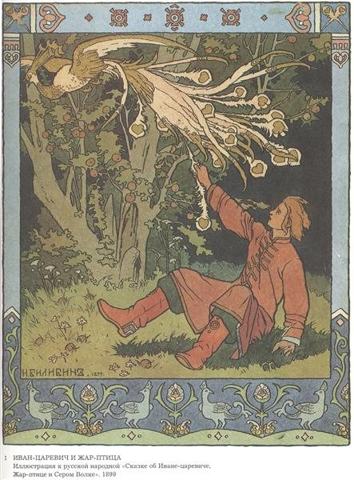
The glowing bird of Russian wonder tale whose single stolen feather starts a fatal quest — first collected by Afanasyev, later Stravinsky's ballet subject.
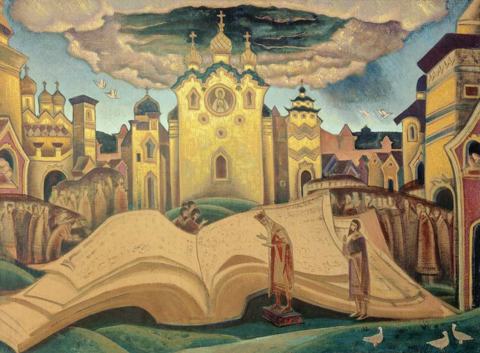
The "father of all stones" at the center of the world in Russian folk charms and the apocryphal Book of the Dove - a formula more than a place.
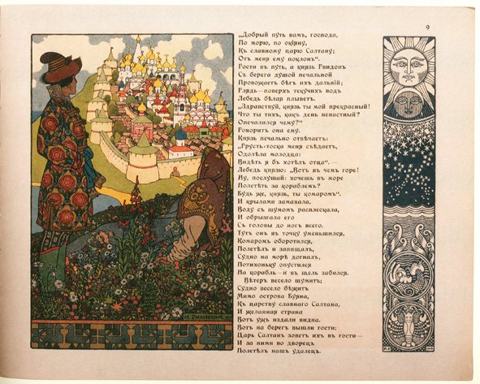
The magical island of Russian folk charm and fairy tale, home to the sacred stone Alatyr and, in wonder-tales, the hidden death of Koschei.
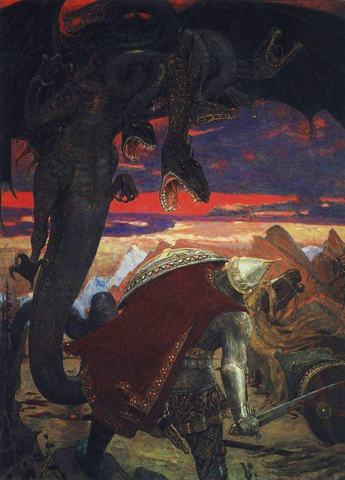
The many-headed dragon — the fire-breathing serpent of Russian epic song, met at a river crossing, and beaten only by a hero who refuses to stop swinging.
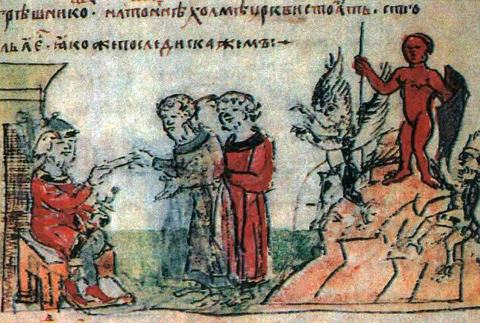
God of thunder and the striking bolt — the oak-crowned sky lord of the early Slavs, sworn by in treaties and thrown into the Dnieper at Rus' baptism.
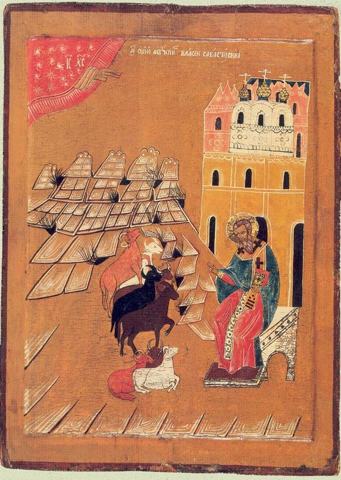
Lord of the cattle and the world below — the second god the Rus' swore by, whose name survived as a curse, a saint's herd, and a beard of grain in the field.
Also mentioned inIlya Muromets (Bogatyr Hero)Likho (One-Eyed Misfortune)
Sources & Further Reading
- 1.Afanasyev, Alexander. Narodnye russkie skazki (Russian Folk Tales), 1855-1863 - especially "Marya Morevna" and "Koschei the Deathless".
- 2.Ralston, W.R.S. Russian Folk-Tales. Smith, Elder & Co., 1873.
- 3.Propp, Vladimir. Morphology of the Folktale. Leningrad, 1928; English trans. Univ. of Texas Press, 2nd ed. 1968.
- 4.Propp, Vladimir. Istoricheskie korni volshebnoi skazki (Historical Roots of the Wondertale). Leningrad, 1946.
- 5.Uther, Hans-Jorg. The Types of International Folktales, ATU 302 "The Ogre's Heart in the Egg". Academia Scientiarum Fennica, 2004.
- 6.Haney, Jack V. An Introduction to the Russian Folktale. M.E. Sharpe, 1999.
- 7.Warner, Elizabeth. Russian Myths. British Museum Press, 2002.
- 8.Dixon-Kennedy, Mike. Encyclopedia of Russian and Slavic Myth and Legend. ABC-CLIO, 1998.
Spot an error or have a source to suggest? Write to info@viseterna.com. We cite primary sources and modern scholarship, and we correct fast.