
Jarilo (Yarilo)
A Slavic spring figure known mainly from 18th- and 19th-century peasant rituals, not medieval texts — his "godhood" is largely later reconstruction.
Snow Maiden (Snegurochka), Viktor Vasnetsov, 1899 · Public domain · source
A God Assembled from Rituals
Jarilo (also Yarilo, Yarylo) is not attested in any medieval chronicle, treaty, or missionary account. He appears in no pantheon list beside Perun and has no idol described by any hostile churchman. What exists instead is a body of Russian, Belarusian, and Ukrainian folk ritual, recorded almost entirely by ethnographers and clergy between the eighteenth and early twentieth centuries, describing a spring or early-summer festival centered on a figure of that name 2,4,5. Calling Jarilo a "god" at all is already an interpretive choice, projecting the status of a full deity onto what the direct evidence shows as a seasonal folk custom 4.
The name is on firmer ground than the figure: it derives from the Slavic root jar-, covering both "spring" and a fierce, burning vigor — the same root that gives Russian yaryi, "fierce" or "impassioned," and that recurs in the names of several other Slavic figures associated with heat, anger, or sexual force 3,5.
The Funeral of Yarilo
The best-documented Jarilo custom is his ritual death. Ethnographic accounts from Russian and Belarusian villages describe women, usually married rather than unmarried, fashioning a straw or wooden effigy of an old or dying man — sometimes with exaggeratedly male anatomy — carrying it through the village with mock mourning, and burying or destroying it outside the settlement, often to the accompaniment of laughter as much as lament 2,4. The rite was generally timed to the end of the spring cycle, around or shortly after the summer solstice, and was read by nineteenth-century folklorists as marking the point at which spring's fertilizing force had spent itself and given way to the ripening of the harvest 2,4.
One of the fullest surviving descriptions comes filtered through outrage rather than sympathy: Orthodox clergy in Voronezh recorded, and condemned, public Yarilo festivities there in the 1760s, complete with drinking, brawling, and a demonstratively phallic effigy paraded through the streets before its mock burial 2. Hostile as the source is, it is one of the more detailed eyewitness accounts of the custom in its full, unbowdlerized form, precisely because the writer found it worth denouncing in detail 2.
A Vegetation God, Not a War God
Where Jarilo does appear, his associations are consistent: young men and women, garlands, ripening grain, unrestrained sexuality, and a white horse in some regional variants — the whole complex pointing toward fertility and the fields rather than toward weapons or sworn oaths 3,4. Compare that with the 980 Kyivan pantheon of Perun, Dazhbog, and Stribog, gods of thunder, sun, and wind installed by a prince for political and martial reasons — Jarilo belongs to an entirely different register of belief, the agricultural and erotic folk calendar rather than the state cult 1,4.
Yarovit: A Different, Older God
A genuinely medieval figure is sometimes folded into Jarilo's story, and the two need to be kept apart. Yarovit (also Gerovit, Herovith) was a war god of the Polabian Slavs, worshipped at Wolgast and Havelberg, whose cult Herbord of Michelsberg describes directly: a golden shield hung in Yarovit's temple, forbidden to be touched except in wartime, and Herbord equates the god outright with Mars 1. Yarovit shares Jarilo's root — both come from jar- — and some scholars treat the names as reflexes of a single older figure who split, in different regions, into a war god in the west and a fertility figure in the east 3,4.
That connection is plausible rather than proven. Nothing in Herbord's account of Yarovit mentions spring rites, effigies, or fertility, and nothing in the Yarilo ethnography mentions war; the link rests on shared etymology and a general comparative instinct, not on any text that names them as the same being 1,4.
Reconstructing a Dying God
Twentieth-century comparative mythologists went further still, folding Jarilo into a hypothesized East Slavic "dying-and-rising" vegetation-god complex alongside Morana and the ritual figures Kupala and Kostroma, and sometimes proposing him as an aspect or son of Veles in a reconstructed cosmic myth involving Perun 4. This kind of synthesis, built from folk songs, seasonal ritual, and comparison with other Indo-European traditions, has been influential in popular accounts of Slavic religion — and is exactly the sort of confident reconstruction that Kalik and Uchitel warn rests on chains of inference rather than on attested pre-Christian sources 4.
What Jarilo Is Today
Jarilo's afterlife is largely a modern one. The nineteenth-century Russian playwright Alexander Ostrovsky and, after him, the composer Nikolai Rimsky-Korsakov made him the offstage Sun God whose wrath drives the plot of The Snow Maiden, transforming a village ritual figure into a full operatic deity — itself a striking example of literary elaboration outpacing evidence 3,4. Contemporary Rodnover and neo-pagan movements have carried that elaboration further, treating Jarilo as a settled member of a reconstructed pantheon. The honest summary sits well short of that: a real and richly documented folk custom, a plausible but unproven link to a genuine medieval war god, and a "god" who owes much of his current shape to eighteenth-century peasants, nineteenth-century scholars, and a nineteenth-century stage 2,3,4.
Continue Exploring
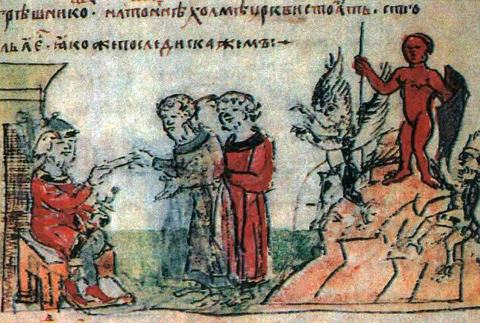
God of thunder and the striking bolt — the oak-crowned sky lord of the early Slavs, sworn by in treaties and thrown into the Dnieper at Rus' baptism.
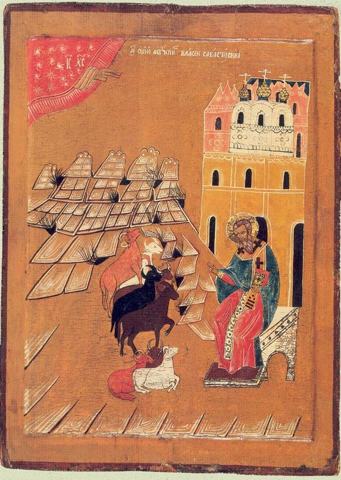
Lord of the cattle and the world below — the second god the Rus' swore by, whose name survived as a curse, a saint's herd, and a beard of grain in the field.
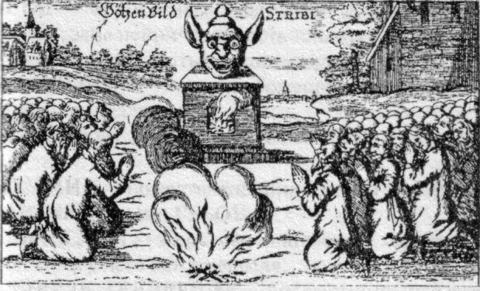
Wind god of the pagan Kyivan pantheon, remembered in the Tale of Igor's Campaign as the ancestor whose grandsons are the winds themselves.
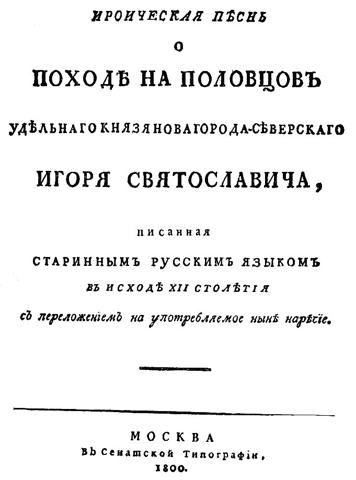
Sun god of the Kyivan pantheon and, in the Tale of Igor's Campaign, the mythical ancestor of the Rus' people themselves.
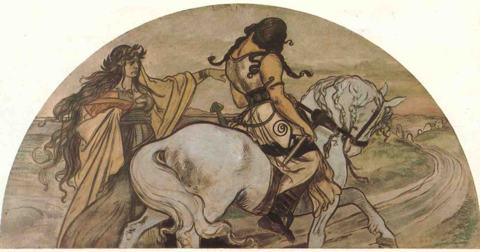
Slavic winter-and-death figure, drowned in effigy every spring. The rite is documented from 1420; whether a real goddess stood behind it is debated.
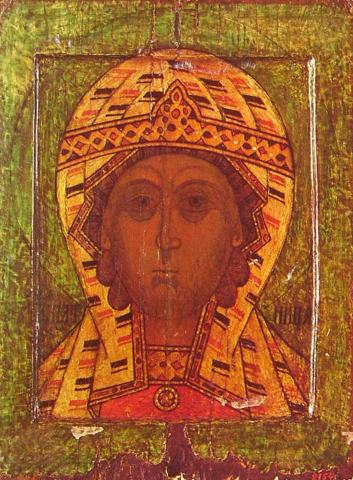
Mother of the damp earth and the spun thread — the only goddess on Vladimir's hill, who outlived her own cult as a night spirit and as Saint Friday.
Sources & Further Reading
- 1.Herbord of Michelsberg, Dialogus de Vita Ottonis Episcopi Bambergensis (c. 1158).
- 2.Ivanits, Linda J. Russian Folk Belief. M.E. Sharpe, 1989.
- 3.Machal, Jan. Slavic Mythology, in The Mythology of All Races, vol. III. Marshall Jones, 1918.
- 4.Kalik, Judith & Alexander Uchitel. Slavic Gods and Heroes. Routledge, 2019.
- 5.Dixon-Kennedy, Mike. Encyclopedia of Russian and Slavic Myth and Legend. ABC-CLIO, 1998.
Spot an error or have a source to suggest? Write to info@viseterna.com. We cite primary sources and modern scholarship, and we correct fast.