
Likho (One-Eyed Misfortune)
The one-eyed embodiment of misfortune in Slavic folk tale, blinded and evaded in a story that runs remarkably close to Homer's Polyphemus.
Odysseus and Polyphemus, Arnold Böcklin, 1896 · Public domain · source
An Old Word for Bad Luck
In modern Russian and Ukrainian, likho is simply a noun for misfortune, calamity, or evil in the abstract - it survives in everyday phrases warning against provoking bad luck that has not yet noticed you, close in spirit to "let sleeping dogs lie" 5,6. Folk belief personified the abstraction into an actual being: a monstrous embodiment of one's own ill fortune that a person could, in the logic of the wonder-tale, physically meet, outwit, or maim 5,6. Etymologists connect the word to an old root meaning "excessive" or "odd," as opposed to an even, balanced number, which fits a figure defined by being one too many or one short - most visibly in the single eye that gives the being its standard epithet, odnoglazoe, "one-eyed" 5.
What Likho Looks Like
Descriptions are not fixed the way a god's cult image would be, because Likho belongs to wonder-tales rather than to any reported cult: there is no medieval chronicle mention, no missionary sermon condemning "Likho-worship," and no archaeological trace, and everything known comes from stories collected by folklorists from the nineteenth century onward 5,6. Most versions describe a gaunt, one-eyed old woman dressed in black, sometimes gigantic, living alone in a hut or cave at the forest's edge; a smaller set of regional variants instead makes Likho a one-eyed male forest goblin, closer in size and territory to the leshy 5. What holds constant across the variation is the single eye and the basic role: whoever meets Likho meets their own bad luck given a body and an address 5,6.
The Man Who Confronts Misfortune
The best-known tale, recorded by Alexander Afanasyev in his nineteenth-century collection of Russian folk tales, gives Likho a plot that runs remarkably close to Polyphemus and Odysseus in Homer's Odyssey, without either story owing the other anything directly 1,2,3. A craftsman - a blacksmith in the most common telling - has already lost everything he owns and decides, having nothing left to lose, to go looking for Likho on purpose rather than wait to be found. He is taken in for the night at Likho's hut, along with other unlucky travelers, and Likho, one-eyed and enormous, begins picking off the guests one by one to eat. The smith waits until Likho sleeps, heats an awl or a spit in the fire, and drives it into the single eye, blinding the monster exactly as Odysseus blinds Polyphemus with a fire-hardened stake 1,2,3. Likho, roaring and groping at the doorway, feels only the backs of the household's sheep as the smith and the surviving guests slip out disguised in sheepskins - the identical trick, down to the detail of counting bodies by touch alone, that lets Odysseus's men escape Polyphemus's cave under his rams 1,2,3.
A Tale Older Than the Telling
Folklorists classify the story as tale type ATU 1137, "The Ogre (Devil) Blinded," a pattern the standard international index traces across Greek, Caucasian, Balkan, Baltic, and Slavic tradition, with the Russian Likho tale as one of its best-attested Eastern European representatives 3. The resemblance to Polyphemus is genuinely striking and has been noted since the earliest comparative folklorists began cataloguing Eurasian tale types, but the scholarly consensus treats it as convergent transmission across a very old and widely traveled story-pattern, not evidence that Russian peasants had read Homer or that the Odyssey borrowed from the Slavic east 3,4. Ralston's nineteenth-century survey of Russian wonder-tales already places this cluster of ogre stories inside a broader comparative frame, reading them as evidence of how far a single tale-type could travel while individual details - the weapon, the disguise, the number of sheep - stayed remarkably stable 4.
Not a Cult, a Caution
What distinguishes Likho from a demoted pagan deity, in the way some popular writing likes to frame every Slavic monster, is the total absence of any older layer beneath the story. Unlike Veles or Perun, condemned by name in medieval sermons, Likho appears in no list of idols and prompted no missionary complaint; on the evidence available it is a folk-tale figure and a piece of everyday language before it is anything else, closer in kind to Koschei the wondertale villain than to a fallen god 5,6. That has not stopped the figure from surviving where the gods did not: the word for bad luck still walks through Russian and Ukrainian conversation every day, needing no temple to keep it alive 6.
Continue Exploring
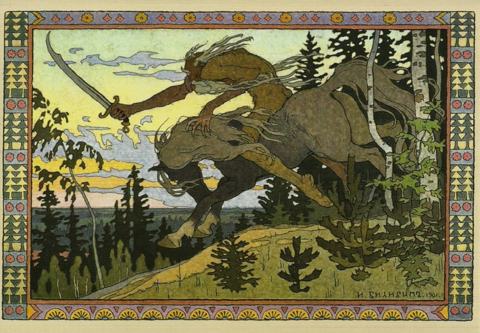
The undying sorcerer of Russian folktale who hid his death in a needle, inside an egg, inside a duck, inside a hare, inside a chest, beneath an oak.
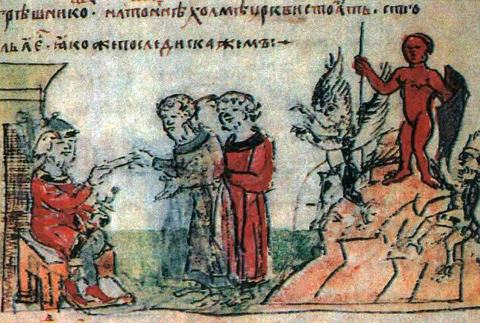
God of thunder and the striking bolt — the oak-crowned sky lord of the early Slavs, sworn by in treaties and thrown into the Dnieper at Rus' baptism.
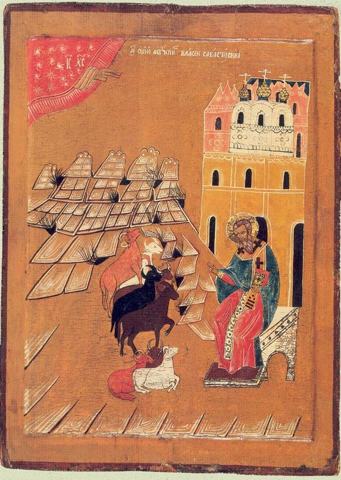
Lord of the cattle and the world below — the second god the Rus' swore by, whose name survived as a curse, a saint's herd, and a beard of grain in the field.
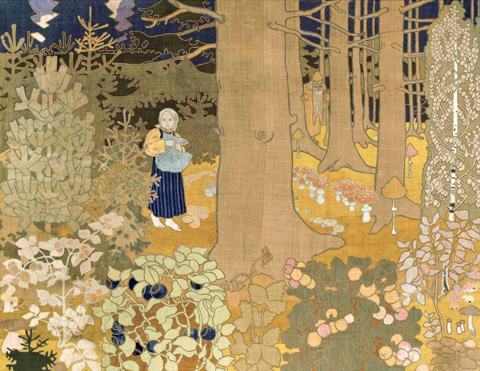
The Slavic forest lord who leads travellers in circles, owns the wolves and the game, and can stand taller than the pines or shorter than the grass.
The many-headed dragon — the fire-breathing serpent of Russian epic song, met at a river crossing, and beaten only by a hero who refuses to stop swinging.
Slavic water spirit of the restless dead: a drowned or unbaptised girl who leaves the river for one week each summer to walk the fields and the woods.
Sources & Further Reading
- 1."Likho odnoglazoe" (One-Eyed Likho), in Afanasyev, Alexander. Narodnye russkie skazki (Russian Folk Tales), 1855-1863.
- 2.Haney, Jack V., trans. and ed. An Anthology of Russian Folktales. Routledge, 2014.
- 3.Uther, Hans-Jorg. "The Types of International Folktales: A Classification and Bibliography." Folklore Fellows' Communications 284-286. Suomalainen Tiedeakatemia, 2004.
- 4.Ralston, W. R. S. Russian Folk-Tales. Smith, Elder & Co., 1873.
- 5.Dixon-Kennedy, Mike. Encyclopedia of Russian and Slavic Myth and Legend. ABC-CLIO, 1998.
- 6.Ivanits, Linda J. Russian Folk Belief. M.E. Sharpe, 1989.
Spot an error or have a source to suggest? Write to info@viseterna.com. We cite primary sources and modern scholarship, and we correct fast.