
The Zbruch Idol
A carved limestone pillar recovered from the Zbruch river in 1848, popularly called Svetovid - though some scholars now argue it may be a 19th-century fake.
The Zbruch Idol, limestone, Archaeological Museum, Krakow · Public domain · source
Found in a Drought
In August 1848, an unusually low water level in the Zbruch river, on what was then the border between Austrian Galicia and the Russian Empire, exposed a carved stone pillar near the village of Lychkivtsi 3. The prevailing explanation is that the river had shifted course at some earlier point, submerging an object that had been deliberately taken down and disposed of, most likely during the Christianization of the surrounding region, rather than lost by accident 3,4. The find quickly attracted Polish and Ukrainian antiquarian attention, and within decades it was the single most reproduced image in every survey of Slavic paganism 1,7.
Reading the Stone
The idol is a limestone shaft roughly 2.67 metres tall, carved on all four faces and divided into three horizontal registers 3. At the top, each face carries a separate figure wearing a single shared conical cap, one of them holding a small ring-shaped object read by most students as a drinking horn; a narrower middle band shows four smaller figures with joined, interlocking arms running around the shaft; and the lowest register carries a single large kneeling figure, its arms raised as though bracing the whole structure from beneath 2,3. The three-tier division is usually read as a schematic cosmology — an upper register of gods, a middle band of the human world, and a bearing figure below standing for the underworld — though this reading is an inference from the carving's layout, not something the stone itself explains 3,7.
Svetovid, or Four Gods, or Neither
The earliest serious study, Aleksandr Famintsyn's 1884 survey of Slavic deities, identified the pillar with Svetovid, the four-headed god Saxo Grammaticus describes at Arkona on Rügen, and Gabriel Lenczyk's mid-twentieth-century study of the idol reinforced that identification while adding a solar reading of some of its carved bands 1,2. The comparison is visually obvious — four faces under one cap or crown — but geographically awkward: Svetovid belonged to the West Slavic Rani on the Baltic, while the Zbruch Idol was recovered deep in East Slavic territory with no textual link connecting the two traditions 2,6. Boris Rybakov rejected the single-god reading outright, arguing in his 1987 study of Rus' paganism that the four upper figures represent four separate deities — he proposed Perun, Mokosh, Dazhbog, and Veles among the candidates — carved together on one shaft rather than four faces of a single being 3. Neither reading commands full consensus, and Gieysztor's survey of Slavic mythology presents the identity of the carved figures as an open question rather than a settled fact 3,6.
The Bohit Question
Field archaeology gave the idol a plausible original context decades after its discovery. Irina Rusanova and Boris Timoshchuk's excavations, published in full only in 2007, identified a fortified hilltop sanctuary at Bohit, near the idol's find spot on the Zbruch, with cult platforms and evidence of continued ritual use into the twelfth or thirteenth century — a site the excavators argued could plausibly have held the idol before its removal 4. That fieldwork gave the authenticity case its strongest physical support: a genuine, excavated cult landscape in the right place and period, rather than an isolated stone with no archaeological context at all 4.
Is It Even Genuine?
The idol's authenticity was rarely questioned for a century and a half, but that consensus broke in 2011. Aleksey Komar and Natalia Khamaiko published a detailed reassessment arguing the pillar's carving style, its unusually good preservation, and its suspiciously close visual match to Saxo's literary description of Svetovid are more consistent with a nineteenth-century Romantic-era production, possibly connected to the antiquarian and poet Tymon Zaborowski, than with genuine pre-Christian workmanship 5. Their argument has not displaced the traditional dating, and specialists remain divided: Rusanova and Timoshchuk's Bohit fieldwork is frequently cited against the forgery hypothesis, while Komar and Khamaiko's stylistic objections have not been fully answered either 3,4,5. Readers should treat the idol's date as genuinely contested rather than settled in either direction 5,7.
From Riverbed to Museum Hall
The idol passed through private and academic hands in Poland before entering the Archaeological Museum in Kraków, where it remains on permanent display, with plaster and resin replicas distributed to museums across Poland and Ukraine 2,7. It has become the default visual shorthand for "Slavic paganism" in textbooks, tourism, and popular culture far beyond what the thin, contested evidence about its date and meaning can really support, and it is now also a recurring symbol for modern Rodnover and neo-pagan movements who treat the Rybakov or Svetovid readings as settled fact rather than as two of several competing scholarly hypotheses 6,7.
Continue Exploring
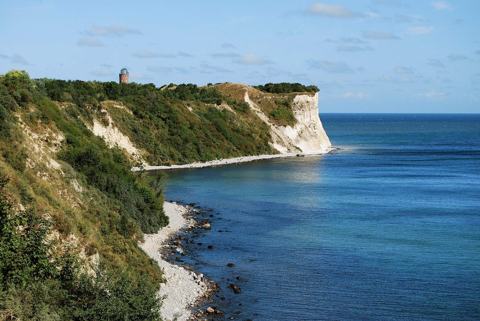
A Rugian temple-fortress with the best-documented pagan cult in the Slavic world - and the site of its most precisely dated destruction, in 1168.
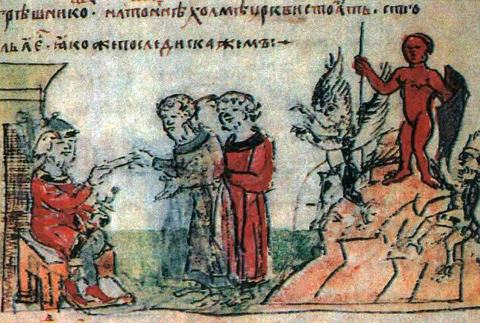
God of thunder and the striking bolt — the oak-crowned sky lord of the early Slavs, sworn by in treaties and thrown into the Dnieper at Rus' baptism.
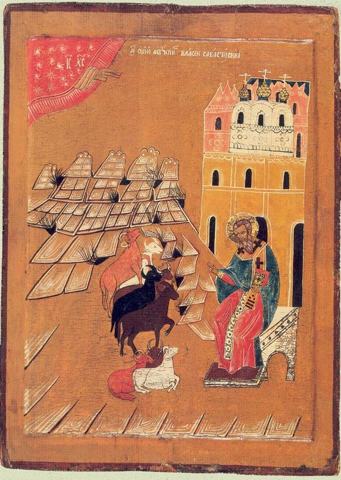
Lord of the cattle and the world below — the second god the Rus' swore by, whose name survived as a curse, a saint's herd, and a beard of grain in the field.
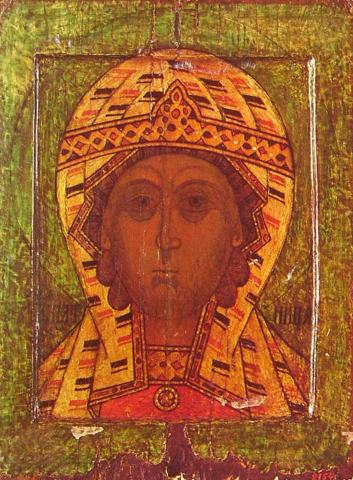
Mother of the damp earth and the spun thread — the only goddess on Vladimir's hill, who outlived her own cult as a night spirit and as Saint Friday.
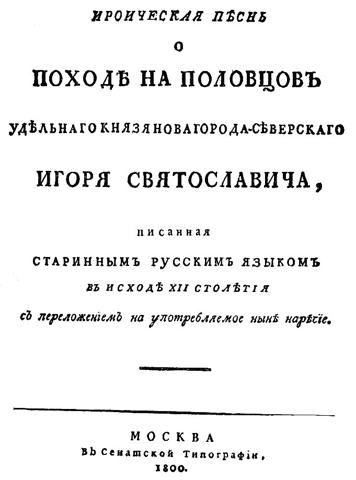
Sun god of the Kyivan pantheon and, in the Tale of Igor's Campaign, the mythical ancestor of the Rus' people themselves.
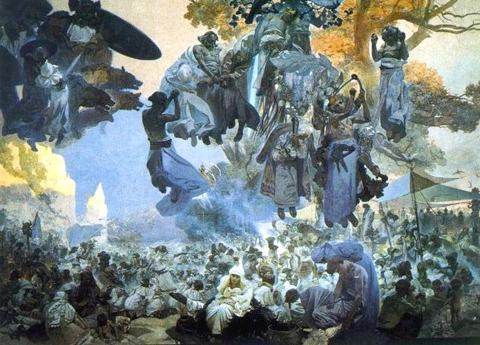
Four-headed war-oracle god of the Rugian Slavs at Arkona, described in unmatched detail by Saxo Grammaticus before Danes destroyed his temple in 1168.
Sources & Further Reading
- 1.Famintsyn, Aleksandr S. Bozhestva drevnikh slavyan (Deities of the Ancient Slavs). St Petersburg, 1884.
- 2.Lenczyk, Gabriel. "Swiatowid zbruczanski." Materialy Archeologiczne, 1964.
- 3.Rybakov, Boris A. Yazychestvo Drevney Rusi (Paganism of Ancient Rus). Moscow, 1987.
- 4.Rusanova, Irina P. & Boris A. Timoshchuk. Yazycheskie svyatilishcha drevnikh slavyan (Pagan Sanctuaries of the Ancient Slavs). Moscow, 2007.
- 5.Komar, Aleksey & Natalia Khamaiko. "Zbruchsky idol: pamyatnik epokhi romantizma?" (The Zbruch Idol: A Monument of the Romantic Era?). Ruthenica X, 2011, pp. 166-217.
- 6.Gieysztor, Aleksander. Mitologia Slowian. Wydawnictwa Artystyczne i Filmowe, 1982.
- 7.Dixon-Kennedy, Mike. Encyclopedia of Russian and Slavic Myth and Legend. ABC-CLIO, 1998.
Spot an error or have a source to suggest? Write to info@viseterna.com. We cite primary sources and modern scholarship, and we correct fast.