
Lada (Slavic Goddess)
Popularly the Slavic goddess of love, spring and marriage. Most Slavists think she began as a song refrain misread as a divine name.
Lada, Sergey Konenkov, 1909 (State Tretyakov Gallery, Moscow); photograph by Shakko, 2014 · CC BY-SA 4.0 · source
The Popular Picture
In almost every modern retelling of Slavic myth, Lada is the goddess of love, beauty, marriage and the returning spring — often paired with a male counterpart, Lado, and given a son or brother named Lel. She is one of the most recognisable names in the popular Slavic pantheon, and one of the least secure. Before going further it is worth saying plainly what the scholarship says: the majority of Slavists regard Lada as a name that entered the pantheon by accident, not by inheritance 4,5,7.
Where the Name Actually Appears
The earliest documents that mention anything like Lada are not myths but sermons and church prohibitions from early fifteenth-century Poland. Preachers complained about villagers singing and dancing at Whitsun to words they transcribed as Alado, Lado, Yassa, Yleli and Tya, and diocesan statutes associated with Poznań in 1420 forbade those songs outright 1,2.
Crucially, the clerics who recorded these syllables did not agree on what they were. Some of them treated the words as the names of demons or idols; others simply described them as heathen noise sung by drunken women 1,2,4. Then, a generation or two later, Jan Długosz built a tidy Polish pantheon in his Annales, and there the syllables became gods with departments — a system that reads suspiciously like Roman mythology dressed in Polish 3,4.
The Refrain Argument
The sceptical case, argued most forcefully by Aleksander Brückner around the turn of the twentieth century, is straightforward. Lada, lado, lelum polelum and their cousins are ordinary Slavic song vocabulary — meaningless or near-meaningless refrain syllables, the equivalent of "fa la la", still sung in wedding and midsummer songs across the Slavic world. The Proto-Slavic root ladъ means order, harmony, agreement; lada is attested in living speech simply as a term of endearment for a spouse or beloved 4,7.
On this reading, a fifteenth-century cleric heard a spring song whose chorus ran "oh lado, lado", assumed the peasants were calling on an idol, and wrote it down as one. Długosz then inherited the note and gave the idol a job description. Brückner extended the same argument to Jassa, Nyja, Dziewanna and much of the rest of the Polish list 4. Jan Máchal, surveying the material in 1918, reached a similarly cautious verdict 5.
The Case for the Defence
Not everyone agrees. Soviet-era scholarship, above all Boris Rybakov, argued for a genuine and very old goddess — Rybakov reconstructed Lada as one half of a pair of divine birth-mothers alongside a daughter Lelya, tied to spring rites, and read her back into prehistoric imagery 6. Ukrainian and Russian ethnographic tradition also records Lada's name in a wide belt of ritual songs, and the Encyclopedia of Ukraine notes that the name is embedded in seasonal song cycles far beyond the reach of any single Polish chronicler 8.
Rybakov's method, however, has been widely criticised for reading modern folklore back into archaeological material without an intervening chain of evidence, and few Western Slavists follow his reconstruction in detail 4,7. Andrzej Szyjewski treats Lada as, at best, an open question: possible as a local or regional figure, unproven as a pan-Slavic goddess 7.
Why It Matters
The Lada problem is a useful lesson for anyone reading about Slavic religion. The Slavs left no scripture, no Edda, no Homer. Nearly everything we have comes from three kinds of witness: hostile Christian clergy writing centuries after conversion, chroniclers filling gaps with classical analogy, and folklorists collecting songs eight hundred years downstream of paganism 4,5,7.
Some Slavic gods survive that filter with real credentials — Perun is attested in oath formulas in tenth-century Rus treaties, Veles stands opposite him in the same texts, and Mokosh appears in the Kievan idol list 5,7. Lada does not. She belongs to the second tier: names that may be real, but that first reach us already mediated by someone who was guessing.
Lada in Modern Culture
None of this has slowed her down. Nineteenth-century Romantic nationalism embraced Lada enthusiastically as a Slavic Venus; Sergey Konenkov carved her in 1909; contemporary Rodnovery (Slavic native faith) communities honour her as a major goddess with a full seasonal calendar. The name is attached to festivals, choirs and, famously, a Soviet car marque 6,7.
That afterlife is genuine culture, and worth recording as such. It simply is not evidence of a pre-Christian goddess. Where a spring counterpart is wanted with firmer documentation, the seasonal opposite of Morana — the winter effigy drowned every year — rests on a rite that church authorities were complaining about in writing, which is more than can be said for Lada's biography 2,7.
Continue Exploring
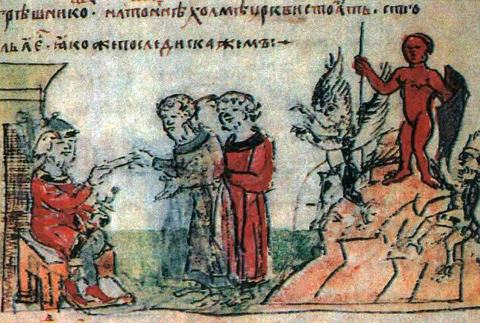
God of thunder and the striking bolt — the oak-crowned sky lord of the early Slavs, sworn by in treaties and thrown into the Dnieper at Rus' baptism.
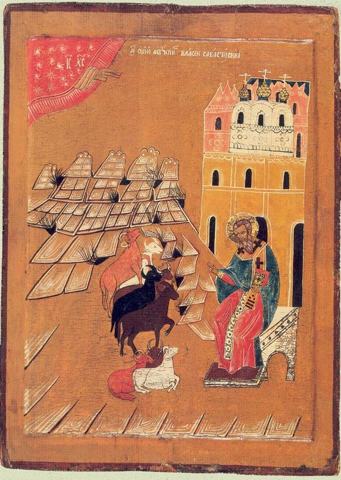
Lord of the cattle and the world below — the second god the Rus' swore by, whose name survived as a curse, a saint's herd, and a beard of grain in the field.
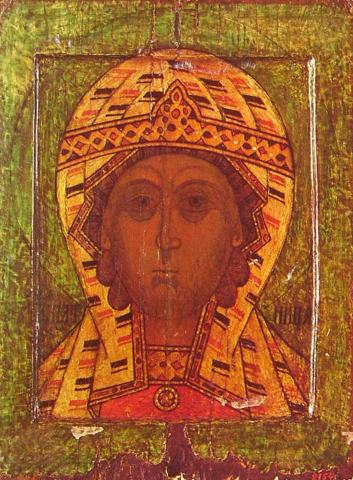
Mother of the damp earth and the spun thread — the only goddess on Vladimir's hill, who outlived her own cult as a night spirit and as Saint Friday.
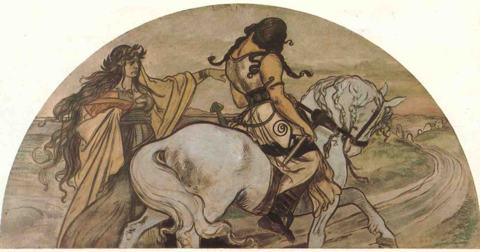
Slavic winter-and-death figure, drowned in effigy every spring. The rite is documented from 1420; whether a real goddess stood behind it is debated.
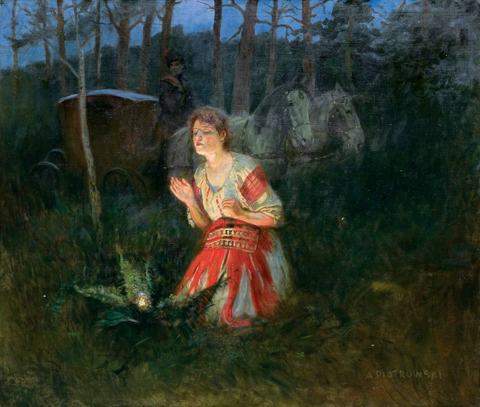
Slavic midsummer's eve of bonfires, floating flower wreaths and the legend of a fern that blooms once a year - grafted onto the feast of St John the Baptist.
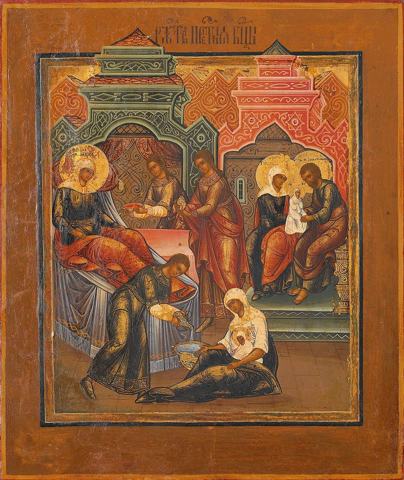
A name condemned in medieval Russian sermons alongside birth-spirits called the rozhanitsy - read by some as a supreme creator god, by others as no god at all.
Sources & Further Reading
- 1.Sermons of Lucas of Wielki Kozmin and related Polish preaching texts (c. 1405-1412) condemning festival songs invoking "Alado" and similar names.
- 2.Statutes of the Synod of Poznan (1420) and other Polish diocesan bans on Whitsun songs naming Lado, Yleli, Yassa and Tya.
- 3.Jan Dlugosz, Annales seu cronicae incliti Regni Poloniae, Book I (written c. 1455-1480).
- 4.Bruckner, Aleksander. Mitologia slowianska i polska. Warsaw, 1918/1924 (repr. PWN, 1980).
- 5.Machal, Jan. Slavic Mythology, in The Mythology of All Races, vol. III. Marshall Jones, 1918.
- 6.Rybakov, Boris. Yazychestvo drevnikh slavyan (The Paganism of the Ancient Slavs). Nauka, 1981.
- 7.Szyjewski, Andrzej. Religia Slowian. Wydawnictwo WAM, 2003.
- 8.Encyclopedia of Ukraine, "Lada". Canadian Institute of Ukrainian Studies.
Spot an error or have a source to suggest? Write to info@viseterna.com. We cite primary sources and modern scholarship, and we correct fast.