
Zmey, the Slavic Dragon
The many-headed dragon — the fire-breathing serpent of Russian epic song, met at a river crossing, and beaten only by a hero who refuses to stop swinging.
Dobrynya Nikitich's Fight with the Seven-Headed Zmey Gorynych, Russian lubok print · Public domain · source
Serpent, Snake, Dragon
The Slavic word is simply the word for snake with a masculine ending: Russian zmey, Ukrainian zmiy, Serbian and Croatian zmaj, Polish żmij, all from the same root as zemlya, the earth 6. A zmey is therefore an earth-serpent before it is anything else, and the flying, fire-breathing, multi-headed version is what the folklore made of it 4,6.
The famous Russian form is Zmey Gorynych, whose second name is a patronymic built on gora, "mountain," so he is the serpent son of the mountain, or of the mountains he lives in 1,4. He has three heads as a default and six, nine, or twelve in escalating variants; he breathes fire, flies, carries off women, demands tribute from villages, and guards a hoard 1,2.
Dobrynya at the Puchai River
The oldest well-recorded Russian dragon narrative is a bylina, one of the sung heroic epics collected from peasant singers in the far north in the eighteenth and nineteenth centuries 1. In it, Dobrynya Nikitich ignores his mother's warning and swims in the Puchai river; the serpent falls on him while he is naked and unarmed, and he beats it off with a cap of Greek earth filled with sand, then spares it on terms — it will stop raiding Rus', and he will stop hunting it 1.
The serpent breaks the truce immediately and carries off Zabava Putyatichna, niece of Prince Vladimir 1. Dobrynya rides to the mountains and fights for three days; when he is ready to give up, a voice from the sky tells him to fight three hours more, and he kills it 1. Then comes the detail that makes the song strange and memorable: the serpent's blood floods the ground and refuses to soak away for three days, until the hero commands the damp mother earth to open and drink it 1,4.
Tugarin and the Serpent-Knights
The epics also produce a half-human version. Tugarin Zmeevich, "Tugarin son of the Serpent," is the enemy of Alyosha Popovich: a huge, gluttonous figure who flies on paper wings, is received at Vladimir's table, and behaves so grossly at the feast that the hero picks a fight with him and kills him in the field 1. Historians have long connected the name to Tugorkan, an eleventh-century Polovtsian khan, which would make the serpent an enemy nation given a monstrous shape 1,4.
That is the pattern in Russian epic generally. The dragon and the steppe raider blur into each other, and the songs were sung by people whose ancestors had genuinely been carried off in raids 1,4.
The Bridge Over the Smorodina
The wondertales work differently. There the hero — often Ivan — meets the serpent at the Kalinov bridge over the river Smorodina, a crossing that folklorists read as a boundary between the world of the living and the world of the dead, and fights successive dragons of three, six, nine, and twelve heads on consecutive nights 2,5.
The heads are the mechanism of the story. Struck off, they grow back unless the stumps are dealt with — burned, or prevented from rejoining — and in many variants the dragon has a "fiery finger" it uses to reattach them, which the hero must cut away first 2. Afterwards the dragon's mother or wife pursues the hero in a new shape, as a well, an apple tree, or a bed, each offering something the traveller wants and each fatal to accept 2.
Saint George on the Horse
Christianity supplied the other great Slavic dragon image. The Miracle of St George and the Dragon circulated widely in Old Russian redactions: a serpent by a lake exacts a child in tribute, the king's daughter is next, and George arrives, subdues it with the sign of the cross and the spear, and has the princess lead it into the city on her girdle before it is killed and the people baptised 3.
The icon type — the rider on a white horse, spear angled down into the serpent's mouth — became one of the most reproduced images in Russian religious art and eventually the emblem of Moscow 3,4. In the countryside George also absorbed the older role of guardian of cattle and of the spring pasture opening, and Ivanits documents the layered result: a saint who is at once a martyr, a dragon-slayer, and the man you invoke before letting the herd out in April 4.
Dragons Who Are Not Enemies
South Slavic tradition keeps a version that Russian folklore mostly lost. In Serbian, Bulgarian, and Macedonian belief the zmaj can be a protector: a local dragon who defends his own district's fields and rain against the ala or hala, the storm demon that brings hail and drags the clouds away, with the two fighting overhead during a summer storm 6. Heroes of the epic songs are given dragon parentage as a mark of superhuman quality, and Vuk Grgurević is remembered in song as Zmaj Ognjeni Vuk, "Vuk the Fiery Dragon" 6.
The same word therefore covers a village's champion in the south and the abductor of princesses in the north, which is a reminder that "the Slavic dragon" is a convenience rather than a single creature 6.
The Storm-Myth Question
Because the dragon steals water, cattle, and women, and because a thunder god strikes serpents, the zmey is frequently presented as the folkloric survival of a pre-Christian myth in which Perun pursues Veles across the sky 5. That reconstruction, assembled by Ivanov and Toporov from charms, songs, and comparative Indo-European material, is coherent and widely repeated 5.
It is also unattested. No medieval Slavic source records the duel, and the folklore that supposedly preserves it was collected eight centuries after Christianisation, in a landscape saturated with Saint George, Saint Elijah, and Byzantine hagiography 5,6. Kalik and Uchitel argue that a great deal of the reconstructed Slavic pantheon rests on inference of exactly this kind 6. The dragon-slaying pattern is genuinely international — the folktale type is found from Ireland to India — and a Russian singer in 1870 did not need a pagan inheritance to produce it 1,6.
What is documented is a superb body of song and story: a serpent at a river crossing, a hero with the wrong equipment, blood the earth will not absorb, and heads that keep coming back 1,2.
Continue Exploring
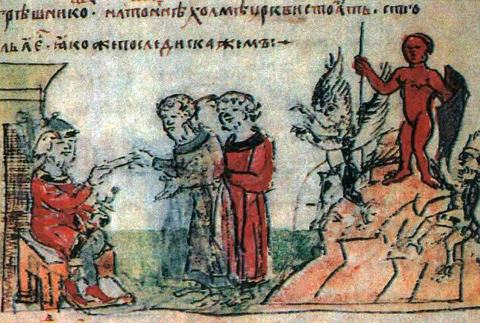
God of thunder and the striking bolt — the oak-crowned sky lord of the early Slavs, sworn by in treaties and thrown into the Dnieper at Rus' baptism.
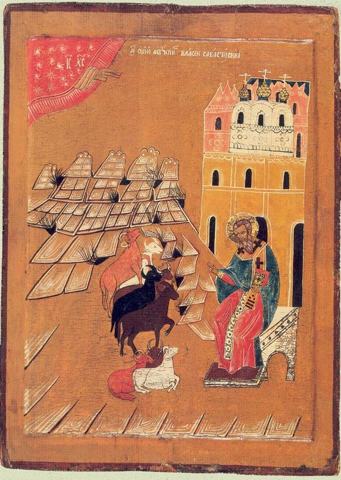
Lord of the cattle and the world below — the second god the Rus' swore by, whose name survived as a curse, a saint's herd, and a beard of grain in the field.
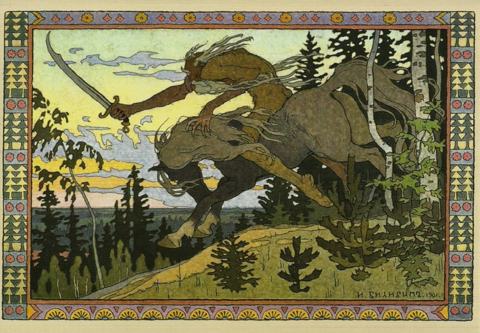
The undying sorcerer of Russian folktale who hid his death in a needle, inside an egg, inside a duck, inside a hare, inside a chest, beneath an oak.
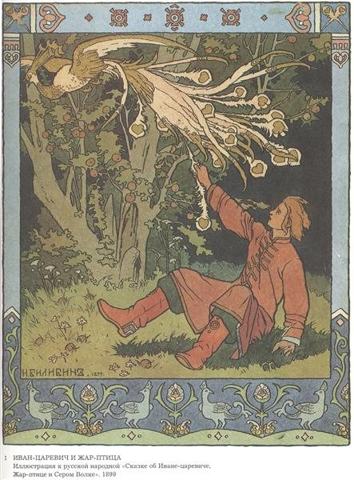
The glowing bird of Russian wonder tale whose single stolen feather starts a fatal quest — first collected by Afanasyev, later Stravinsky's ballet subject.
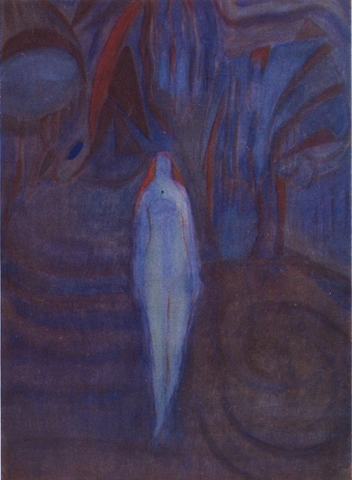
The beautiful, dangerous fairy-women of South Slavic mountains and epic song — healers, archers and shapeshifters, distinct from the East Slavic rusalka.
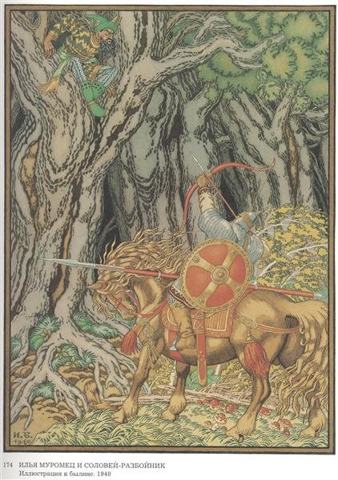
The paralysed peasant's son of Murom who rose from the stove to become Russia's greatest epic hero, and shot down the monstrous Nightingale the Robber.
Also mentioned inDobrynya Nikitich (Bogatyr Hero)
Sources & Further Reading
- 1.Byliny of Dobrynya Nikitich and the Serpent, in Bailey, James & Tatyana Ivanova (trans.). An Anthology of Russian Folk Epics. M.E. Sharpe, 1998.
- 2.Afanasyev, Alexander. Narodnye russkie skazki (Russian Folk Tales), 1855–1863.
- 3.The Miracle of St George and the Dragon (Chudo Georgiia o zmie), Old Russian redactions.
- 4.Ivanits, Linda J. Russian Folk Belief. M.E. Sharpe, 1989.
- 5.Ivanov, V. V. & V. N. Toporov. Issledovaniia v oblasti slavianskikh drevnostei. Nauka, Moscow, 1974.
- 6.Kalik, Judith & Alexander Uchitel. Slavic Gods and Heroes. Routledge, 2019.
Spot an error or have a source to suggest? Write to info@viseterna.com. We cite primary sources and modern scholarship, and we correct fast.