
The Primary Chronicle (Tale of Bygone Years)
The founding chronicle of Kyivan Rus', c. 1113 - the only narrative source for Vladimir's pagan pantheon of 980 and its fall eight years later.
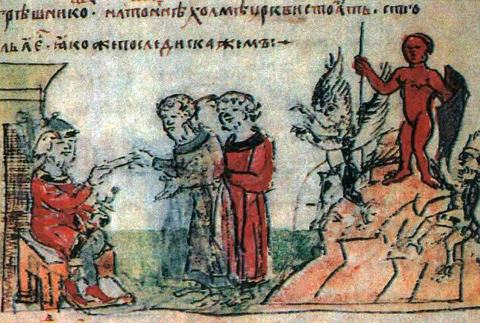
The killing of the Varangian Theodor and his son, miniature from the Radzivill Chronicle, late 15th-century copy of a 13th-century original · Public domain · source
What It Is
The Primary Chronicle — Church Slavonic Povest' vremennykh let, usually translated The Tale of Bygone Years — is the founding historical narrative of Kyivan Rus', a year-by-year account running from a legendary ninth-century past up to the second decade of the twelfth century 1,2. It is not one thing written once. What survives is a compilation, apparently assembled and revised in Kyiv in stages around 1113, 1116, and 1118, weaving together earlier annals, monastic records, oral legend, treaty documents, and borrowed Byzantine material into a single continuous story of how Rus' came to be and how it became Christian 2,4. Tradition credits the monk Nestor of the Kyiv Caves Monastery as author; modern scholarship treats that attribution as unreliable and looks instead to an anonymous process of compilation, possibly finished by Sylvester, abbot of St Michael's Monastery, around 1116 1,2.
The Manuscripts
No copy from the chronicle's own century survives. The earliest complete witness is the Laurentian Codex, copied by the monk Laurentius in 1377 for the Prince of Suzdal, now held in the National Library of Russia 1. A second major branch, the Hypatian Codex, was copied roughly half a century later and preserves a longer, sometimes divergent text, particularly for the chronicle's final years 1,2. A third, the richly illustrated Radziwill Chronicle, copied around 1500, adds several hundred colored miniatures to the same underlying narrative, including the scene of the killing of the Varangian martyr Theodor and his son reproduced here 1. None of the three simply copies another; all three descend, with real differences, from a lost common original, which is exactly what makes reconstructing "the" Primary Chronicle a textological puzzle rather than a matter of opening a book 2,3.
Vladimir's Pantheon of 980
The chronicle's single most quoted religious passage falls under the year 980. Before his conversion, Prince Vladimir Sviatoslavich is said to have set up a state pantheon on a hill outside his palace in Kyiv: an idol of Perun with a silver head and a golden mustache, and beside him Khors, Dazhbog, Stribog, Simargl, and Mokosh 1,4,5. No other source lists these six names together, and no other source claims a Rus' prince deliberately assembled a state cult out of gods drawn from different regional and even different ethnic traditions — Khors and Simargl are generally read as Iranian loanwords, not native Slavic names 4. The chronicle also records, immediately after, the killing of a Christian Varangian and his son by a pagan mob in 983, the closest thing the text offers to an eyewitness account of the cult it describes 1.
Toppling Perun, 988
The same chronicle gives the pantheon's ending in comparably vivid, and comparably unverifiable, detail. After sending envoys to investigate Islam, Latin Christianity, Judaism, and Byzantine Orthodoxy — the famous "testing of the faiths," in which the ambassadors returning from Constantinople report they no longer knew whether they stood on earth or in heaven — Vladimir accepts Byzantine baptism around 988 and orders Kyiv's idols destroyed 1,4. Perun's image is tied to a horse's tail, dragged down to the Dnieper while beaten with sticks, and thrown in the river, with men posted along the bank to push it past the rapids and out of the city 1. Whether this happened as narrated, or was shaped a century later into an origin story fit for a newly Christian dynasty, cannot be settled from the text alone 4,5.
More Than a Chronicle of Gods
Religion is a small fraction of the whole. The Primary Chronicle also preserves the earliest Rus'-Byzantine treaty texts, under 907, 911, 945, and 971, in which Rus' envoys swear oaths by Perun and by Volos, "the cattle god" — the fullest contemporary evidence for Veles anywhere in the record 1,2. It narrates the semi-legendary founding of Kyiv by three brothers, the death of Prince Oleg from a snake hidden in his own horse's skull, and the ninth-century "calling of the Varangians" that opens debate, still unresolved, over how far Rus' statehood owed itself to Scandinavian newcomers versus existing Slavic society 2,4. Later entries move into demonstrable political history — princely successions, wars, church foundations — and the further the text runs from 980, the more it reads as contemporary record rather than origin legend 2.
How the Text Was Built
Shakhmatov's 1908 textual archaeology remains the starting point for modern study: comparing the surviving codices letter by letter, he argued for a series of lost earlier compilations behind the 1113 text, each layered over the last, and proposed that political interests at Kyiv's court shaped which material survived and which was cut 3. Later scholars, including Likhachev, refined rather than overturned that layered picture, and Ostrowski's interlinear edition lets readers compare the Laurentian, Hypatian, and Radziwill readings side by side rather than accept any one manuscript as the authoritative text 2,6. Franklin and Shepard's history of early Rus' treats the chronicle as indispensable and unreliable in the same breath: it is effectively the only continuous narrative source for the period it covers, which means every fact drawn from it about the pagan pantheon of Mokosh, Dazhbog, and Stribog rests on a single, politically interested, twelfth-century retelling of events already a century or more in the past 4,5.
Continue Exploring
God of thunder and the striking bolt — the oak-crowned sky lord of the early Slavs, sworn by in treaties and thrown into the Dnieper at Rus' baptism.
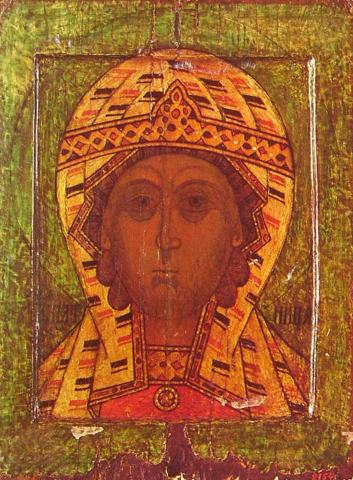
Mother of the damp earth and the spun thread — the only goddess on Vladimir's hill, who outlived her own cult as a night spirit and as Saint Friday.
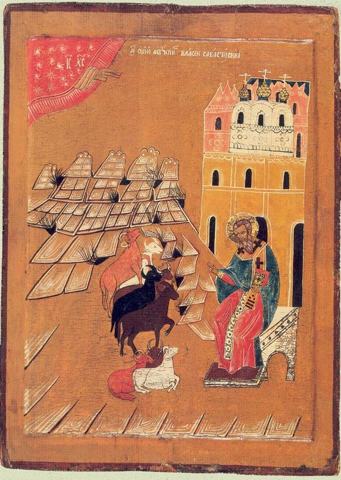
Lord of the cattle and the world below — the second god the Rus' swore by, whose name survived as a curse, a saint's herd, and a beard of grain in the field.
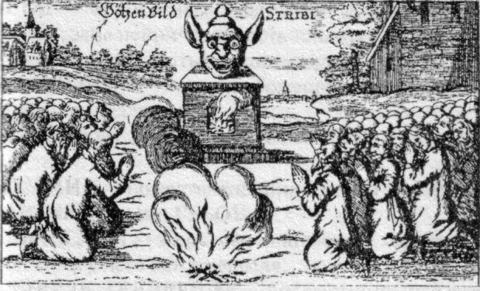
Wind god of the pagan Kyivan pantheon, remembered in the Tale of Igor's Campaign as the ancestor whose grandsons are the winds themselves.
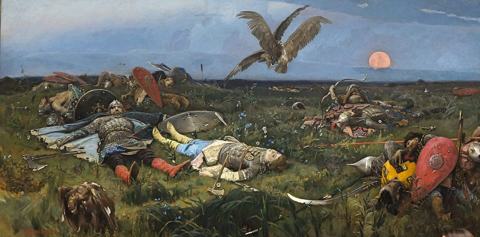
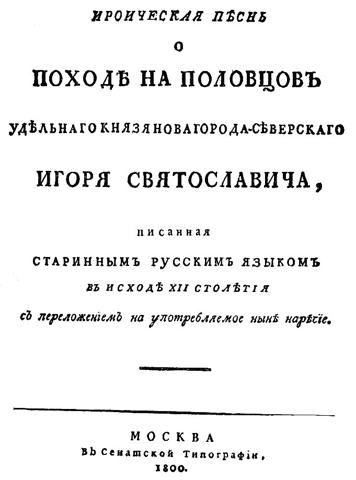
A 12th-century epic of a failed raid, its only manuscript burned in Moscow in 1812, and the two-century forgery debate that followed it.
Sun god of the Kyivan pantheon and, in the Tale of Igor's Campaign, the mythical ancestor of the Rus' people themselves.
Also mentioned inKoliada (Slavic Winter Festival)Svarog
Sources & Further Reading
- 1.Cross, Samuel Hazzard & Olgerd P. Sherbowitz-Wetzor, trans. The Russian Primary Chronicle: Laurentian Text. Medieval Academy of America, 1953.
- 2.Ostrowski, Donald, ed., with David Birnbaum & Horace G. Lunt. The Povest' vremennykh let: An Interlinear Collation and Paradosis. Harvard University Press, 2003.
- 3.Shakhmatov, Aleksey A. Razyskaniya o drevneishikh russkikh letopisnykh svodakh (Investigations into the Oldest Russian Chronicle Compilations). St Petersburg, 1908.
- 4.Franklin, Simon & Jonathan Shepard. The Emergence of Rus 750-1200. Longman, 1996.
- 5.Vernadsky, George. Kievan Russia. Yale University Press, 1948.
- 6.Likhachev, Dmitry S., ed. Povest' vremennykh let, with commentary. Moscow-Leningrad: Izdatel'stvo AN SSSR, 1950.
Spot an error or have a source to suggest? Write to info@viseterna.com. We cite primary sources and modern scholarship, and we correct fast.