
The Tale of Igor's Campaign
A 12th-century epic of a failed raid, its only manuscript burned in Moscow in 1812, and the two-century forgery debate that followed it.
After Prince Igor's Battle with the Polovtsians, Viktor Vasnetsov, 1880 (State Tretyakov Gallery) · Public domain · source
A Raid That Failed
The Tale of Igor's Campaign (Old East Slavic Slovo o polku Igoreve) is an anonymous epic poem, generally dated to the late twelfth century, that turns a minor military disaster into a meditation on Rus' disunity 1. Its subject is a real, recorded event: in 1185, Prince Igor Svyatoslavich of Novhorod-Siverskyi led a small, independent raid against the Polovtsians (Cumans) of the steppe, was defeated and captured, and later escaped 1,6. The poem compresses that campaign into a dense, image-heavy lament, opens and closes with invocations of an older singer named Boyan, and repeatedly breaks from narrative into appeals for the quarrelling Rus' princes to unite against the steppe rather than raid it piecemeal 1,4. Its Christian framing sits closely alongside pre-Christian imagery, a mixture that later became central to arguments about when and by whom it was written 4,6.
Boyan's Grandfather and the Old Gods
Three lines carry almost the entire weight of pre-Christian religion in the poem, and all three are grammatical genealogies rather than theology. The poet calls the legendary bard Boyan "Veles's grandson," in the single line anywhere in medieval East Slavic literature that connects Veles to poetry or prophetic speech 1,4. Later, the poem describes the wind turning against Igor's army as "the winds, Stribog's grandsons, blowing arrows from the sea," the only surviving text that treats Stribog as an active mythological agent rather than a bare name in a chronicle list 1. Twice more the poet calls the people of Rus' themselves "Dazhbog's grandsons," casting the sun god as a distant ancestor of an entire people and their princes 1. A fourth figure, Div, shrieks a warning from a treetop before the battle and is otherwise unattested anywhere in Slavic tradition, which has made him a magnet for speculative identification with everything from an Iranian demon to a simple bird 4,6. None of these four lines describes worship, ritual, or a temple; they are poetic ornament drawing on a mythic vocabulary the audience of 1185 is assumed to have still recognised 4.
Found, Copied, and Burned
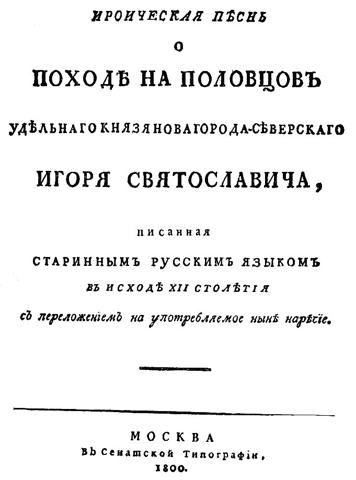
The poem's entire modern existence traces back to a single medieval manuscript, bound with unrelated texts, that the collector Count Aleksei Musin-Pushkin acquired around 1795 from the library of the Transfiguration Monastery in Yaroslavl 1. Musin-Pushkin had transcript copies made, including one presented to Empress Catherine the Great, and published the first printed edition, with two scholarly collaborators, in 1800 1. That precaution turned out to matter enormously: the original manuscript, kept in Musin-Pushkin's Moscow house, was destroyed in the fire that swept the city during the French occupation in 1812, leaving the 1800 printed edition and the surviving handwritten copies as the only witnesses to a text no living scholar has ever seen 1.
Two Centuries of Forgery Suspicion
A manuscript that no longer exists, transcribed by an aristocrat with a documented taste for antiquities, was an obvious target for doubt, and the doubt has never fully gone away. Early suspects included Musin-Pushkin himself, the Czech Slavist Josef Dobrovsky, and a minor forger named Anton Bardin who was separately caught faking other "old" manuscripts 6. Edward Keenan's 2003 monograph gave the skeptical case its most sustained modern form, arguing at length that Dobrovsky composed the poem in the 1790s as a literary exercise; the book renewed the debate but persuaded few specialists in Slavic linguistics 5. The case for authenticity rests chiefly on language rather than history: Jakobson, Gregoire, and Szeftel's 1948 study argued the poem's grammar was too internally consistent with other genuine twelfth-century texts to be a later invention, and Andrey Zaliznyak's 2004 study pushed the argument further, showing that the poem's use of enclitic particles follows rules of Old East Slavic grammar that were not correctly described by any scholar, and could not have been reconstructed by any forger, until the discovery of birch-bark documents in the twentieth century 3,4. Most specialists now treat the poem as a genuine medieval work, though the debate itself remains part of the text's identity 3,4,6.
Yaroslavna's Lament and the Poem's Afterlife
The poem's most quoted passage is not military but domestic: Igor's wife, Yaroslavna, standing on the city wall at Putyvl, addresses the wind, the Dnieper, and the sun directly, asking each why it worked against her husband — a passage translators from Nabokov onward single out as the poem's emotional center 2. Vladimir Nabokov's 1960 English translation remains the standard literary rendering for Anglophone readers, and Alexander Borodin's unfinished opera Prince Igor, completed after his death by Rimsky-Korsakov and Glazunov, carried the story to an international audience that had never read the original 2. Soviet-era scholarship, particularly Dmitry Likhachev's editions and commentary, treated the poem as a cornerstone of Old Russian literary identity, a status that has made the authenticity question politically loaded as well as philological 3.
Reading It Honestly
As a source for primary-chronicle-style history, the Tale is thin: it names real princes and a real campaign but compresses, rearranges, and mourns rather than reports. As a source for pre-Christian religion it is thinner still — three genealogical epithets and one unexplained shrieking figure, none of them evidence of active cult practice in the 1180s 1,4. Its real value lies elsewhere, as the single most sophisticated piece of pre-Mongol Rus' literature to survive at all, however narrowly it survived.
Continue Exploring
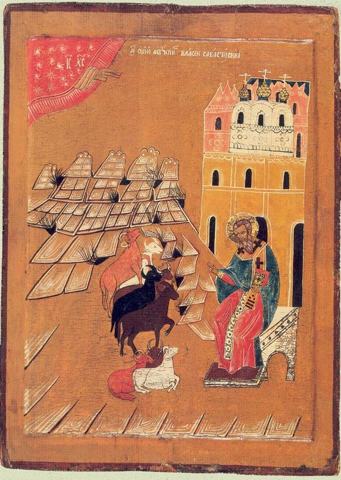
Lord of the cattle and the world below — the second god the Rus' swore by, whose name survived as a curse, a saint's herd, and a beard of grain in the field.
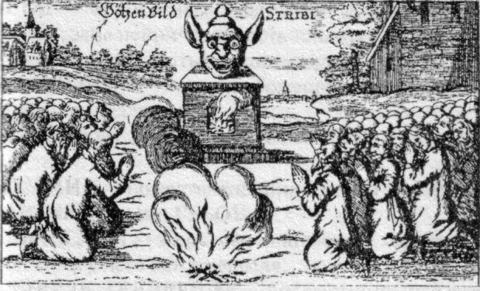
Wind god of the pagan Kyivan pantheon, remembered in the Tale of Igor's Campaign as the ancestor whose grandsons are the winds themselves.
Sun god of the Kyivan pantheon and, in the Tale of Igor's Campaign, the mythical ancestor of the Rus' people themselves.
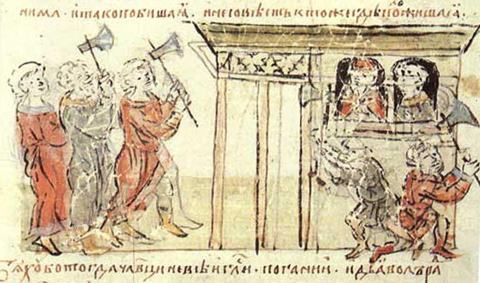
The founding chronicle of Kyivan Rus', c. 1113 - the only narrative source for Vladimir's pagan pantheon of 980 and its fall eight years later.
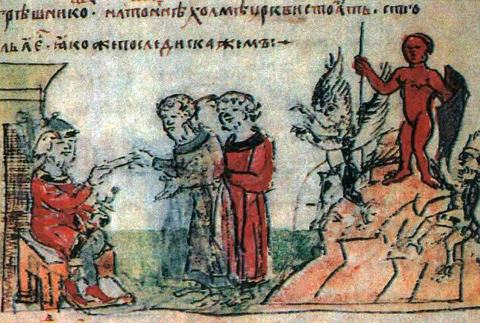
God of thunder and the striking bolt — the oak-crowned sky lord of the early Slavs, sworn by in treaties and thrown into the Dnieper at Rus' baptism.
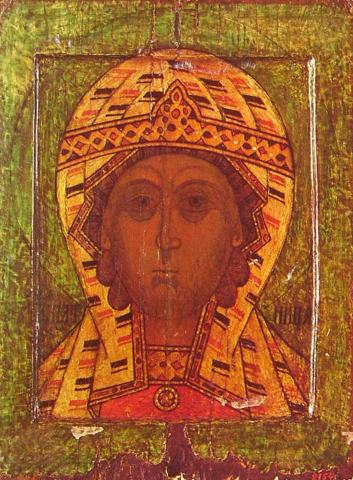
Mother of the damp earth and the spun thread — the only goddess on Vladimir's hill, who outlived her own cult as a night spirit and as Saint Friday.
Sources & Further Reading
- 1.Slovo o polku Igoreve (The Tale of Igor's Campaign), Old East Slavic, composed c. 1185-1200.
- 2.Nabokov, Vladimir, trans. The Song of Igor's Campaign: An Epic of the Twelfth Century. 1960.
- 3.Jakobson, Roman, Henri Gregoire & Marc Szeftel. La Geste du Prince Igor'. Annuaire de l'Institut de Philologie et d'Histoire Orientales et Slaves, 1948.
- 4.Zaliznyak, Andrey A. Slovo o polku Igoreve: Vzglyad lingvista (The Tale of Igor's Campaign: A Linguist's View). Moscow, 2004.
- 5.Keenan, Edward L. Josef Dobrovsky and the Origins of the Igor' Tale. Harvard University Press, 2003.
- 6.Likhachev, Dmitry S., ed. Slovo o polku Igoreve. Moscow-Leningrad, 1950.
Spot an error or have a source to suggest? Write to info@viseterna.com. We cite primary sources and modern scholarship, and we correct fast.