
Vyraj (Iriy, the Slavic Otherworld Paradise)
A warm otherworld at the earth's edge where migratory birds winter and, per some folklore, the dead go too - modern ethnography only, no medieval attestation.
Common cranes in migration, Andreas Trepte, 2004 · CC BY-SA 2.5 · source
A Name for the Warm Land
Vyraj — also Iriy, Vyriy, or Irij depending on the region and the language, East Slavic вирий/ирий, with West and South Slavic cousins closer to the word for "paradise" — names a distant, warm otherworld at the edge of the earth or beyond the sea 1,4,5. Unlike Perun or Mokosh, the word appears in no medieval chronicle, no anti-pagan sermon, and no treaty oath; everything known about it comes from folklore collected by ethnographers from the nineteenth century onward, which makes it, if anything, less securely rooted than the gods condemned from the pulpit 1,3,5. Its etymology is itself disputed: proposals connect it to a root for a warm southern land, to words for whirling or eddying water, and, more speculatively, to raj, "paradise" — a folk association that may be later reinterpretation rather than the word's origin 2,4,5.
Where the Birds Go
The one idea attached to Vyraj with real ethnographic weight, recorded across Russian, Ukrainian, and Belarusian villages, is that migratory birds spend the winter there and carry something of human life with them when they go 1,3,4. Storks, swallows, cuckoos, and cranes were widely believed to fly to Vyraj each autumn and return in spring bringing warmth and the new season with them; snakes, lizards, and insects were sometimes said to winter there as well 1,3. The belief runs deeper than a nature-note about bird migration, because storks and swallows in the same folklore are also the carriers of unborn children and, in places, of the souls of the dead — the same journey serving as both a seasonal and a spiritual passage 1,3,4.
The Gate and the Key
Vyraj is usually pictured as a walled garden behind an iron gate, sometimes set in the crown of a great world tree — the vertical, tree-organised cosmos that Ivanov and Toporov's structuralist reconstruction of Slavic mythology treats as a recurring underlying pattern — closed to the living 4,5,7. Folklore assigns it a guardian: in some tellings this is Veles, who holds the keys and is occasionally imagined taking a bird's shape himself to move in and out of it, an image that fits his broader folkloric role as a power operating on the boundary between worlds 4,6. The gate's opening and closing had a real calendar echo in East Slavic custom: on the feast later fixed to the Forty Martyrs of Sebaste in March, villagers baked small bird-shaped loaves called zhaivoronky, "larks," and tossed them into the air with songs calling spring back from the other side — a rite widely read as a folk memory of unlocking Vyraj for the birds' return, though the interpretation is the ethnographers' rather than anything the singers themselves are recorded explaining in those terms 1,3.
Paradise, Ancestors, and Nav
Some collectors record Vyraj as a destination for human souls as well as birds, which sets it uneasily alongside Nav, the East Slavic word for the dead and, in places, for their realm 1,5. The two ideas are not consistently distinguished in the sources: certain regional traditions treat Vyraj as a paradise the righteous dead reach, others keep it strictly a bird-and-animal wintering ground with no human dead in it at all, and no single authoritative version resolves the difference 1,4,5. That inconsistency is itself the honest finding — nineteenth-century Slavic peasant cosmology was not a fixed system with one otherworld in one place, and collectors working in different provinces wrote down genuinely different pictures 4,5.
Modern Overreach
Popular websites and some neo-pagan writing now place Vyraj as the top tier of a tidy three-world Slavic cosmology, often paired with the Yav-Prav-Nav scheme and tied to Rod and the Rozhanitsy as a "supreme god's garden." That scheme leans heavily on the Book of Veles, a mid-twentieth-century forgery rejected by specialists, and on Boris Rybakov's contested reconstruction of Rod as a high creator god; Szyjewski notes the proposed Rod-Vyraj link as a possible but unproven regional idea, not an established medieval doctrine 4,6. What can be said without overreaching is more modest: a name for a warm, walled otherworld at the edge of the earth, attached most firmly to the migration of birds, recorded only in modern folklore, and never quite fixed in place by the people who described it 1,4,5.
Continue Exploring
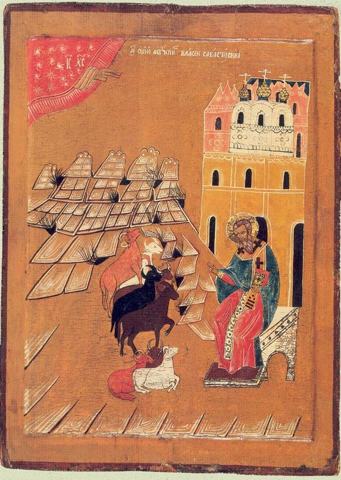
Lord of the cattle and the world below — the second god the Rus' swore by, whose name survived as a curse, a saint's herd, and a beard of grain in the field.
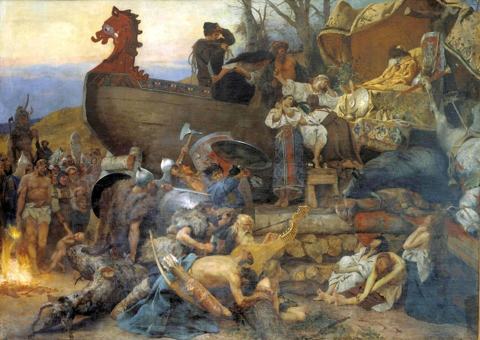
The land of the dead — an old Slavic word for a corpse and for the dead who come back, and the least documented otherworld in European mythology.
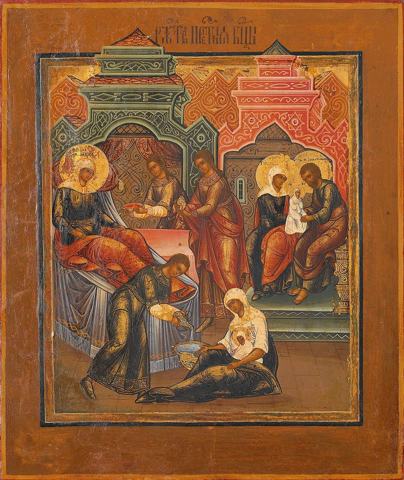
A name condemned in medieval Russian sermons alongside birth-spirits called the rozhanitsy - read by some as a supreme creator god, by others as no god at all.
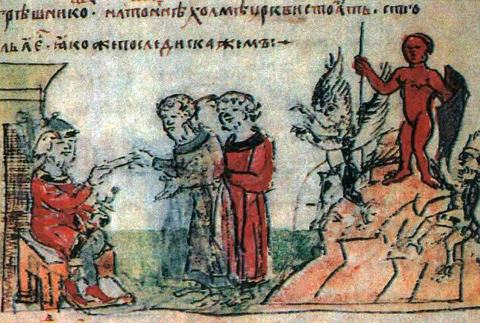
God of thunder and the striking bolt — the oak-crowned sky lord of the early Slavs, sworn by in treaties and thrown into the Dnieper at Rus' baptism.
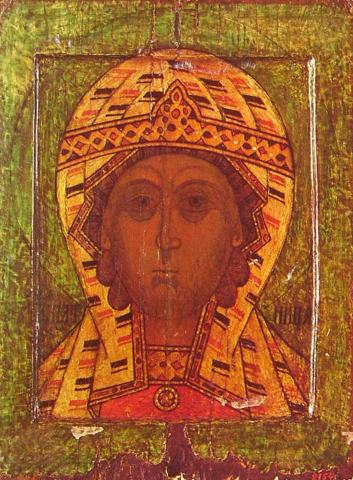
Mother of the damp earth and the spun thread — the only goddess on Vladimir's hill, who outlived her own cult as a night spirit and as Saint Friday.
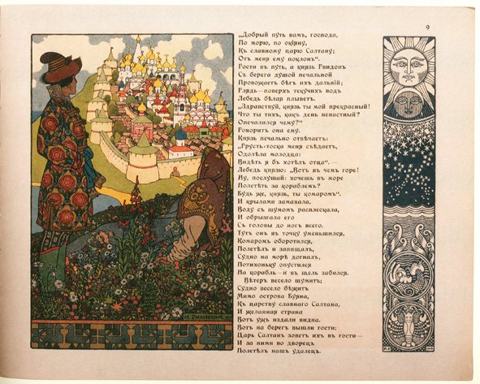
The magical island of Russian folk charm and fairy tale, home to the sacred stone Alatyr and, in wonder-tales, the hidden death of Koschei.
Also mentioned inAlatyr (the Sacred Stone)Sirin, Alkonost and Gamayun (Bird-Women of Slavic Lore)
Sources & Further Reading
- 1.Afanasyev, Alexander. Poeticheskie vozzreniia slavian na prirodu (The Poetic Views of the Slavs on Nature), 3 vols. Moscow, 1865-1869.
- 2.Machal, Jan. Slavic Mythology, in The Mythology of All Races, vol. III. Marshall Jones, 1918.
- 3.Ivanits, Linda J. Russian Folk Belief. M.E. Sharpe, 1989.
- 4.Szyjewski, Andrzej. Religia Slowian. Wydawnictwo WAM, 2003.
- 5.Dixon-Kennedy, Mike. Encyclopedia of Russian and Slavic Myth and Legend. ABC-CLIO, 1998.
- 6.Kalik, Judith & Alexander Uchitel. Slavic Gods and Heroes. Routledge, 2019.
- 7.Ivanov, V. V. & V. N. Toporov. Issledovaniia v oblasti slavianskikh drevnostei. Nauka, Moscow, 1974.
Spot an error or have a source to suggest? Write to info@viseterna.com. We cite primary sources and modern scholarship, and we correct fast.