
Xochiquetzal (Aztec Goddess of Flowers and Beauty)
The Aztec goddess of beauty, love, and the household arts — patroness of weavers and courtesans, married to Tlaloc until Tezcatlipoca took her for himself.
Xochiquetzal, Codex Fejervary-Mayer, page 29, pre-Columbian central Mexico · Public domain · source
Flower Quetzal Feather
Xochiquetzal joins xochitl, flower, to quetzalli, the precious green tail feather of the quetzal bird — a name usually rendered "Flower Quetzal Feather," pairing the two things Mexica poetry most often reached for to describe anything beautiful or precious 4. She governs beauty, sexual love, and pleasure specifically, which Sahagun's informants distinguish from the reproductive and agricultural fertility handled by goddesses like Chalchiuhtlicue — Xochiquetzal's domain is desire and delight for their own sake 1,4. She is also patroness of the household arts practiced mostly by women: spinning, weaving, and embroidery, and by extension the artisans, the ahuianime (professional companions and courtesans), and anyone whose skill was making something desirable to look at 1,4.
Wife of Tlaloc, Prize of Tezcatlipoca
The best-known story about her is a theft. Colonial sources, most fully the Historia de los Mexicanos por sus pinturas, describe Xochiquetzal as married first to Tlaloc, until Tezcatlipoca abducted her and installed her as his own consort instead, enthroning her over love and pleasure in her new household 2. Other colonial threads instead pair her first with Piltzintecuhtli — sometimes identified with Xochipilli, "Flower Prince," a young god of flowers, music, and pleasure closely associated with her in art and cult — a union credited with producing Centeotl, the young maize god 4. The sources do not agree with each other on this point, and modern popular retellings tend to flatten the two traditions into a single tidy biography that the sixteenth-century record does not actually provide.
Tamoanchan and the Broken Tree
Xochiquetzal's home is Tamoanchan, a paradise-garden in the western sky rather than a place on earth, shared with other flower and pleasure deities 1,4. Several colonial accounts locate at Tamoanchan the story of a forbidden flowering tree, broken by a goddess who picks its blossoms against the other gods' command — an act punished by the introduction of bloodletting, pain, and death into the world. Some tellings name the tree-breaker as Xochiquetzal; others leave her unnamed or assign the act to a different goddess of the same general type, and the identification with Xochiquetzal specifically should be treated as one reading among competing ones rather than settled fact 2,4.
The Arts of the Loom
Xochiquetzal's patronage of weaving was not incidental decoration. Nahua women's handiwork — cloth, featherwork, embroidery — carried real ritual and economic weight in Mexica society, offered as tribute and used to mark status, and Xochiquetzal stood as the divine model claimed by the women who produced it 1,4. Her day in the 260-day ritual calendar, 1 Xochitl ("1 Flower"), opens a trecena, one of the twenty thirteen-day periods into which the tonalpohualli was divided, and codices belonging to this divinatory tradition, such as the Codex Fejervary-Mayer, show her enthroned beside flowering plants in exactly this calendrical role 3.
Confessor of Desire
Xochiquetzal also heard confession. Nahua religious practice included a one-time ritual confession of sexual transgression, made to a priest who absolved the penitent in the goddess's name — a role most closely associated with Tlazolteotl, "Filth Goddess," but one that period sources sometimes extend to Xochiquetzal as well, since the two goddesses' territories of sexuality and purification overlap and are not always kept distinct even by the friars recording them 4. Nicholson's survey of Mexica religion places both goddesses within the same broad fertility-and-pleasure grouping of deities rather than treating them as cleanly separated cults, which is one reason the overlap keeps recurring in the sources 6. Untangling exactly where one goddess's jurisdiction ends and the other's begins is a live problem in the scholarship rather than a solved one.
The Feast Held Every Eight Years
Xochiquetzal's most distinctive festival was Atamalcualiztli, "the eating of water tamales," held only once every eight years to mark the point at which the solar and Venus calendars realigned. Duran describes eight days of fasting on plain, unseasoned tamales, masked dancers costumed as birds, animals, and gods, and rites that dramatized fertility, abundance, and the goddess's own cycle of loss and return 5. It is a festival built, appropriately, around scarcity before plenty — austerity observed in the name of the goddess of pleasure.
Continue Exploring
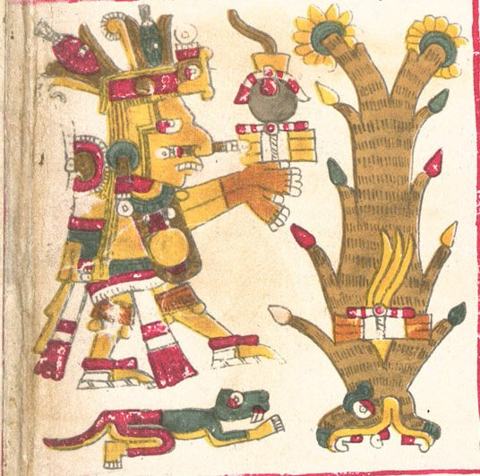
The Aztec maize god, born of two rival colonial traditions and honored at both the spring planting and the harvest festival that bracket his short green life.
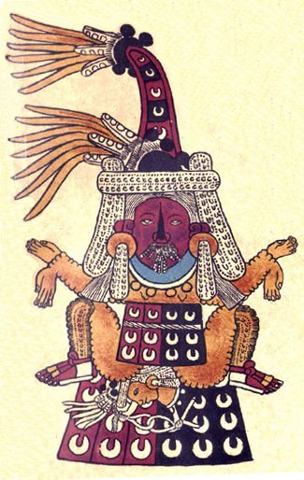
The Aztec goddess of lust and vice who is also the goddess of confession — the one being who can absorb a person's wrongdoing and leave them clean.
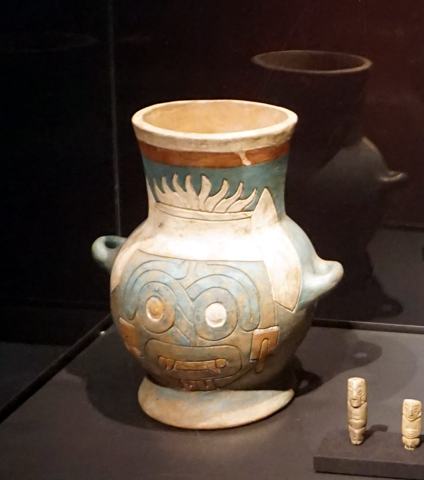
The goggle-eyed rain god who makes things sprout — giver of the storms that feed the maize, keeper of a green paradise, and taker of children.
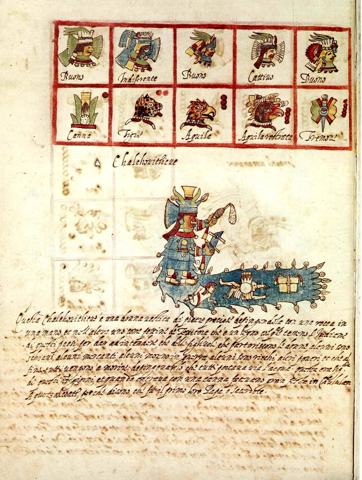
Tlaloc's consort and goddess of lakes and rivers, who ruled the Fourth Sun that ended in flood, and whom midwives invoked to bathe every newborn child.
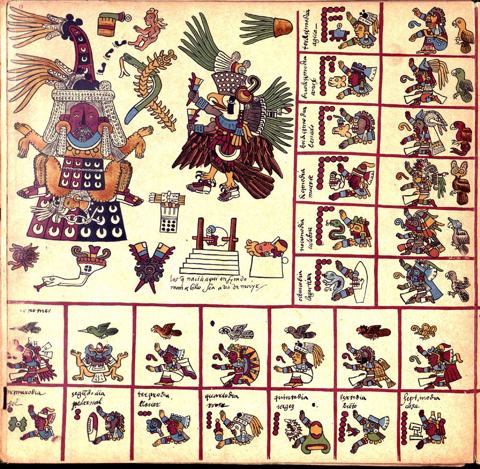
The 260-day sacred count that set every Aztec's birth-fate, built from 13 numbers and 20 day-signs, inherited from far older Mesoamerican tradition.
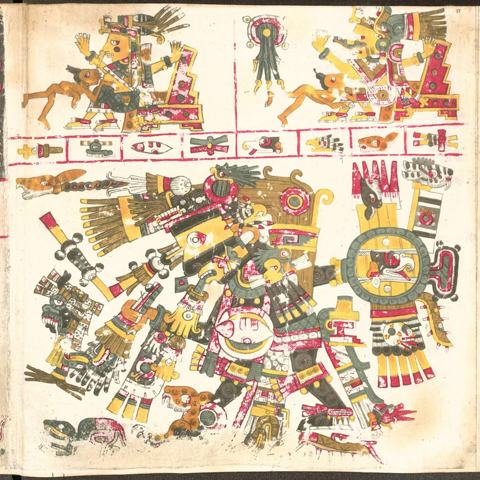
The Smoking Mirror — god of night, sorcery, kingship and fate, whose obsidian glass shows what men do in the dark and who owns them all as slaves.
Sources & Further Reading
- 1.Bernardino de Sahagun, Florentine Codex — General History of the Things of New Spain (c. 1547–1579), Book 1.
- 2.Historia de los Mexicanos por sus pinturas (16th century).
- 3.Codex Fejervary-Mayer (pre-Columbian ritual manuscript).
- 4.Miller, Mary & Karl Taube. The Gods and Symbols of Ancient Mexico and the Maya. Thames & Hudson, 1993.
- 5.Diego Duran, Book of the Gods and Rites and The Ancient Calendar (c. 1574–1579).
- 6.Nicholson, H. B. 'Religion in Pre-Hispanic Central Mexico.' Handbook of Middle American Indians, vol. 10. University of Texas Press, 1971.
Spot an error or have a source to suggest? Write to info@viseterna.com. We cite primary sources and modern scholarship, and we correct fast.