
Chalchiuhtlicue (Aztec Water Goddess)
Tlaloc's consort and goddess of lakes and rivers, who ruled the Fourth Sun that ended in flood, and whom midwives invoked to bathe every newborn child.
Chalchiuhtlicue, Codex Rios (Codex Vaticanus A / Vaticanus 3738), Vatican Library, later 16th century (Loubat facsimile edition, 1900) · Public domain · source
She of the Jade Skirt
Chalchiuhtlicue takes her name from chalchihuitl, jade or precious greenstone, and cueitl, skirt — "she of the jade skirt," a name that describes her the way Coatlicue's serpent skirt describes her: by the one garment an image-maker could not leave off 4. She governs water once it has left the sky and settled on the earth — lakes, rivers, springs, standing pools — as well as the more violent water of floods and drownings, and she was addressed, depending on the source, as Tlaloc's wife or his sister 1,4.
Consort of the Rain
The division of labor between the two is fairly consistent across the sources: Tlaloc and his helper spirits, the tlaloque, send rain down from the mountains, while Chalchiuhtlicue holds authority over the water once it arrives — the lakes it fills, the rivers it becomes, the springs it feeds 1,4. The pairing is functional rather than incidental. Sahagun's informants describe her as invoked alongside Tlaloc in the rites of the rain-and-agriculture complex, and Nicholson groups her within the same "Tlaloc Complex" of deities in his survey of Mexica religion, rather than treating her as an independent cult on her own footing 1,6.
The Fourth Sun and the Flood
Chalchiuhtlicue's other major role is cosmological. In the Leyenda de los Soles, the Nahuatl creation history preserved in the Codex Chimalpopoca, she presides over one of the four world-ages that preceded the present sun — most often numbered the fourth — which ends when the sky itself comes down and the world is inundated, its people transformed into fish as they drown 2. Some modern retellings dress this up as marital revenge, Chalchiuhtlicue punishing Tlaloc for some offense by flooding his world; the earliest Nahuatl text supplies no such motive, only the catastrophe itself, and the Historia de los Mexicanos por sus pinturas gives yet another arrangement of which god ruled which ruined age 2,3.
Water at the Threshold of Life
Chalchiuhtlicue's most intimate role had nothing to do with cosmic ages. Book 6 of the Florentine Codex preserves the formal speeches Nahua midwives delivered over a newborn child, and central to the rite is a ritual bath, performed in the child's name and addressed to Chalchiuhtlicue as much as to the infant: water poured over the small body to wash away the impurity inherited from the parents' union, to give the child a clean start, and, for a girl, to invoke the goddess directly as the pattern for the woman she would become 1. The same water rite that marked entry into life could also, on ceremonial calendar days, double as a naming occasion — Chalchiuhtlicue standing, in practice, at both ends of the household's most private ritual.
The Feast of the Drowned
Chalchiuhtlicue's public worship converged with Tlaloc's in Etzalcualiztli, the sixth month of the ritual year, when priests bathed at dawn in the lake surrounding Tenochtitlan and fasted on a maize-and-bean porridge that gave the festival its name 1. Codex Borbonicus, painted close to the conquest, illustrates the month's rites and the water deities associated with it, part of the same visual tradition that gives Chalchiuhtlicue her standard iconography: a jade or turquoise nose ornament, a headdress with tassels representing falling rain, and streams of water — sometimes carrying small human figures — pouring from her hands or skirt 5.
A Contested Colossus
As with several major Mexica goddesses, the best-known sculpture bearing Chalchiuhtlicue's name is not securely hers. A colossal stone figure over three meters tall, recovered near the Pyramid of the Moon at Teotihuacan and now in the National Museum of Anthropology, has been labeled Chalchiuhtlicue since the nineteenth century, but the identification rests on later Mexica religious categories applied backward onto a much older Teotihuacan image whose original meaning is not recorded 4. It is the same caution that attaches to the Coatlicue monolith: a museum label is not the same thing as a name the sculptor actually intended.
Continue Exploring
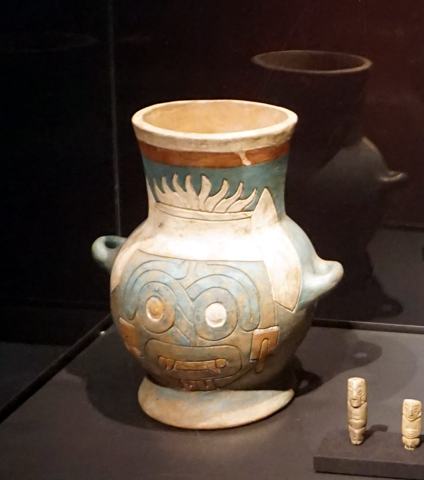
The goggle-eyed rain god who makes things sprout — giver of the storms that feed the maize, keeper of a green paradise, and taker of children.
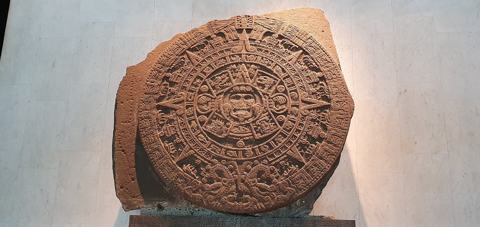
The Aztec myth of four ruined world-ages before this one, each ended by its own catastrophe, in an order and cast of gods the sources don't agree on.
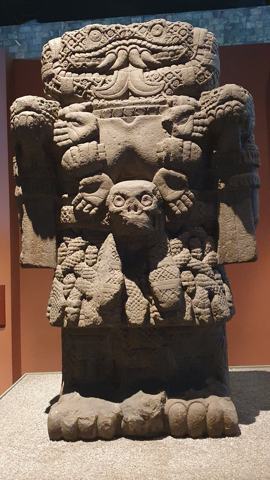
She of the Serpent Skirt — the Mexica earth mother who conceived Huitzilopochtli from a ball of feathers, and the colossal monolith that carries her name.
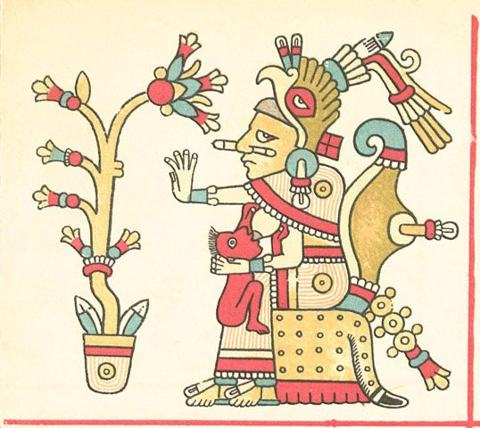
The Aztec goddess of beauty, love, and the household arts — patroness of weavers and courtesans, married to Tlaloc until Tezcatlipoca took her for himself.
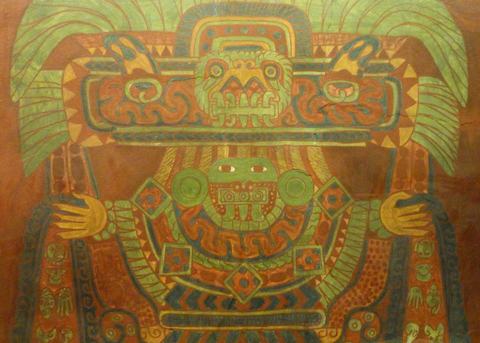
The rain god's paradise of unfailing summer, reserved for those the water took — and the name modern scholars gave a debated mural at Teotihuacan.
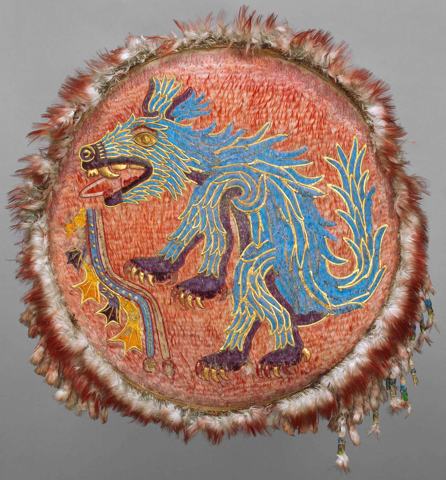
A small, dog-sized water beast with a hand at the end of its tail, said to drown swimmers and eat their eyes, nails, and teeth.
Sources & Further Reading
- 1.Bernardino de Sahagun, Florentine Codex — General History of the Things of New Spain (c. 1547–1579), Books 1, 2 and 6.
- 2.Bierhorst, John, trans. History and Mythology of the Aztecs — The Codex Chimalpopoca. University of Arizona Press, 1992.
- 3.Historia de los Mexicanos por sus pinturas (16th century).
- 4.Miller, Mary & Karl Taube. The Gods and Symbols of Ancient Mexico and the Maya. Thames & Hudson, 1993.
- 5.Codex Borbonicus (Mexica ritual manuscript, painted at or shortly after the conquest; exact date debated).
- 6.Nicholson, H. B. 'Religion in Pre-Hispanic Central Mexico.' Handbook of Middle American Indians, vol. 10. University of Texas Press, 1971.
Spot an error or have a source to suggest? Write to info@viseterna.com. We cite primary sources and modern scholarship, and we correct fast.