
Tlalocan
The rain god's paradise of unfailing summer, reserved for those the water took — and the name modern scholars gave a debated mural at Teotihuacan.
The so-called Great Goddess of Teotihuacan, mural, Tepantitla compound, Teotihuacan; photograph by Juan Carlos Fonseca Mata, 2010 · CC BY-SA 4.0 · source
The Green Place
Tlalocan is the paradise of Tlaloc, described in Book 3 of the Florentine Codex as a place of unbroken springtime, thick with maize, squash, amaranth, chili, and beans growing without a season to stop them 1. It is not a reward for virtue. Mexica cosmology sorted its afterlives by the manner of a person's death rather than by conduct, and Tlalocan's residents are simply the people water, or something connected to water, had claimed: those killed by drowning, struck by lightning, or carried off by dropsy, gout, and the skin conditions attributed to the rain complex 1,3. They were buried rather than cremated, sent off with seed placed in the face and a digging stick set in the hand — equipment, not decoration, for a green land they were expected to keep working 1. The colonial-era Codex Vaticanus A lists Tlalocan alongside the sun's heaven and the nursing-tree of dead infants as one of several afterlife destinations assigned strictly by how a person died, with Tlaloc's realm reserved for the water-taken and everyone else routed toward Mictlan regardless of how they had lived 2.
A Household of Small Rain-Bringers
Tlaloc does not run Tlalocan alone. His consort Chalchiuhtlicue shares rule over the place in most accounts, and the tlaloque, the small rain-spirits who live in mountains and break their water jars to make thunder and rain, are described as living there too, tending the realm's perpetual crop 1,4. Lopez Austin's study, which treats Tlalocan as one of a pair with Tamoanchan, a similarly hazy mist-place of origins in the same cosmology, argues that both function less as fixed destinations than as recurring images of fertility and mist that Mesoamerican sources invoke wherever they need a green, wet, generative "elsewhere" — a reading that cautions against drawing Tlalocan as a single settled map 3. It stands in explicit contrast to Mictlan, the cold northward underworld that received the ordinary dead: Tlalocan is Mictlan's opposite number, warm where Mictlan is cold, green where Mictlan is a four-year road through obsidian wind, and reserved for a much smaller, more specific set of the dead 1,3.
A Mural Named After a Myth
The best-known image linked to Tlalocan is not Mexica at all. A mural excavated at Tepantitla, a residential compound at Teotihuacan, a city that had been abandoned for centuries before the Mexica ever settled the Basin of Mexico, shows small painted figures playing, swimming, and singing among butterflies and flowering vines below a large frontal deity figure in an elaborate feathered headdress 4,7. In 1942 Alfonso Caso, comparing the scene to Sahagun's description of Tlaloc's green afterlife, named the mural "El Tlalocan" and the identification stuck, giving the compound and the mural their modern name 6.
What the Mural Actually Shows
The identification is older than it is settled. Caso was reading a mural at Teotihuacan, painted centuries before 500 CE, through a description of Aztec belief written down a thousand years later by a different culture, in a different language, under Spanish supervision — a gap Pasztory's study of Teotihuacan art treats as a serious problem for taking "Tlalocan" as a simple label rather than a modern interpretive overlay 7. The large central figure has itself been read multiple ways: as Tlaloc, as a distinct so-called "Great Goddess" of Teotihuacan proposed by later iconographers, or as a more generalized fertility or mountain deity whose identity the Teotihuacanos themselves may not have mapped onto any single later Aztec god; Taube's survey of Mesoamerican myth treats the mural's imagery as genuinely ambiguous rather than as a settled Tlaloc portrait 4,5,7. Whether the mural depicts an afterlife at all, rather than an earthly ritual scene, a mountain-of-sustenance, or something the framework of Aztec paradise imagery is simply the wrong lens for, remains argued rather than resolved 7.
Two Tlalocans, Centuries Apart
What is not in serious doubt is that the underlying idea — a green, wet, deity-ruled land of ease connected to mountains and rain — runs very deep in central Mexican religion, deep enough that a thousand-year-old mural and a sixteenth-century Nahuatl description can still look, to modern eyes, like versions of the same place 3,4. What is in doubt is whether that resemblance reflects real continuity of belief across a millennium or a modern scholar's pattern-matching across a gap the sources cannot actually close. The honest position keeps both possibilities open: Tepantitla's mural as a strong, suggestive echo of the Tlalocan idea, and "Tlalocan" itself as the Aztec name for something considerably older than the Aztecs, whose own Teotihuacan-period name — if it had one — no longer survives 3,6,7.
Continue Exploring
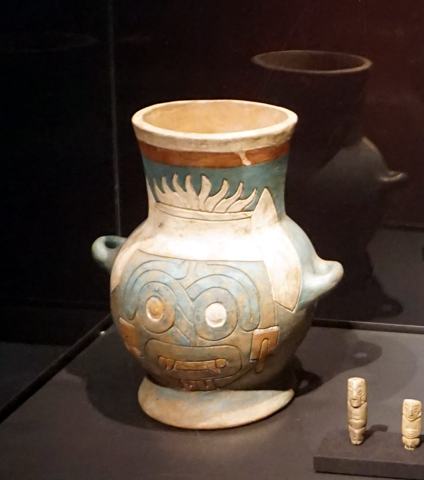
The goggle-eyed rain god who makes things sprout — giver of the storms that feed the maize, keeper of a green paradise, and taker of children.
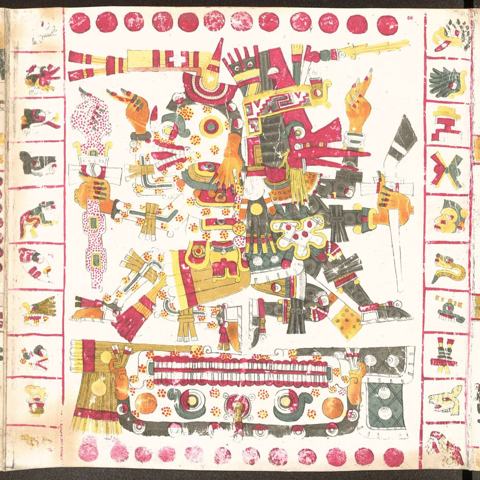
The Place of the Dead — a ninefold underworld reached by a four-year journey, where the ordinary dead arrive at last and simply cease.
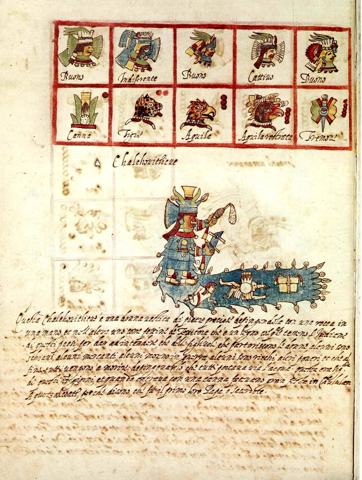
Tlaloc's consort and goddess of lakes and rivers, who ruled the Fourth Sun that ended in flood, and whom midwives invoked to bathe every newborn child.
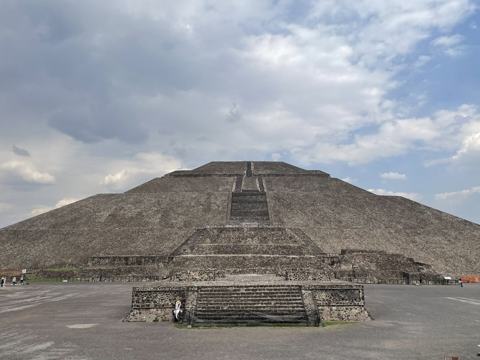
A vast city already ancient when the Aztecs found it, mythologised by them as the place where the gods sacrificed themselves to make the Fifth Sun.
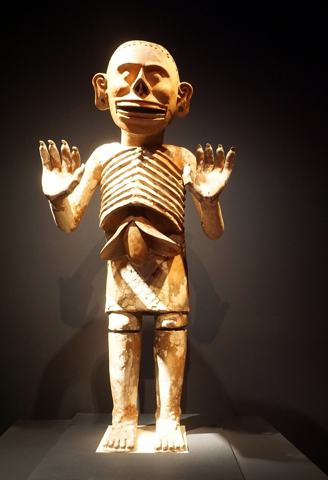
Lord of the Place of the Dead — the skeletal ruler of the ninefold underworld, keeper of humanity's bones and destination of everyone who dies ordinarily.
A small, dog-sized water beast with a hand at the end of its tail, said to drown swimmers and eat their eyes, nails, and teeth.
Also mentioned inCihuateteo
Sources & Further Reading
- 1.Bernardino de Sahagun, Florentine Codex — General History of the Things of New Spain (c. 1547-1579), Book 3.
- 2.Codex Vaticanus A (Codex Rios, c. 1570).
- 3.Lopez Austin, Alfredo. Tamoanchan, Tlalocan: Places of Mist. University Press of Colorado, 1997.
- 4.Miller, Mary & Karl Taube. The Gods and Symbols of Ancient Mexico and the Maya. Thames & Hudson, 1993.
- 5.Taube, Karl. Aztec and Maya Myths. British Museum Press, 1993.
- 6.Caso, Alfonso. "El Paraiso Terrenal en Teotihuacan." Cuadernos Americanos, 1942.
- 7.Pasztory, Esther. Teotihuacan — An Experiment in Living. University of Oklahoma Press, 1997.
Spot an error or have a source to suggest? Write to info@viseterna.com. We cite primary sources and modern scholarship, and we correct fast.