
Chaac
The rain god who splits the clouds with a lightning axe — one god and four, the most frequently depicted deity in the surviving Maya books.
Mayapan-style incense burner in the form of the rain god Chahk, Eastern Yucatan, Late Postclassic Maya, 1100-1300 CE (de Young Museum, San Francisco) · CC0 · source
God B
Chaac — Classic Maya Chaahk, and in older literature Chac — is the Maya god of rain, thunder, lightning and storms 5,6. In the lettering scheme applied to the figures in the surviving Maya books he is God B, and he is the single most frequently depicted deity in those manuscripts, appearing on page after page of the Dresden and Madrid codices in almanacs concerned with planting, rainfall and the agricultural year 1,5.
He is recognisable by a long down-curving snout, a shell ear ornament, a serpent-like or reptilian eye, and often a knotted headdress; the body is frequently painted blue 5,6. Where a Mesoamerican rain god is expected, this is the Maya face: the counterpart in function of the central Mexican Tlaloc, the Zapotec Cocijo and the Mixtec Dzahui, without being any of them 6.
The Axe and the Thunder
Chaac's characteristic implement is a stone axe, and the mechanics are explicit in the imagery: he strikes the clouds with it, and the blow makes lightning and thunder, after which rain falls 5,6. In many scenes the axe itself is animate, taking the form of the flare-headed serpent-footed deity K'awiil, whose forehead is pierced by a smoking celestial torch — lightning personified as an object a god can hold 5,6.
He is also shown with a serpent, standing in water, riding a caiman, canoeing, or fishing, and in the codices he is repeatedly paired with maize: the almanacs alternate images of Chaac bringing water with images of the young maize god thriving or failing 1,5. The rain god's calendar is the farmer's calendar.
Four Chaacs, Four Directions
Chaac is one deity and four at the same time, a pattern common in Maya thought 5,6. Colonial Yucatec sources name a Chaac for each cardinal direction in the associated colour: Chak Xib Chaac in the red east, Sak Xib Chaac in the white north, Ek Xib Chaac in the black west, and Kan Xib Chaac in the yellow south 2,5.
They overlap with, and are sometimes conflated with, the four Bacabs — the sky-bearers Landa names at the corners of the world, who also carry directional colours and preside over the year-bearer ceremonies 2,5. The colonial incantations gathered as the Ritual of the Bacabs address these directional powers directly in curing formulas, calling on them by colour and by quarter 3. The overlap between Chaacs and Bacabs is a genuine feature of the sources rather than a modern confusion, and the two sets are not cleanly separable 5.
Cenotes, Caves and Mountains
Northern Yucatan is a limestone shelf with almost no surface rivers. Water is reached through cenotes, sinkholes where the roof of the aquifer has collapsed, and through caves — so the openings in the earth were where the rain gods were petitioned 7. The Sacred Cenote at Chichen Itza received offerings of jade, gold, copal and human remains dredged from it in the early twentieth century, a deposit consistent with Landa's report that people were thrown in during droughts 2,7.
The Puuc region's architecture makes the same point in stone. Buildings at Uxmal, Kabah and their neighbours carry stacked masks with long curling snouts along their facades and corners; the Codz Poop at Kabah is faced almost entirely with them 6,7. These are conventionally called Chaac masks, and the identification is reasonable, though some specialists argue the mask complex is a broader "witz" or living-mountain motif that is not exclusively the rain god 6,7.
Ch'a Chaak
The rain ceremony has survived. Ch'a Chaak — "fetch the rain" — is still performed in Yucatec Maya communities when the rains are late, led by an h-men, a ritual specialist 6,7. An altar of green branches is raised, offerings of maize bread baked in an earth oven and of the fermented honey drink balche are laid out, and the four directional Chaacs are petitioned in turn 6,7.
Its most-quoted feature is that boys are stationed at the corners of the altar to croak as frogs, whose calls announce rain 6. The ceremony has been documented from the colonial period onward, and while it has absorbed Catholic elements over four centuries, it remains one of the more direct continuities between ancient and living Maya ritual 6,7.
Two Things Chaac Is Not
First, he is not the "chacmool." The reclining stone figures with a bowl on the belly, found at Chichen Itza, Tula and the Templo Mayor of Tenochtitlan, were named in 1875 by Augustus Le Plongeon, who excavated one at Chichen and attached to it a name of his own devising and a fanciful identification with a local ruler 6. The label stuck in archaeology while the derivation was abandoned; the figures are offering-bearers and have no established connection to the rain god 6.
Second, he should not be flattened into Tlaloc. The two are functional equivalents across a shared Mesoamerican concern with rain, and Postclassic Yucatan absorbed central Mexican imagery — but Chaahk is attested in Classic Maya inscriptions and art with his own name, his own axe, and his own mythology long before that contact, at Kukulkan's Chichen Itza and well beyond it 5,6,7.
Continue Exploring
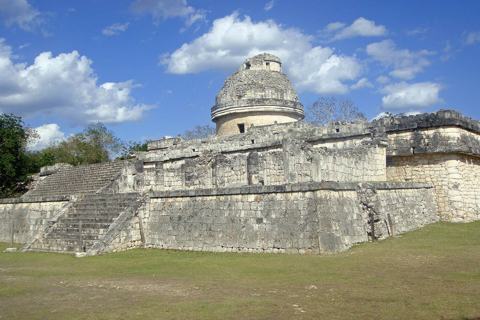
The great Postclassic Maya city of Yucatan — home to Kukulkan's pyramid and the Sacred Cenote, and a decades-long argument over how "Toltec" its art really is.
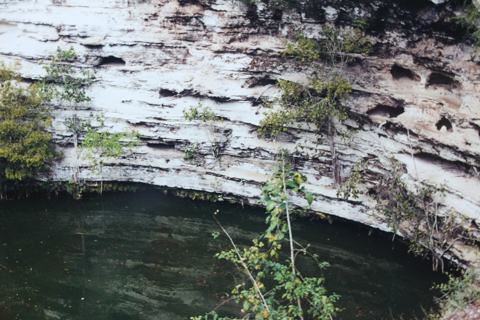
The natural sinkhole at Chichen Itza where the Maya threw offerings of jade, gold, and people, dredged by an American consul in the early 1900s.
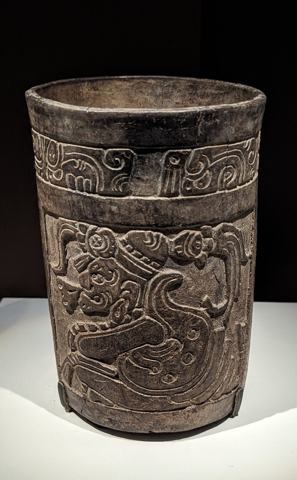
The four brothers who hold up the sky at the world's corners, tied to colours and directions in Landa's account of Maya cosmology and calendar.
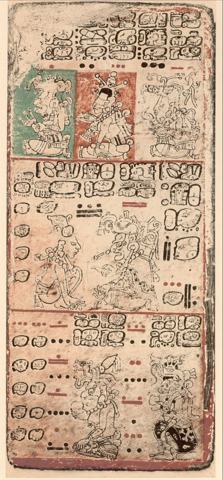
The oldest surviving book of the Americas — a Maya screenfold of astronomical tables, deciphered by a Dresden librarian, that survived a 1945 firestorm.
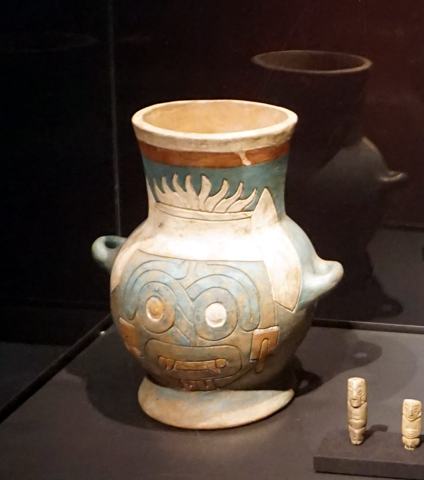
The goggle-eyed rain god who makes things sprout — giver of the storms that feed the maize, keeper of a green paradise, and taker of children.
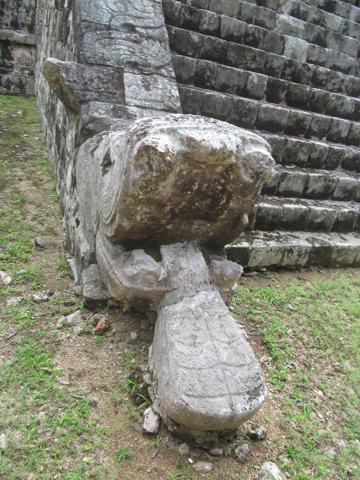
The Feathered Serpent of the Maya — creator's voice in the Popol Vuh, patron of Chichen Itza, and the shadow that descends its pyramid at the equinox.
Also mentioned inAh Puch (Maya Death God)Hunab KuHuracan (Heart of Sky, Maya Storm God)ItzamnaK'awiil (God K)Kinich AhauThe Maya World Tree
Sources & Further Reading
- 1.The Dresden Codex and the Madrid Codex (Postclassic Maya screenfolds).
- 2.Diego de Landa, Relacion de las cosas de Yucatan (c. 1566).
- 3.The Ritual of the Bacabs (colonial Yucatec Maya medical incantations).
- 4.The Books of Chilam Balam (colonial-era Yucatec Maya).
- 5.Taube, Karl. The Major Gods of Ancient Yucatan. Dumbarton Oaks, 1992.
- 6.Miller, Mary & Karl Taube. The Gods and Symbols of Ancient Mexico and the Maya. Thames & Hudson, 1993.
- 7.Sharer, Robert J. with Loa P. Traxler. The Ancient Maya, 6th edition. Stanford University Press, 2006.
Spot an error or have a source to suggest? Write to info@viseterna.com. We cite primary sources and modern scholarship, and we correct fast.