
The Florentine Codex
The 16th-century Nahuatl-Spanish encyclopedia of Aztec life and gods, compiled by a friar with Nahua scholars — the single richest source on Mexica myth.
Pochteca (long-distance merchants) on a trading journey, Florentine Codex, Book 9, painted by Nahua tlacuiloque under the supervision of Bernardino de Sahagun, c. 1575-1577 · Public domain · source
An Encyclopedia Built From Interviews
The Florentine Codex is the modern name for the Historia General de las Cosas de Nueva Espana, "General History of the Things of New Spain," a twelve-book encyclopedia of Nahua religion, government, natural history, and daily life compiled in Mexico City and Tlatelolco between roughly the 1550s and 1577 1,2. Its author of record is Bernardino de Sahagun, a Franciscan friar who arrived in Mexico in 1529, but the work was not his alone: he directed a team of bilingual Nahua graduates of the Colegio de Santa Cruz de Tlatelolco, who interviewed elder informants in Nahuatl, transcribed and organized their answers, and painted the manuscript's roughly 2,500 illustrations 2,4. Leon-Portilla and other historians have called Sahagun the first field ethnographer for exactly this method: structured questioning of named native authorities, cross-checked against multiple informant groups in different towns, rather than a friar simply writing down what he assumed 4.
Two Languages, Twelve Books
The finished manuscript is laid out in two columns per page, Nahuatl on one side and a Spanish version, not always a literal translation, on the other, framed by the paintings 1,2. Book 1 covers the gods; Book 2, the monthly festivals and rites; Book 3, the origin of the gods and the afterlife; Book 4 and 5, the day-count and omens; Book 6, formal rhetoric and prayer; Book 7, the sun, moon, and stars; Book 8, rulers; Book 9, merchants; Book 10, the Nahua people themselves, their vices, virtues, and bodies; Book 11, animals, plants, and minerals; and Book 12, the Spanish conquest as Tlatelolco remembered it 1,2. Modern reference works on Aztec religion, among them Miller and Taube's dictionary of gods and symbols and Taube's survey of Aztec and Maya myth, draw on this book-by-book structure constantly, since between them the twelve books cover nearly every deity and rite this Codex describes 6,7. Later Codex entries lean on this material constantly: the Coyolxauhqui myth comes from Book 3 [and see Coyolxauhqui], the creation of the Fifth Sun from Book 7 [see The Five Suns], and the day-sign lore behind the Tonalpohualli from Books 4 and 5.
From Confiscation Order to Medici Library
Sahagun's project was not welcomed by everyone. In 1577 King Philip II, worried that a Nahuatl compendium of the old religion could help idolatry survive rather than stamp it out, ordered Sahagun's papers seized and sent to Spain, and forbade further work of the kind 1. A fair copy nonetheless reached Europe and, by 1588, had entered the library of the Medici family in Florence, where it remains: three bound volumes, MS Med. Palat. 218-220, in the Biblioteca Medicea Laurenziana, which is where the manuscript's modern name comes from 1. How exactly it moved from a royal confiscation order to a Florentine palace library is not fully documented, and historians can only reconstruct the likely diplomatic channel through gifts among the period's ruling houses 1.
Translating It Back
For nearly four centuries the Florentine Codex was known mainly to specialists able to read sixteenth-century Nahuatl. That changed between 1950 and 1982, when Arthur J. O. Anderson and Charles E. Dibble published the first complete translation into any modern language, English, across thirteen parts issued by the School of American Research and the University of Utah 2. Their work, undertaken over thirty years, is still the standard scholarly edition, and both translators were later honored by the Mexican and Spanish governments for it 2. In 2023 the Getty Research Institute launched a free digital edition with new translations and searchable, page-linked images made from the original Florence manuscript, putting both the paintings and the text in front of a non-specialist audience for the first time 3.
What the Interviews Leave Uncertain
Because the Historia General was assembled from interviews conducted decades after the conquest, by informants who had lived through Spanish evangelization and sometimes through direct interrogation about their own former beliefs, scholars treat it as a filtered source rather than a transparent window onto pre-conquest religion 2,4. It is not even the only such filtered account: the Dominican friar Diego Duran compiled an independent history of the same period from different informants and sources, and where the two overlap, as in the fall of Coyolxauhqui, their agreement is one of the few checks scholars have on either text alone 5. Book 12, the conquest narrative, shows the filtering happening in real time: Sahagun revised it in 1585, producing a version notably softer on Hernan Cortes and the Spanish role than the 1570s original, apparently in response to criticism that the earlier text was too sympathetic to the defeated Mexica 2. Modern readers of the Codex, this site included, treat Sahagun's informants as the best available witnesses to Nahua tradition, while remembering that the Historia General is a colonial document, produced under Franciscan supervision for a Franciscan purpose, and not a direct transcript of Aztec belief before 1519 2,4.
A Living Source
Unlike the pre-conquest screenfolds such as the Codex Borgia, the Florentine Codex was made after the conquest, expressly to record a world its Franciscan sponsors believed was disappearing. That double status, missionary project and irreplaceable ethnography at once, is why it remains the most cited single source behind this Codex's Aztec pantheon entries, from Huitzilopochtli and Tlaloc to the sacrifice ground at Templo Mayor, and why UNESCO added it to the Memory of the World register as one of the foundational documents of the encounter between the Americas and Europe 1,3.
Continue Exploring
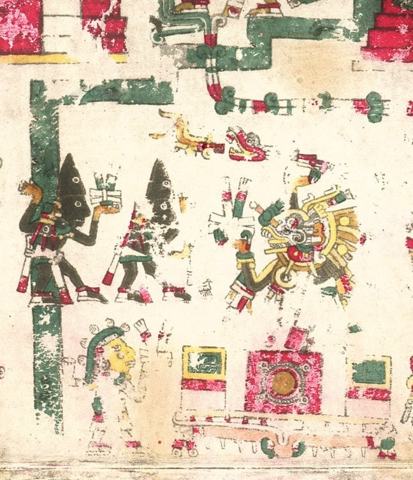
A pre-conquest screenfold of gods and days, painted for diviners to read fate — one of the few Mexican books that survived the conquest untouched.
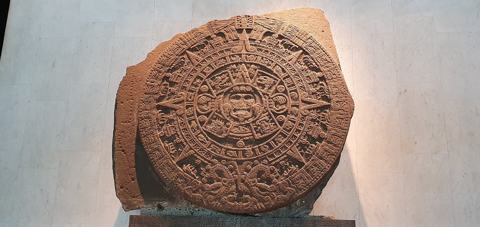
The Aztec myth of four ruined world-ages before this one, each ended by its own catastrophe, in an order and cast of gods the sources don't agree on.
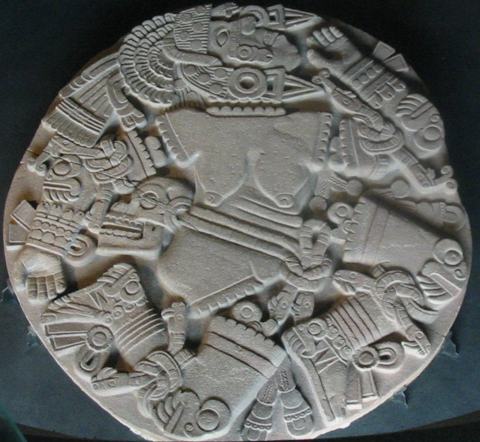
The dismembered sister of Huitzilopochtli, often read as the moon — and the carved disc whose discovery in 1978 uncovered the Templo Mayor itself.
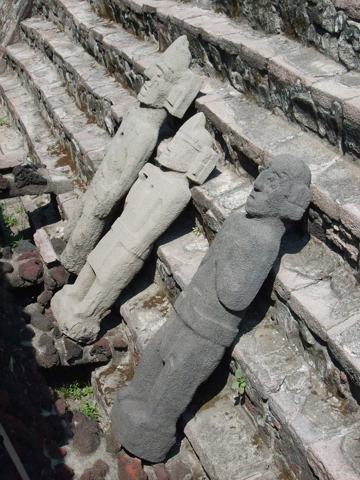
Tenochtitlan's twin pyramid to Huitzilopochtli and Tlaloc, demolished in 1521 and lost until 1978, when electrical workers struck the Coyolxauhqui stone.
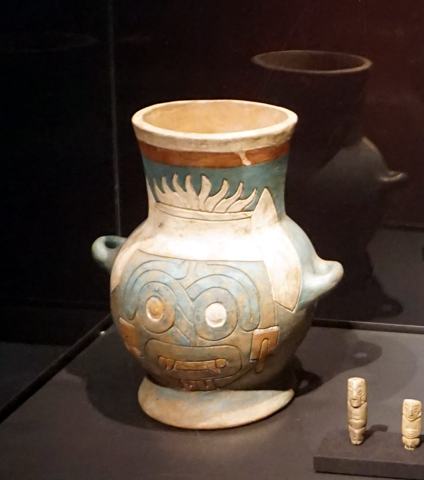
The goggle-eyed rain god who makes things sprout — giver of the storms that feed the maize, keeper of a green paradise, and taker of children.
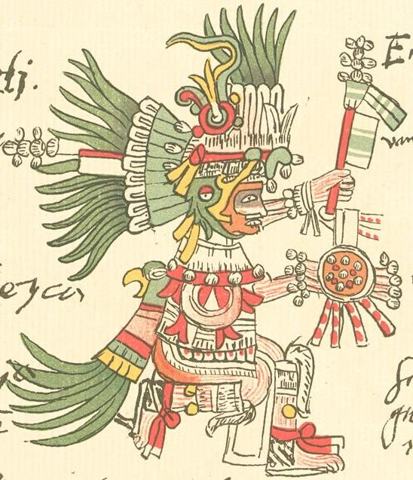
Hummingbird of the Left — the Mexica sun-and-war god, born fully armed on Serpent Mountain and enthroned atop the Great Temple of Tenochtitlan.
Also mentioned inMictlantecuhtli
Sources & Further Reading
- 1.Sahagun, Bernardino de. Florentine Codex — General History of the Things of New Spain (Historia General de las Cosas de Nueva Espana), completed c. 1577. Biblioteca Medicea Laurenziana, Florence, MS Med. Palat. 218-220.
- 2.Sahagun, Bernardino de. Florentine Codex — General History of the Things of New Spain. Translated by Arthur J. O. Anderson and Charles E. Dibble. 13 vols. School of American Research and the University of Utah Press, 1950-1982.
- 3.Getty Research Institute. Digital Florentine Codex — new online edition and translation.
- 4.Leon-Portilla, Miguel. Bernardino de Sahagun -- First Anthropologist. Translated by Mauricio J. Mixco. University of Oklahoma Press, 2002.
- 5.Diego Duran, Historia de las Indias de Nueva Espana e Islas de Tierra Firme (c. 1581).
- 6.Miller, Mary & Karl Taube. The Gods and Symbols of Ancient Mexico and the Maya. Thames & Hudson, 1993.
- 7.Taube, Karl. Aztec and Maya Myths. British Museum Press, 1993.
Spot an error or have a source to suggest? Write to info@viseterna.com. We cite primary sources and modern scholarship, and we correct fast.