
Templo Mayor
Tenochtitlan's twin pyramid to Huitzilopochtli and Tlaloc, demolished in 1521 and lost until 1978, when electrical workers struck the Coyolxauhqui stone.
Standard-bearer figures on an excavated stairway of the Templo Mayor, Mexico City; photograph by Simon Burchell, 2007 · CC BY-SA 4.0 · source
Coatepec, Rebuilt in Stone
The Templo Mayor was the great pyramid at the ceremonial center of Tenochtitlan, the Mexica capital that today lies under the historic core of Mexico City 2. It was built as twin shrines sharing a single stepped base: one staircase climbed to Huitzilopochtli, god of the sun and war, the other to Tlaloc, god of rain, and the whole structure was understood as Coatepec, the Serpent Mountain where Huitzilopochtli was born and defeated his sister Coyolxauhqui, fused with a mountain of sustenance sacred to Tlaloc 2,6. Sahagun's Book 2 describes the festivals staged on its platforms in detail, month by month, including the great war-god festival of Panquetzaliztli, for which the temple precinct was the fixed stage 1.
Seven Temples, One Site
Archaeologists have identified at least seven successive rebuildings of the pyramid, each larger than the last and built directly over its predecessor, spanning roughly two centuries from Tenochtitlan's founding to the Spanish conquest 2. Every expansion was an act of politics as much as devotion: a new king enlarging the temple of the war god was announcing the growth of the empire that fed it captives 2,3. Bernal Diaz del Castillo, who climbed the temple with Hernan Cortes in 1519, left an eyewitness Spanish account of its summit shrines, thick with the smell of old blood and, in his description, hearts still smoking from the day's sacrifice; his memoir was written decades after the fact and is shaped by the conquest narrative he wanted to tell, but it remains the fullest outsider's description of the temple standing and in use 5.
Demolition and Disappearance
After Tenochtitlan fell in 1521, the Spanish tore the temple down and built the new colonial city, including the cathedral, over and around its ruins 2. For nearly 450 years its exact footprint was known only approximately, from colonial-era descriptions and occasional fragments turned up during construction, not from a mapped, excavated site 2.
21 February 1978
That changed by accident. Workers for Mexico City's electric utility, digging behind the cathedral, struck a carved stone disc more than three meters across: the dismemberment monument of Coyolxauhqui 2. The find, described in full in this Codex's Coyolxauhqui entry, triggered the Templo Mayor Project, a systematic excavation led by archaeologist Eduardo Matos Moctezuma that cleared an entire city block of colonial-era buildings to expose the pyramid's stacked construction stages 2. Work continued for years beyond the initial 1978-1982 campaign and has never fully stopped; INAH archaeologists still open new excavation units on adjacent blocks as buildings come up for renovation, and new caches are still reported from the wider precinct 2,3.
What Came Out of the Ground
The excavation recovered more than 200 buried offering caches beneath the temple's floors and stairways, containing tens of thousands of objects: jade and shell ornaments, sacrificed eagles and jaguars, crocodile skeletons, coral, and imported goods from both coasts of the empire and beyond its borders 3,4. Leonardo Lopez Lujan's catalogue of the offerings reads them as a kind of buried map of Tenochtitlan's reach, tribute and trade goods interred as gifts to the gods at the exact center of the city that received them 4. Layered against the temple's rebuilding stages, the offerings let archaeologists match specific caches to specific reigns, turning the pyramid into a stratified political history as much as a religious one 2,3.
The Site Now
The exposed ruins, along with the Museo del Templo Mayor built beside them in 1987 to house the Coyolxauhqui stone and the excavated offerings, form an open-air archaeological site in the middle of downtown Mexico City, wedged between the Metropolitan Cathedral and the National Palace 2,3. Visitors walk a raised path over the pyramid's successive stone shells, looking down into a building sequence that took two hundred years to grow and one Spanish campaign to bury. Broda, Carrasco, and Matos Moctezuma's essay collection remains the standard scholarly synthesis of what the excavation changed about the understanding of Aztec religion and statecraft, arguing that the temple's layered offerings and architecture encode an empire's self-image more precisely than any single written source 3.
Continue Exploring
The goggle-eyed rain god who makes things sprout — giver of the storms that feed the maize, keeper of a green paradise, and taker of children.
Hummingbird of the Left — the Mexica sun-and-war god, born fully armed on Serpent Mountain and enthroned atop the Great Temple of Tenochtitlan.
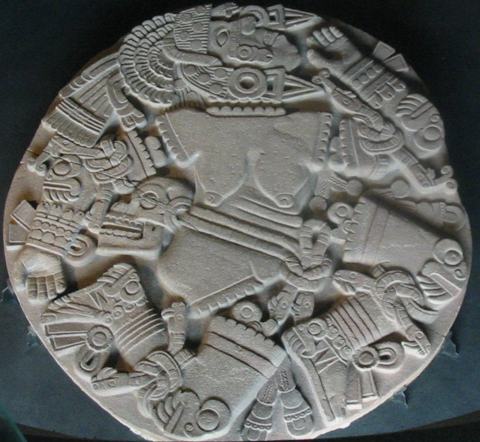
The dismembered sister of Huitzilopochtli, often read as the moon — and the carved disc whose discovery in 1978 uncovered the Templo Mayor itself.
The 16th-century Nahuatl-Spanish encyclopedia of Aztec life and gods, compiled by a friar with Nahua scholars — the single richest source on Mexica myth.
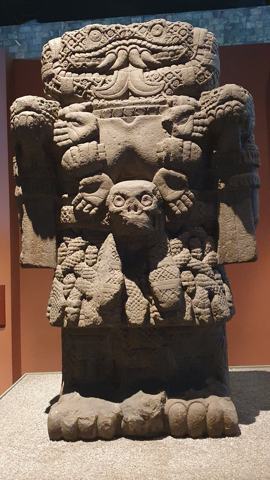
She of the Serpent Skirt — the Mexica earth mother who conceived Huitzilopochtli from a ball of feathers, and the colossal monolith that carries her name.
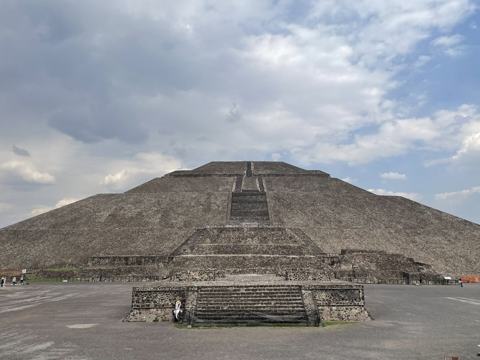
A vast city already ancient when the Aztecs found it, mythologised by them as the place where the gods sacrificed themselves to make the Fifth Sun.
Also mentioned inAztlanThe Aztec Sun StoneThe Flower Wars (Xochiyaoyotl)Xiuhtecuhtli (Aztec Fire Lord)
Sources & Further Reading
- 1.Bernardino de Sahagun, Florentine Codex — General History of the Things of New Spain (c. 1547-1579), Book 2.
- 2.Matos Moctezuma, Eduardo. The Great Temple of the Aztecs: Treasures of Tenochtitlan. Thames & Hudson, 1988.
- 3.Broda, Johanna, David Carrasco & Eduardo Matos Moctezuma. The Great Temple of Tenochtitlan: Center and Periphery in the Aztec World. University of California Press, 1988.
- 4.Lopez Lujan, Leonardo. Las ofrendas del Templo Mayor de Tenochtitlan. Instituto Nacional de Antropologia e Historia, 1993.
- 5.Diaz del Castillo, Bernal. Historia verdadera de la conquista de la Nueva Espana (c. 1568; first published 1632).
- 6.Miller, Mary & Karl Taube. The Gods and Symbols of Ancient Mexico and the Maya. Thames & Hudson, 1993.
Spot an error or have a source to suggest? Write to info@viseterna.com. We cite primary sources and modern scholarship, and we correct fast.