
Ahuizotl (the Water Creature)
A small, dog-sized water beast with a hand at the end of its tail, said to drown swimmers and eat their eyes, nails, and teeth.
Feather-mosaic shield traditionally associated with the ruler Ahuizotl, Mexica, late 15th-early 16th century (Weltmuseum Wien) · CC BY-SA 4.0 · source
A Small, Wet, Dangerous Thing
The ahuizotl appears in Book 11 of the Florentine Codex among the animals of lakes and streams, described in close physical detail rather than as an abstract monster: dog-sized, with small pointed ears, fur that stays waterproof and bristles when wet, and skin Sahagun's informants compare to black, smooth rubber 1. Its most distinctive feature is its hands — one at the end of each forepaw like a small monkey's or raccoon's, and a fifth at the tip of its long tail, shaped like a human hand and able to grip 1,4. It lived in deep pools, sinkholes, and the waters around Lake Texcoco, and its Nahuatl name is usually read as "spiny thing of the water," built from atl, water, though the exact etymology is debated 4,5.
How It Hunted
The Florentine Codex describes the ahuizotl as an active lure, not merely a threat lurking to be stumbled on. It cried out at night in a voice resembling a human infant's wail, or agitated fish and frogs into jumping so that a fisherman or a curious passerby would be drawn to the water's edge to investigate 1. Once someone came close enough, the hand at the end of its tail shot out and dragged them under 1,5.
Eyes, Nails, and Teeth
What happened next is one of the more specific and grim details in the Mesoamerican bestiary. The ahuizotl did not simply drown its catch; Sahagun's account has it eating the victim's eyes, fingernails, and teeth, and afterward releasing the body to float back to the surface days later, missing exactly those parts, as a kind of signature 1,4. In some tellings the creature acted as an agent rather than a free predator, sent out by Tlaloc and Chalchiuhtlicue to collect the souls of people the rain gods wanted for themselves — meaning an ahuizotl death, horrifying as the mechanics sound, could also mark the victim as bound for Tlalocan rather than the ordinary underworld 1,4.
A Ruler's Emblem
The creature's name was also a Mexica personal name, most famously that of Ahuizotl, eighth ruler of Tenochtitlan, who reigned from 1486 to 1502 and presided over one of the empire's periods of greatest military expansion 2. The Codex Mendoza, the primary pictorial source for the sequence of Mexica rulers, records his name-glyph in the standard convention of the genre: a small animal figure standing in for the sound and sense of his name, the same beast Sahagun's naturalists describe in Book 11 2. Naming a ruler after a dangerous, hard-to-see water predator fits a broader Mexica pattern of taking animal and nature names as marks of power rather than as anything to be softened for comfort 4.
The Shield in Vienna
A feather-mosaic war shield, or chimalli, now held in the Weltmuseum Wien and traditionally called the "Ahuizotl shield," carries a mosaic image of a fanged, clawed, blue-furred quadruped with an elaborately curling tail, worked in hummingbird and other feathers over a wood-and-hide frame 4. It is one of a small group of surviving Mexica featherwork objects, most of them long housed in European collections after being sent to the Habsburg court in the early sixteenth century, and its animal device is generally read as connected either to the ruler's own name-glyph or to a coyote-type war emblem associated with the office rather than as a literal illustrated portrait of the Book 11 lake creature 4,6. The two readings are not mutually exclusive — a ruler named for a fearsome water beast could plausibly carry its image into battle either way — and the surviving scholarship has not settled which is closer to what the shield's sixteenth-century owner understood himself to be wearing 4,6.
What Kind of Creature
Zelia Nuttall's late nineteenth-century survey of Mexican folklore treated the ahuizotl as a genuine survival of pre-conquest belief still remembered, in altered form, among her contemporaries, rather than as a purely literary invention of Sahagun's informants 3. Modern reference works file it as one of a family of Mesoamerican water-monsters that includes crocodilian earth-beasts and lake serpents, sharing the basic logic that deep water is a border, and that what waits on its far side does not play fair 4,5.
Continue Exploring
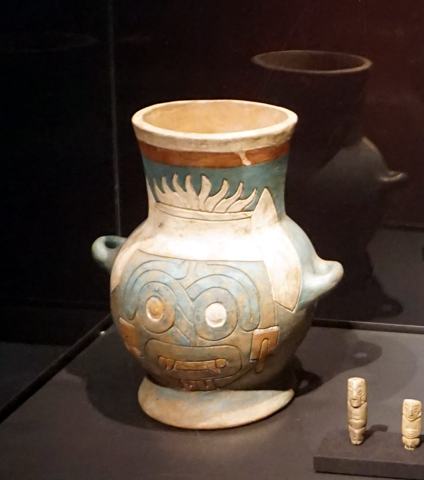
The goggle-eyed rain god who makes things sprout — giver of the storms that feed the maize, keeper of a green paradise, and taker of children.
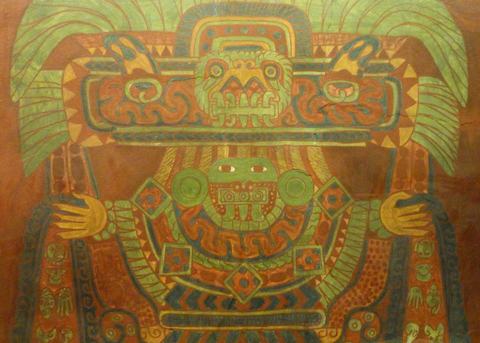
The rain god's paradise of unfailing summer, reserved for those the water took — and the name modern scholars gave a debated mural at Teotihuacan.
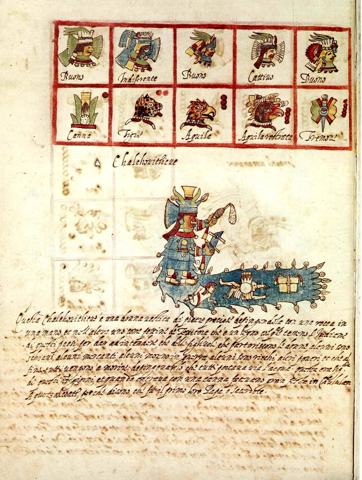
Tlaloc's consort and goddess of lakes and rivers, who ruled the Fourth Sun that ended in flood, and whom midwives invoked to bathe every newborn child.
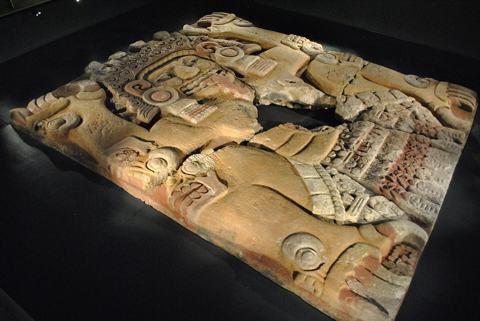
The crocodilian earth deity torn in two to make sky and ground — and the twelve-ton painted monolith of her unearthed at the Templo Mayor in 2006.
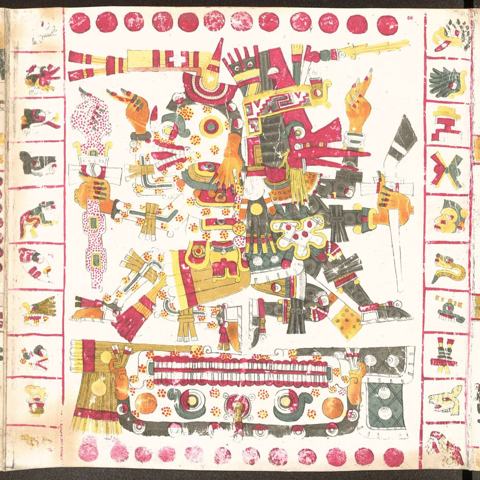
The Place of the Dead — a ninefold underworld reached by a four-year journey, where the ordinary dead arrive at last and simply cease.
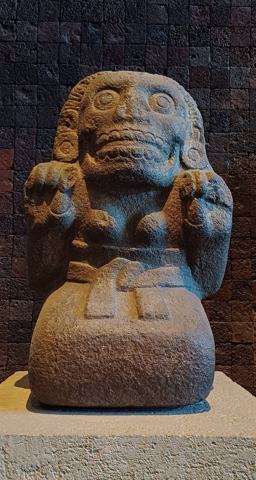
Deified spirits of women who died in childbirth, honored as fallen warriors by day and feared as child-stealing ghosts on certain nights.
Sources & Further Reading
- 1.Bernardino de Sahagun, Florentine Codex — General History of the Things of New Spain (c. 1547-1579), Book 11.
- 2.Codex Mendoza (c. 1541).
- 3.Nuttall, Zelia. "A Note on Ancient Mexican Folk-Lore." Journal of American Folklore, 1895.
- 4.Miller, Mary & Karl Taube. The Gods and Symbols of Ancient Mexico and the Maya. Thames & Hudson, 1993.
- 5.Read, Kay Almere & Jason J. Gonzalez. Handbook of Mesoamerican Mythology. ABC-CLIO, 2000.
- 6.Taube, Karl. Aztec and Maya Myths. British Museum Press, 1993.
Spot an error or have a source to suggest? Write to info@viseterna.com. We cite primary sources and modern scholarship, and we correct fast.