
The Dagda
The good god — not morally good but good at everything: the club-bearing, cauldron-owning father figure of the Tuatha De Danann, and their crudest comedian.
Newgrange passage tomb, Brú na Bóinne, Barbara y Eugenio, 2007 · CC BY 2.0 · source
What His Name Actually Means
The Dagda is one of the leading figures of the Tuatha De Danann, the divine race of medieval Irish literature. His name is regularly analysed as dago-dewos, "good god," and the texts are unusually explicit that "good" here means competent rather than virtuous 5,6. In Cath Maige Tuired he tells the assembled Tuatha De that he will do everything they have each promised to do on their own, and they answer, "It is you who are the good god" 1.
He carries other names. Eochaid Ollathair, "Eochaid All-Father," and Ruad Rofhessa, "Red One of Great Knowledge," attach to him across the tradition, and he is variously father, brother, or son of other Tuatha De figures depending on the text — a fluidity typical of a mythology preserved by Christian monks assembling much older material into pseudo-history 1,2,5. He is almost always definite: the Dagda, a title rather than a personal name 6.
Club, Cauldron, and Harp
Three possessions define him. His weapon is the lorg mor, an enormous club so heavy that it is dragged on wheels and leaves a track like a boundary ditch; one end of it kills, and the other end restores the dead to life 1,5. The double function is the point, and it recurs in Irish material as a way of marking a power that is not simply destructive 5,7.
His cauldron, the coire ansic or "undry," is one of the four treasures the Tuatha De bring to Ireland, and Lebor Gabala Erenn names its city of origin as Murias; no company ever went away from it unsatisfied 2,5. His harp, called Uaithne, is stolen by the Fomorians and summoned back to his hand across their hall; it plays the three strains that Irish tradition assigns to a master harper — goltraige, the sorrow strain, gentraige, the laughter strain, and suantraige, the sleep strain — and he uses them in that order on his enemies 1,5.
The Porridge and the Truce
Cath Maige Tuired, the central text for the Dagda, gives him one of the great comic set-pieces of early Irish literature, and it is deliberately undignified. Sent to the Fomorian camp to stall for time, he is served porridge in the king's own cauldron — eighty gallons of milk, meal and fat, with whole goats, sheep, and pigs boiled in — and told he will be killed if he does not eat all of it 1.
He does, scraping the pit with a ladle big enough for a man and woman to lie in, and falls asleep with his belly distended 1. What follows is coarse: his gait is described in unsparing detail, he is mocked, and he then sleeps with a Fomorian woman who, in return, promises to turn her magic against her own people 1. Gray's edition treats the sequence as functional rather than merely crude — the Dagda absorbs the enemy's excess and converts it into an alliance, and the humour is part of how the text characterises him 1,6.
The Morrigan at the Ford
Before the same battle, the Dagda keeps an appointment. At Samhain he meets a woman washing at the river Unius in Connacht, standing with one foot on either bank, and they couple; the place is afterwards called "the Bed of the Couple" 1. She is The Morrigan, and having lain with him she promises to destroy the Fomorian king Indech and to take from him "the blood of his heart and the kidneys of his valour," which she delivers to the Irish forces at the ford 1.
The scene is one of the clearest surviving examples of an Irish sovereignty motif: union with a territorial goddess at a boundary of time and place secures victory in the land she represents 1,5,7. The Dagda's other liaisons follow a similar pattern, including one with Boand, whose river he is entangled with in the Dindshenchas 3,4.
Boand, Aengus, and the Brug
The Dagda's affair with Boand, wife of Nechtan and the personification of the river Boyne, produces Aengus, called Mac Oc, "the young son" 3,4. To conceal the pregnancy the Dagda halts the sun so that nine months pass in what appears to be a single day, and the child is born and fostered away 4,5.
Aengus later takes the great mound of Brug na Boinne — Newgrange — from his father by a trick of words, asking for it for a day and a night, an Old Irish phrase that can also mean "for all days and nights," and refusing to leave 4,5. Some recensions transfer the trick to Aengus dispossessing Elcmar instead, and the Dindshenchas place-lore keeps the Dagda associated with the Boyne monuments regardless 3,4. The identification of literary Brug na Boinne with the real Neolithic passage tomb is a genuine link between medieval text and standing archaeology, though the monument is three thousand years older than the stories told about it 3,6.
Reading Him Carefully
Two cautions are worth stating. First, the Dagda comes to us entirely through medieval Irish manuscripts written by Christian scholars, who arranged the Tuatha De Danann into an invasion sequence of pseudo-history in Lebor Gabala Erenn and who felt free to euhemerise gods into kings 2,6. Nothing about him is attested in pre-Christian Irish writing, because there was none of any length 6.
Second, the frequent comparison with Gaulish material — the mallet-carrying Sucellus, or Caesar's remark that the Gauls claim descent from Dis Pater — is a suggestion, not a demonstration 7. Green notes the resemblance of the club-and-cauldron complex to continental iconography while making clear that the Irish and Gaulish evidence are separated by centuries, a sea, and completely different kinds of source 7. What survives securely is a figure the texts themselves treat as enormous, capable, appetitive, and funny — a father god who is never once solemn 1,5.
Continue Exploring
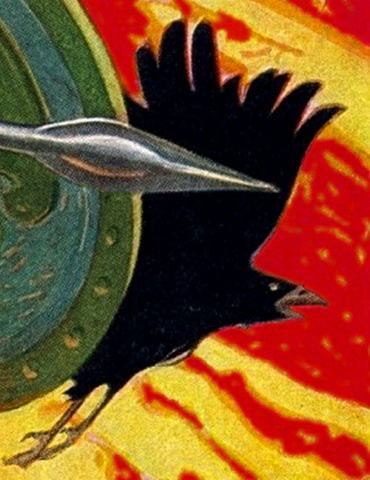
The great queen of war and fate — a shape-shifting Irish goddess who takes crow form above the battlefield and decides its outcome before it is fought.
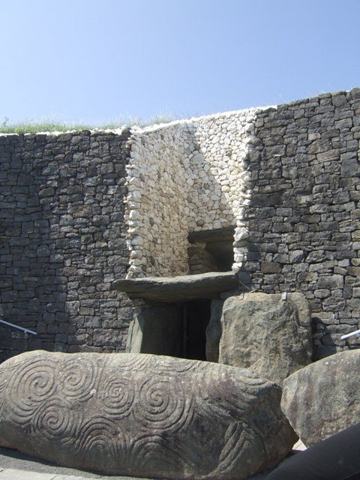
A 5,000-year-old passage tomb on the Boyne, built for the winter solstice centuries before the Celts arrived — later remembered as the Dagda's own hall.
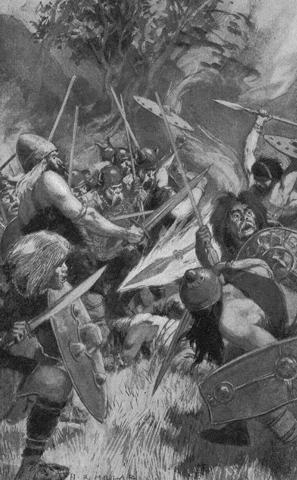
Ireland's race of gods — arriving with four treasures from four lost cities, winning Ireland twice, then losing it once and withdrawing into the mounds.
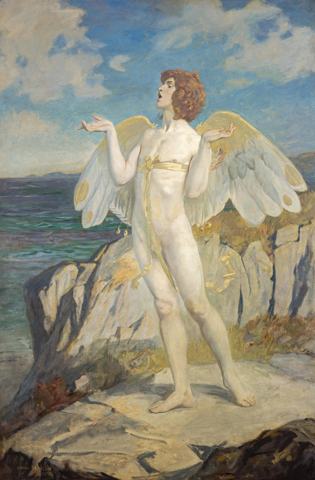
The young god of Brú na Bóinne — conceived in a stolen day, owner of a house won by a pun, and the lover who followed a dream into a lake of swans.
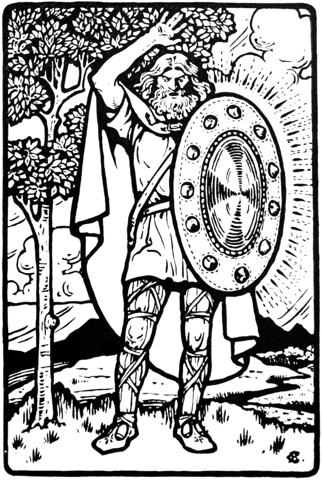
The Irish sea god — ferryman between worlds, master of illusion and the mist of invisibility, and the presiding figure of the Otherworld voyages.
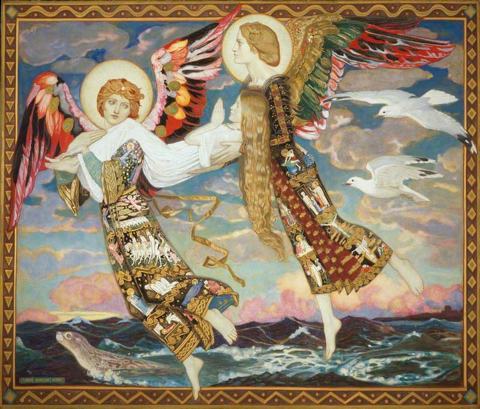
Goddess of poetry, smithcraft and healing — a triple Brigit in the glossaries, a saint at Kildare, and the figure Imbolc still belongs to.
Also mentioned inCernunnosDanuLebor Gabala Erenn (The Book of Invasions)OgmaSamhainTaranis (Celtic Thunder God)The Fomorians (Fomoire)The Four Treasures of the Tuatha De DanannThe Holy Grail
Sources & Further Reading
- 1.Cath Maige Tuired: The Second Battle of Mag Tuired, ed. and trans. Elizabeth A. Gray. Irish Texts Society vol. 52, 1982.
- 2.Lebor Gabala Erenn (The Book of the Taking of Ireland), ed. R. A. S. Macalister. Irish Texts Society, 1938–1956.
- 3.The Metrical Dindshenchas, ed. and trans. Edward Gwynn. Royal Irish Academy, 1903–1935.
- 4.Tochmarc Etaine (The Wooing of Etain), Middle Irish.
- 5.MacKillop, James. Dictionary of Celtic Mythology. Oxford University Press, 1998.
- 6.Koch, John T. (ed.). Celtic Culture: A Historical Encyclopedia. ABC-CLIO, 2006.
- 7.Green, Miranda J. Dictionary of Celtic Myth and Legend. Thames & Hudson, 1992.
Spot an error or have a source to suggest? Write to info@viseterna.com. We cite primary sources and modern scholarship, and we correct fast.