
The Morrigan
The great queen of war and fate — a shape-shifting Irish goddess who takes crow form above the battlefield and decides its outcome before it is fought.
The Morrigan, Joseph Christian Leyendecker, 1911 (book illustration) · Public domain · source
Who the Morrigan Is
The Morrígan is the Irish goddess of war, sovereignty, and prophecy: a shape-shifter who appears as a crow over armies, as a beautiful woman offering herself to a hero, as an eel, a wolf, a heifer, and an old woman milking a cow 5. She belongs to the Tuatha Dé Danann, the divine race of Irish tradition, and she is less a combatant than a decider — the presence whose arrival tells you the battle is already settled 5,6.
She is often assumed to be a straightforward war goddess on the Valkyrie model. The Irish material is stranger than that. Her power operates through prophecy, satire, sexual encounter, and the fertility of the land at least as much as through violence 6.
The Name, and a Warning About the Sources
Her name is genuinely contested. Read with a long vowel, Mór-Rígan means "great queen"; read short, Morrígan has been connected to an Indo-European root for terror and nightmare — the same family as the mare in English "nightmare" — giving "phantom queen" 5. Medieval Irish glossators offered both, and modern scholarship has not closed the case 5,6.
Everything we know about her comes from manuscripts written by Christian monks, centuries after Irish paganism had ceased to be practised, in a literary culture with its own aims 5,6. There are no pagan Irish scriptures. The tales preserve real mythological material, but they preserve it through a filter, and Clark's study is largely an account of how the filter progressively demoted the goddesses it transmitted 6.
Three Sisters, or One Goddess
Lebor Gabála Érenn lists three daughters of Ernmas among the Tuatha Dé Danann: Badb, Macha, and the Morrígan, the last also named Anann 1. Elsewhere the trio is Badb, Macha, and Nemain, or the Morrígan appears alone; the names shuffle between texts and one figure's deeds are attributed to another 1,5.
The most economical reading, and the common scholarly one, is that these are aspects of a single complex war-and-sovereignty goddess who could be counted as one or as three depending on the text — triplicity being a habit of Celtic religion generally, visible in Romano-Celtic sculpture as well as in Irish narrative 5,6. Badb, "crow" or "scald-crow," is the aspect most tightly bound to the battlefield bird 5.
The Dagda at the Ford
In Cath Maige Tuired, before the Tuatha Dé Danann fight the Fomorians, the Dagda comes to a river at Samhain and finds the Morrígan straddling it, washing, one foot on each bank 2. They couple there, and the place is thereafter called the Bed of the Couple 2.
What she gives him is intelligence and a guarantee. She tells him where the Fomorians will land and what he must do, and promises to take on the enemy king Indech mac Dé Domnann herself — pledging to deprive him of "the blood of his heart and the kidneys of his valour," which she later delivers to the assembled hosts 2. The sequence is a compact statement of what she is: the sovereignty of the land, met at a boundary, granting victory in exchange for union 6.
After the battle she proclaims the triumph to the high places of Ireland, and then delivers a second poem — a prophecy of moral collapse and the end of the world, one of the bleakest passages in medieval Irish literature 2.
Cu Chulainn and the Three Shapes
Her most sustained appearance is opposite the hero Cú Chulainn in the Táin Bó Cúailnge. She comes to him as a young woman offering her love while he is defending Ulster single-handed. He refuses her curtly, saying he has no time for women's backsides while under this pressure — and she promises to hinder him 3.
She keeps the promise in three forms during his combat at the ford: an eel that wraps his legs and trips him, a grey she-wolf that stampedes cattle across him, and a hornless red heifer leading the herd. He wounds each — the eel's ribs, the wolf's eye, the heifer's leg 3. Later he meets an old woman milking a cow with three teats, wounded in exactly those three places. Not recognising her, he blesses her for each drink she gives him, and the three blessings heal the three wounds 3. It is a characteristically Irish resolution: the hero cannot beat her, and her injuries are undone by his own courtesy.
In Táin Bó Regamna she confronts him earlier still, driving a cow with a red woman on a chariot drawn by a one-legged red horse, and warns him in riddles of the great cattle raid to come and of his death 4. At his death, in the later tale, a crow settles on his shoulder — the sign to his enemies that he is finally gone 5.
The Washer at the Ford
One of the darkest images attached to her circle is the washer at the ford: a woman found rinsing bloodied armour and severed limbs in a river, who tells the warrior who asks that the gear is his own 5. The motif appears in the death-tales of heroes and kings and marks the point at which fate is no longer negotiable 5,6.
From Goddess to Banshee
The Morrígan did not survive Christianisation as a goddess; she survived as folklore. Clark traces the long decline by which the great queens of the early literature become mortal queens, then hags, then victims — and the badhbh of later Irish tradition becomes a death-omen figure that merges into the banshee (bean sí), the wailing woman who cries before a death in the family 6. The washer at the ford and the bean nighe of Scottish tradition belong to the same descent 5,6.
Modern Pagan and Celtic reconstructionist practitioners venerate the Morrígan today, drawing on these medieval texts. That devotion is a contemporary religious movement rather than an unbroken continuation of pre-Christian Irish cult, and it is worth naming the difference plainly 6.
Continue Exploring
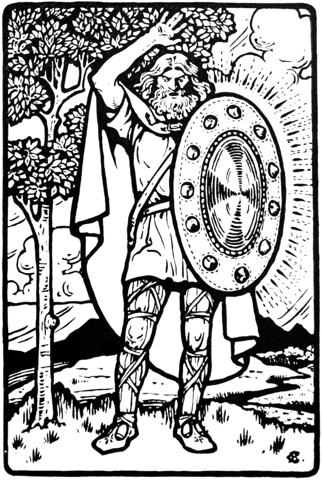
The good god — not morally good but good at everything: the club-bearing, cauldron-owning father figure of the Tuatha De Danann, and their crudest comedian.
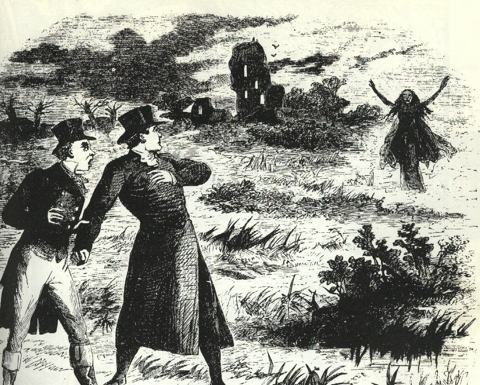
Herald of death — the "woman of the mound," heard rather than seen, whose keening outside a house announces that someone of the family is about to die.
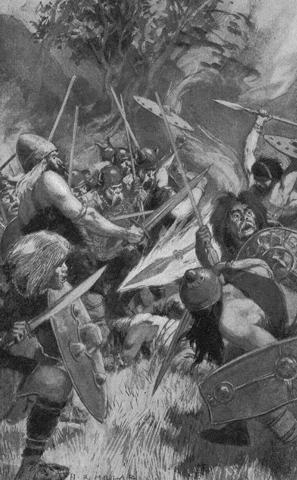
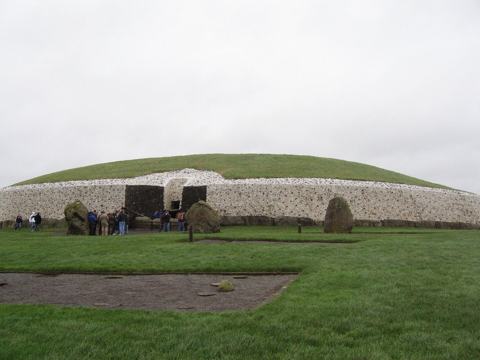
Ireland's race of gods — arriving with four treasures from four lost cities, winning Ireland twice, then losing it once and withdrawing into the mounds.
The Irish sea god — ferryman between worlds, master of illusion and the mist of invisibility, and the presiding figure of the Otherworld voyages.
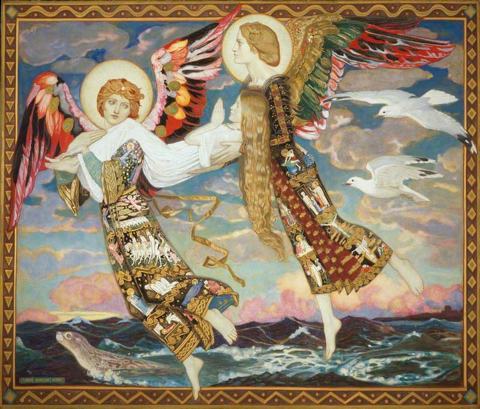
Goddess of poetry, smithcraft and healing — a triple Brigit in the glossaries, a saint at Kildare, and the figure Imbolc still belongs to.
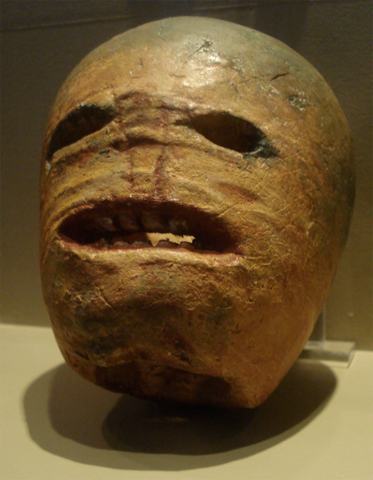
The Gaelic quarter day that opened winter and the Otherworld alike in medieval Irish literature — not, despite a popular myth, the name of a god of the dead.
Also mentioned inCu ChulainnMorgan le FayTain Bo Cuailnge (The Cattle Raid of Cooley)
Sources & Further Reading
- 1.Lebor Gabala Erenn — The Book of Invasions (Middle Irish).
- 2.Cath Maige Tuired — The Second Battle of Mag Tuired (Old/Middle Irish; MS British Library Harley 5280).
- 3.Tain Bo Cuailnge, Recension I (Book of the Dun Cow / Yellow Book of Lecan).
- 4.Tain Bo Regamna (Middle Irish).
- 5.MacKillop, James. Dictionary of Celtic Mythology. Oxford University Press, 1998.
- 6.Clark, Rosalind. The Great Queens: Irish Goddesses from the Morrigan to Cathleen Ni Houlihan. Colin Smythe, 1990.
Spot an error or have a source to suggest? Write to info@viseterna.com. We cite primary sources and modern scholarship, and we correct fast.