
Taranis (Celtic Thunder God)
The Gaulish thunder god named by a Roman poet, sacrificed to by burning according to later scholiasts, and pictured with Jupiter's wheel.
Bronze statuette of Jupiter-Taranis with wheel and thunderbolt, from Le Chatelet, Gourzon, Haute-Marne, France · Public domain · source
Three Names in a Roman Poem
Taranis enters recorded history by way of a single line of Latin poetry. Lucan's Pharsalia, an epic on Rome's civil war written around 65 CE, lists three Gaulish gods who receive human sacrifice, naming Teutates, Esus, and Taranis in their own Gaulish forms rather than translating them into Roman equivalents — unusual for a Roman poet writing about a conquered people's religion 1. That Lucan preserves native names at all is the reason this passage is quoted in nearly every account of Gaulish religion; whether the three actually formed a fixed triad in Gaulish practice, or whether Lucan simply reached for three memorable names to make a point about Gaulish savagery, is a real question the poem itself does not answer 1,6.
The name is close enough to reconstructed Celtic toranos, "thunder" — cognate with Old Irish torann and Welsh taran — that "Taranis" reads transparently as "the Thunderer," a title rather than evidence of personality or myth 5,7.
What the Scholiasts Added
Lucan's line names three gods and says only that they demand blood. The detail of how comes from a much later source: the Commenta Bernensia, scholarly notes on the Pharsalia compiled in the early medieval period but drawing, at least in part, on older material now otherwise lost. The scholia claim that victims of Teutates were drowned head-first in a vessel of liquid, that Esus's were hung from a tree and cut, and that Taranis's were burned inside a container of wood 2. Modern scholarship treats this late, secondhand testimony with real caution — it postdates Lucan by the better part of a millennium, and its account of burning has been connected, not always convincingly, to Caesar's separate and equally suspect description of the Gaulish wicker man 2,6.
Jupiter of the Wheel
Roman-period inscriptions from Gaul, Britain, and the German provinces repeatedly equate a native thunder-god with Jupiter, sometimes explicitly under a Taranis-derived name. Alongside these texts is a body of iconography, concentrated in eastern Gaul and the Rhineland between the second and third centuries CE, showing a bearded, Jupiter-type figure holding a thunderbolt in one hand and a large spoked wheel in the other or resting against his leg — a type sometimes mounted on tall carved pillars known as Jupiter-Giant columns 4,5. The wheel had no place in classical Jupiter iconography before the Roman conquest of Gaul; its appearance there is a native addition grafted onto an imported visual language 4.
An Altar at Chester
Britain preserves a single direct inscription to the god by name. An altar found on Foregate Street in Chester in 1653, and now held among the Arundel Marbles at the Ashmolean Museum, is dedicated Iovi Optimo Maximo Tanaro — "to Jupiter Best and Greatest, the Thunderer" — by Lucius Elufrius Praesens, a princeps of the Twentieth Legion Valeria Victrix originally from Clunia in Spain, dated by its consular formula to 154 CE 3. It is a small, precise piece of evidence: one soldier, one altar, one otherwise unremarkable act of religious bookkeeping, and the closest thing Roman Britain offers to direct testimony that Taranis was a real object of cult rather than only a name in a poem 3,6.
A Debated Identification
The equation of the wheel-bearing Jupiter type with Taranis specifically is an inference, not a documented fact, and it is worth stating plainly that no surviving wheel-and-thunderbolt image is itself labelled with the god's name 4,5. Green's study of the wheel motif argues that its meaning may be closer to solar symbolism than to thunder as such, connecting it to sun-wheel imagery found elsewhere in Iron Age Europe, and treats the Taranis identification as a reasonable working hypothesis rather than a settled conclusion 4. The convenience of the equation — a named thunder-god from a literary source, a wheel-bearing Jupiter from the archaeology, and Jupiter's own thunderbolt as the obvious connecting thread — is exactly what should make a careful reader pause before treating it as proven 4,7.
Reading a God Through Roman Eyes
Everything gathered under the name Taranis comes from outside sources: a Roman poet writing decades after the conquest of Gaul, medieval scholiasts working from now-lost material, and Latin votive formulas carved by soldiers using an imported religious grammar to address a native god 1,2,3. Unlike Lugh or the Dagda, Taranis has no surviving native narrative at all — no birth, no battle, no death — and belongs instead with Cernunnos and Epona among the Gaulish deities the Codex can describe only from the outside: through Roman description, Roman equation, and Roman stone 5,6,7.
Continue Exploring
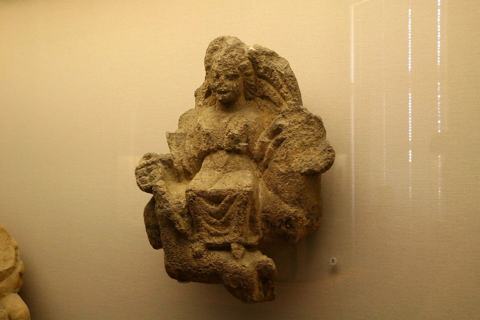
The Gaulish horse goddess whose cult rode with Rome's cavalry — the only Celtic deity ever given a day on the Roman religious calendar.
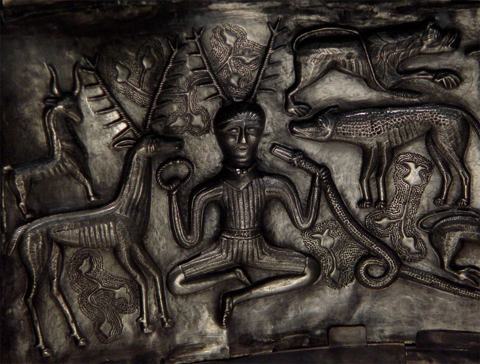
The horned one — an antlered Gaulish god known from images alone, whose name survives on exactly one damaged stone and who has no surviving myth at all.
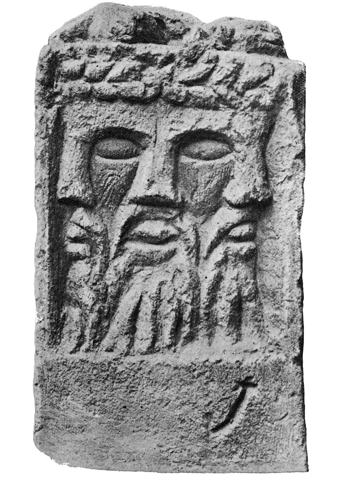
Master of every skill — the young god admitted to Tara because he alone could do all the crafts at once, and who killed his own grandfather Balor.

The good god — not morally good but good at everything: the club-bearing, cauldron-owning father figure of the Tuatha De Danann, and their crudest comedian.
The mother goddess of the Tuatha De Danann — and the most famous Irish deity who may never have existed under that name.
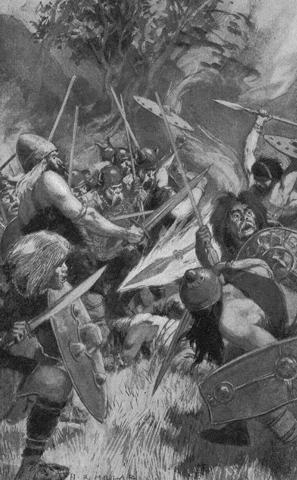
Ireland's race of gods — arriving with four treasures from four lost cities, winning Ireland twice, then losing it once and withdrawing into the mounds.
Sources & Further Reading
- 1.Lucan. Pharsalia (Bellum Civile), Book I, lines 444-446 (c. 65 CE).
- 2.Commenta Bernensia (the Berne scholia) on Lucan's Pharsalia, medieval compilation incorporating earlier material.
- 3.RIB 452. Altar dedicated to Jupiter Optimus Maximus Tanarus, Chester, AD 154. Roman Inscriptions of Britain.
- 4.Green, Miranda J. The Wheel as a Cult-Symbol in the Romano-Celtic World: Aspects of Development from Roman to Medieval Europe. Collection Latomus vol. 183, 1984.
- 5.MacKillop, James. Dictionary of Celtic Mythology. Oxford University Press, 1998.
- 6.Koch, John T. (ed.). Celtic Culture: A Historical Encyclopedia. ABC-CLIO, 2006.
- 7.Green, Miranda J. Dictionary of Celtic Myth and Legend. Thames & Hudson, 1992.
Spot an error or have a source to suggest? Write to info@viseterna.com. We cite primary sources and modern scholarship, and we correct fast.