
Cernunnos
The horned one — an antlered Gaulish god known from images alone, whose name survives on exactly one damaged stone and who has no surviving myth at all.
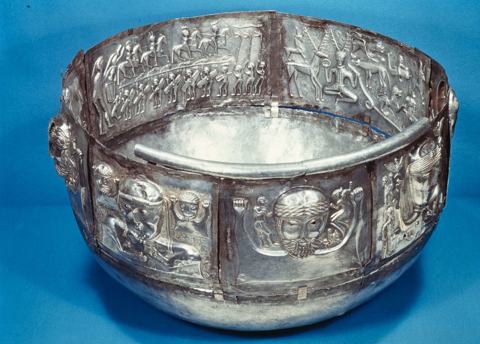
Antlered figure (Cernunnos), Gundestrup Cauldron, c. 150-1 BCE (National Museum of Denmark) · CC BY-SA 3.0 · source
One Name, One Stone
Almost everything popularly said about Cernunnos rests on a single inscription. The Pillar of the Boatmen, erected in Lugdunum of the Parisii — Paris — by a guild of sailors during the reign of Tiberius, carries a series of carved panels naming gods, and on one of them an antlered head appears above the letters _ERNUNNOS, with the first character lost 1. The restoration to Cernunnos is standard and near-universally accepted, and it is the only time in antiquity that the name is known to be written down 1,7.
The name is transparent enough: Gaulish karnon means "horn," so the word means something like "the horned one" or "the antlered one" 7,8. Whether that was his personal name or a descriptive title applied to a type of god is unknowable from one damaged inscription, and the possibility that "Cernunnos" was a generic epithet used of several regional deities is taken seriously 7.
There are no myths. Not a single narrative involving Cernunnos survives from any ancient source, in any language. Everything else is iconography 4,5.
The Gundestrup Cauldron
The most famous image is not from Gaul at all. The Gundestrup cauldron, a large silver vessel found dismantled in a Danish peat bog in 1891, carries on one inner plate a cross-legged figure with stag's antlers, holding a torc in one hand and a ram-horned serpent in the other, surrounded by a stag, a boar, lions, a dolphin-riding rider, and other beasts 2.
The cauldron is a genuinely awkward object for Celtic studies. Its silverworking technique points to Thracian craftsmanship, its imagery mixes Celtic motifs with elements that look Near Eastern, and its date is argued anywhere between the second century BCE and the first century CE 2,5. It was found hundreds of miles outside the Celtic-speaking world. It is still the single richest image of the antlered god type, and it is reproduced on more book covers about the Celts than any other artefact 2,7.
The Iconographic Type
Bober's 1951 catalogue is the foundational scholarly treatment, gathering the representations of the antlered god from across Gaul and northern Italy and analysing the type rather than assuming a single deity behind it 4. The recurring features are consistent: antlers, frequently a torc worn or held, often a second torc or a purse spilling coins or grain, a cross-legged seated posture, and animal company — the stag above all, and the ram-horned snake, a creature with no natural counterpart that appears repeatedly in Gaulish art 4,5.
The type has a very long reach backwards. A rock carving at Val Camonica in the Italian Alps, of Iron Age date, shows a standing antlered figure with a torc on its raised arm and a serpent beside it, several centuries before the Roman-period reliefs 3,5. Roman-era examples from Reims, Sommerecourt, Etang-sur-Arroux and elsewhere show him flanked by Roman gods, sometimes triple-faced, sometimes feeding stags and bulls from a sack 4,5.
What the Images Suggest
Reading meaning out of pictures without texts is where the caution has to start. Green's assessment is that the antlered god is plausibly associated with wild animals, hunting, fertility, and prosperity, on the evidence of the stags, the purse and grain, and the horned serpent's chthonic associations, and she is careful to present this as interpretation of imagery rather than recovered doctrine 5,6.
The cross-legged posture has been read as a native Gaulish seated convention rather than anything exotic, and the antlers themselves are seasonal — a stag sheds and regrows them each year, which makes them an obvious symbol of renewal to modern eyes and may or may not have meant that to a Gaul 4,6. The identification with the Roman Dis Pater or Mercury, sometimes proposed, is another interpretatio and rests on Roman categories 4,7.
Not the Lord of the Underworld, Not the Wiccan Horned God
Two modern layers deserve separating out. First, Cernunnos has been repeatedly cast as a Celtic underworld lord or a "lord of the animals" on the strength of comparative parallels; MacKillop and Koch both note how much of this literature runs well ahead of the evidence 7,8.
Second, the Horned God of twentieth-century Wicca and modern Paganism, worshipped alongside a triple goddess and frequently given the name Cernunnos, is a modern religious construction assembled from Margaret Murray's discredited witch-cult theory, Frazerian comparative anthropology, and the Gundestrup image itself 7,8. This is not a criticism of anyone's living practice, which is real and its own thing. It is simply a different subject from a Gaulish god whose surviving documentation amounts to one broken word and a set of pictures 7.
What Can Honestly Be Said
An antlered male deity, or a category of them, was worshipped across Gaul and neighbouring regions from at least the Iron Age into the Roman period; he is depicted with torcs, wealth, wild animals, and a ram-horned serpent; and in Paris in the early first century CE, a guild of boatmen carved his name as Cernunnos next to a set of Roman gods 1,4,5.
Beyond that the record is silent, and the silence is worth respecting. The insular Celtic literatures of Ireland and Wales — the sources for figures like The Dagda and Lugh — never mention him, and the antlered Conall Cernach or the horned figures of later Irish tradition are connected to him only by suggestion 7,8. He is one of the most recognisable images to survive from ancient Celtic Europe and one of the least understood, and both halves of that are true at once 4,5.
Continue Exploring
A lavishly decorated silver cauldron pulled from a Danish bog in 1891, made by Thracian silversmiths for Celtic patrons and covered in gods no text explains.
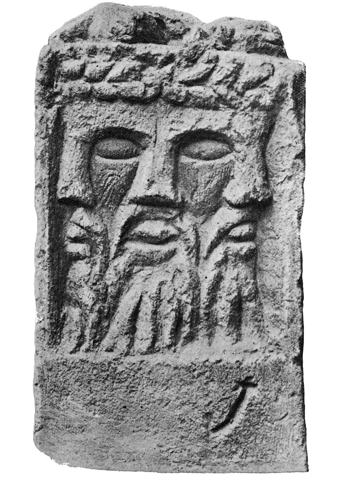
Master of every skill — the young god admitted to Tara because he alone could do all the crafts at once, and who killed his own grandfather Balor.
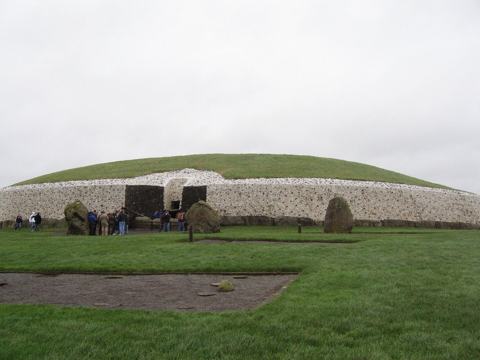
The good god — not morally good but good at everything: the club-bearing, cauldron-owning father figure of the Tuatha De Danann, and their crudest comedian.
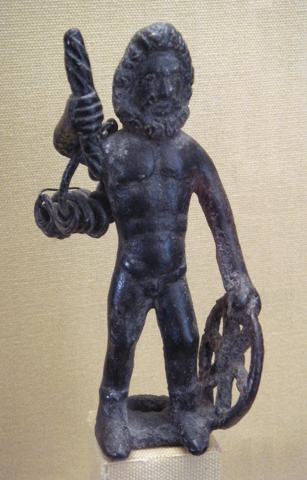
The Gaulish thunder god named by a Roman poet, sacrificed to by burning according to later scholiasts, and pictured with Jupiter's wheel.
The Gaulish horse goddess whose cult rode with Rome's cavalry — the only Celtic deity ever given a day on the Roman religious calendar.
The mother goddess of the Tuatha De Danann — and the most famous Irish deity who may never have existed under that name.
Sources & Further Reading
- 1.The Pillar of the Boatmen (Nautae Parisiaci), Paris, c. 14–37 CE; Musee de Cluny.
- 2.The Gundestrup cauldron, Himmerland, Denmark, c. 150 BCE–1 CE; National Museum of Denmark.
- 3.Rock carving, Naquane/Val Camonica, Lombardy, Italy (Iron Age).
- 4.Bober, Phyllis Fray. 'Cernunnos: Origin and Transformation of a Celtic Divinity.' American Journal of Archaeology 55.1 (1951), 13–51.
- 5.Green, Miranda J. Dictionary of Celtic Myth and Legend. Thames & Hudson, 1992.
- 6.Green, Miranda J. The Gods of the Celts. Alan Sutton, 1986.
- 7.Koch, John T. (ed.). Celtic Culture: A Historical Encyclopedia. ABC-CLIO, 2006.
- 8.MacKillop, James. Dictionary of Celtic Mythology. Oxford University Press, 1998.
Spot an error or have a source to suggest? Write to info@viseterna.com. We cite primary sources and modern scholarship, and we correct fast.