
The Four Treasures of the Tuatha De Danann
Four wonder-objects the Tuatha De Danann brought to Ireland: a screaming stone, an unstoppable spear, an inescapable sword, and a cauldron that never runs dry.
Lia Fail (Stone of Destiny), Hill of Tara, JohnJDuncan, 2012 · CC BY-SA 4.0 · source
Four Gifts from Four Cities
Before they ever reached Ireland, the Tuatha De Danann are said to have lived in the north of the world in four cities, Falias, Gorias, Findias, and Murias, where their poets, smiths, and druids learned every craft they would later bring with them 1,2. When the Tuatha De Danann finally sailed for Ireland, arriving, in the telling of Lebor Gabala Erenn, hidden in a cloud that blotted out the sun for three days, each city sent one object with them: the stone of Fal from Falias, a spear from Gorias, a sword from Findias, and a cauldron from Murias 1,2. Cath Maige Tuired names each treasure's power in a formula worth quoting for its plainness: the stone would cry out beneath the rightful king of Ireland, no battle was ever won against the spear or the man who held it, no one escaped once the sword was drawn, and no company ever left the cauldron unsatisfied 1.
The Stone of Fal
The stone, the Lia Fal, is the same Stone of Destiny later tradition places on the Hill of Tara, where it was said to roar under a king with a rightful claim to the kingship and stay silent under a false one 1,2. Of the four treasures it is the one with the clearest afterlife outside the origin-legend: medieval kingship tales built entire episodes around its cry, and the stone itself, or a stone identified with it, is still standing at Tara today, which makes it the rare mythic object with a physical candidate to point to 2.
The Spear of Lugh
The spear from Gorias belongs, in the fullest telling, to Lugh, and it does its narrative work at the second battle of Mag Tuired, where the Tuatha De Danann finally defeat the monstrous Fomorians and Lugh kills the tyrant king Balor of the Evil Eye 1. Cath Maige Tuired is less interested in describing the weapon than in stating flatly that nothing could stand against it, which is characteristic of how the text treats all four objects: they are defined by what they guarantee, not by how they look 1.
The Sword of Nuada
The sword from Findias belongs to Nuada, the Tuatha De Danann's king, whose own story is bound up with a different kind of object: after he loses an arm in the first battle of Mag Tuired, the physician Dian Cecht fits him with a working arm of silver, and the epithet Airgetlam, "Silver-Handed," follows him ever after 1,4. Because a king in this tradition could not rule while visibly blemished, Nuada steps down until the arm is made whole, then resumes the kingship the sword's inescapability underwrites 1,4. Popular retellings sometimes identify this weapon with the Claiomh Solais, the "Sword of Light" of nineteenth-century Irish folktale, but that is a separate, much later fairy-tale motif collected from oral storytellers, and the early texts never call Nuada's sword by that name; the two should not be treated as the same object 4.
The Cauldron of the Dagda
The cauldron from Murias belongs to the Dagda, and later glossary tradition gives it a name of its own, an Coire Ansic, "the Undry," a vessel that feeds any company from it without ever emptying 4. It is the mythic ancestor of a recurring image in Irish and Welsh material, the cauldron that restores or sustains rather than merely cooks, a family that modern commentators have also connected, cautiously, to the very differently sourced silver Gundestrup Cauldron, on the strength of shared imagery rather than any demonstrated link between the objects 4,5.
Reading Four as a Pattern
Scholars have long noticed that four objects tied to four cardinal directions or provinces is a shape Celtic tradition returns to elsewhere, and Rees and Rees read the four treasures as part of a broader native habit of organizing sovereignty, craft, and territory into fours, a pattern also visible in Ireland's four traditional provinces 3. Twentieth-century comparativists went further and set the stone, spear, sword, and cauldron beside the four hallows of the Grail romances, dish or cup, lance, sword, and stone, as evidence of a shared Celtic substrate behind both traditions; the parallel is suggestive rather than proven, since no text links the two sets directly, and the comparison says as much about how later scholars have wanted to read Celtic material as it does about the medieval Irish text itself 4,5. What Cath Maige Tuired and Lebor Gabala Erenn actually preserve is more modest and, on its own terms, stranger: four objects whose entire description is a single guaranteed effect, carried out of cities nobody ever visits again 1,2.
Continue Exploring
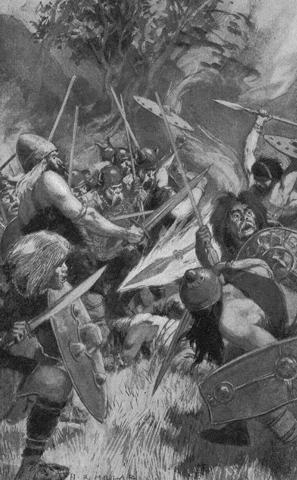
Ireland's race of gods — arriving with four treasures from four lost cities, winning Ireland twice, then losing it once and withdrawing into the mounds.

A standing stone on the Hill of Tara said to roar beneath Ireland's rightful king; the rival Scottish claim on it is a much later legend, not medieval fact.
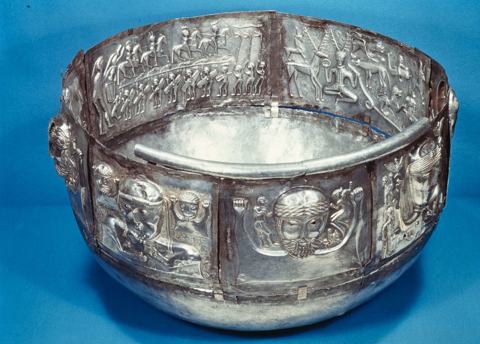
A lavishly decorated silver cauldron pulled from a Danish bog in 1891, made by Thracian silversmiths for Celtic patrons and covered in gods no text explains.
A medieval synthetic history of Ireland: six waves of settlers, the Tuatha De Danann, and the Gaelic Milesians, engineered to answer to the Bible.
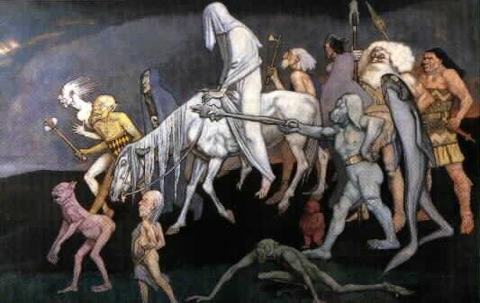
Ireland's monstrous sea-people — raiders, tribute-takers and kin to the gods they fight, led by Balor of the destroying eye.

The Fomorian king whose single destroying eye must be lifted open by four men — and who dies exactly as prophesied, by his own grandson's hand.
Sources & Further Reading
- 1.Cath Maige Tuired, The Second Battle of Mag Tuired, ed. and trans. Elizabeth A. Gray. Irish Texts Society 52, 1982.
- 2.Macalister, R. A. Stewart (ed. and trans.). Lebor Gabala Erenn, The Book of the Taking of Ireland, Parts I-V. Irish Texts Society, 1938-1956.
- 3.Rees, Alwyn and Brinley Rees. Celtic Heritage, Ancient Tradition in Ireland and Wales. Thames & Hudson, 1961.
- 4.MacKillop, James. Dictionary of Celtic Mythology. Oxford University Press, 1998.
- 5.Koch, John T. (ed.). Celtic Culture: A Historical Encyclopedia. ABC-CLIO, 2006.
Spot an error or have a source to suggest? Write to info@viseterna.com. We cite primary sources and modern scholarship, and we correct fast.