
Ogma
God of binding eloquence, credited by medieval tradition — probably wrongly — with inventing Ireland's oldest writing system, ogham.
The Fardel Stone, an ogham-inscribed pillar found in Devon, England (British Museum); photograph by BabelStone · CC BY-SA 3.0 · source
An Old Man Who Drags Men by the Ears
The earliest description of a god plausibly connected to Ogma comes not from Ireland but from a Greek essay written in Roman Gaul. Lucian of Samosata's short piece "Heracles," meant to be read aloud before a public lecture, describes a Gaulish painting of an old, sun-browned man dressed as Heracles — lion-skin, club, bow — but dragging behind him a happy crowd of followers on fine chains of gold and amber, run through holes pierced in their ears and fastened at the other end to the tip of the god's own tongue. Lucian records being told by a Gaulish bystander that the figure is called Ogmios, and that the image represents a native belief that eloquence, not physical strength, is the truly binding power, and greatest of all in old age 1.
No native Gaulish text describes Ogmios in his own words, and Lucian's account is a Greek traveller's report of what he was told about someone else's image — useful as far as it goes, but a single secondhand witness rather than a native scripture 1,6.
The Champion Under Bres
The Irish Ogma appears throughout Cath Maige Tuired as one of the leading Tuatha De Danann, called trenfer, "the strong man," and, in the tradition surrounding him, grianainech, "sun-faced" or "of the radiant countenance" — a description close enough to Lucian's sun-browned Ogmios that scholars have long proposed a connection between the two figures, though the case rests on comparable epithets across languages rather than on any statement either tradition makes about the other 2,7. His genealogy is not fixed: different strands of the tradition make him brother to the Dagda, one more instance of the fluid, sometimes contradictory family trees typical of a mythology compiled by monastic scribes harmonising older and inconsistent material 2,5.
Under Bres's oppressive kingship, Ogma is set, humiliatingly, to hauling firewood for the household despite being, in the text's own account, the one member of the Tuatha De who has already proven his strength and skill in open contest before the king — the same petty indignity the saga piles onto the Dagda in the same passage, and one of the concrete details Cath Maige Tuired uses to show what Bres's reign actually cost 2.
The Talking Sword
At the Second Battle of Mag Tuired, Ogma recovers Orna, the sword of the defeated Fomorian king Tethra, from the battlefield. When it is drawn from its scabbard afterward, the sword itself speaks, reciting aloud every deed done with it and the name of everyone it had killed — a detail Cath Maige Tuired offers without further comment, one of the more genuinely strange images in a saga not short of them 2. It is Ogma's clearest individual moment of action in a text that otherwise mostly groups him with the Dagda and Lugh as one of the Tuatha De's leading men 2,5.
A Script Named After Him
Ogma's other claim to fame is linguistic rather than martial. Ogham, the angular alphabet of notches and strokes cut along the edges of standing stones across Ireland, Wales, and parts of western Britain from roughly the fourth century CE onward, takes its name from him in medieval Irish scholarship, and medieval grammatical tracts make the connection explicit. In Lebor Ogaim, "The Book of Ogam," describes Ogma as a man skilled in speech and poetry who invented the script, and the Auraicept na n-Eces, the medieval "Primer of the Poets," repeats the claim in its own terms — some strands adding that the alphabet was deliberately made difficult so its use would mark off the learned from the unlettered 3.
What Modern Philology Actually Shows
This attribution needs to be handled as exactly what it is: a medieval etymology built backward from a resemblance between two names, not a record of how ogham actually came to exist. McManus's philological study of the surviving inscriptions dates the script's invention to around the fourth century CE and argues, on the evidence of its internal structure, that it was very likely devised by someone thinking in terms of the Latin alphabet — almost certainly in a literate, probably early Christian or Christian-adjacent milieu, centuries after any plausible pagan cult of Ogma could have been active 4. The tree-name tradition attached to individual ogham letters in later manuscripts is later still, a medieval scholarly overlay rather than an ancient feature of the script 3,4. None of this makes the god less real to the tradition that claimed him as inventor; it only means the claim belongs to medieval Irish intellectual history rather than to the fourth-century stonecutters who actually used the alphabet 4.
Two Ogmas, or One
Whether Ogmios of Roman Gaul and Ogma of medieval Ireland are the same god carried across five centuries and a change of language, or two figures whose names happen to resemble each other, cannot be settled from the evidence available. What can be said is narrower and more solid: a Gaulish god of persuasive, binding speech was worshipped visibly enough for a Greek writer to describe his image in the second century, and an Irish god of strength and eloquence, linked in the literature to the Dagda and Lugh, was credited eight hundred years later with inventing Ireland's oldest surviving writing system 1,2,5,6.
Continue Exploring
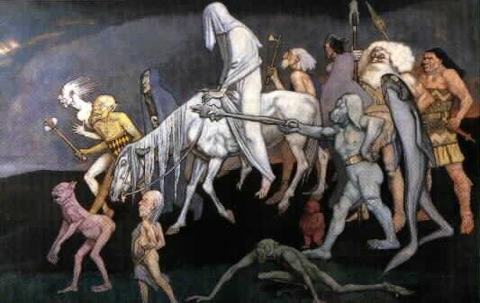
Ireland's monstrous sea-people — raiders, tribute-takers and kin to the gods they fight, led by Balor of the destroying eye.
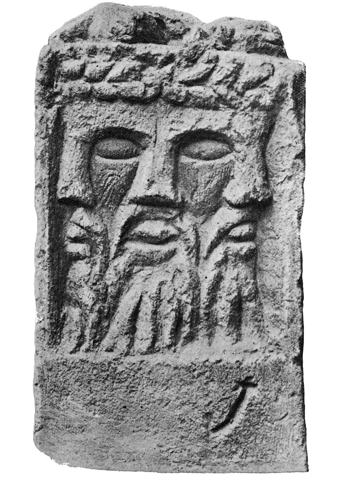
Master of every skill — the young god admitted to Tara because he alone could do all the crafts at once, and who killed his own grandfather Balor.
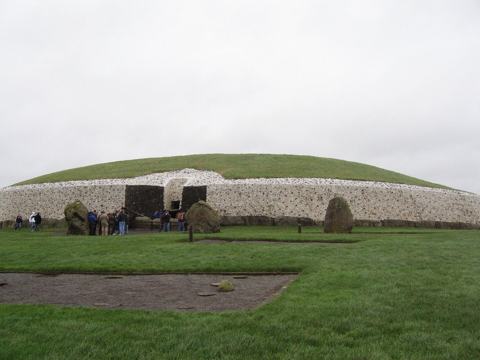
The good god — not morally good but good at everything: the club-bearing, cauldron-owning father figure of the Tuatha De Danann, and their crudest comedian.
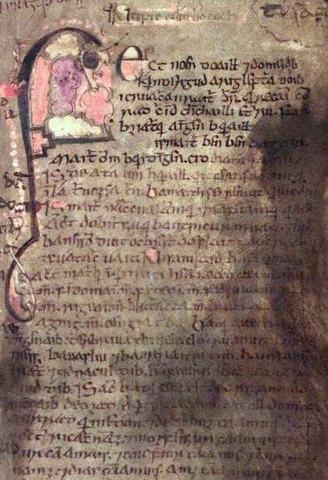
The mother goddess of the Tuatha De Danann — and the most famous Irish deity who may never have existed under that name.
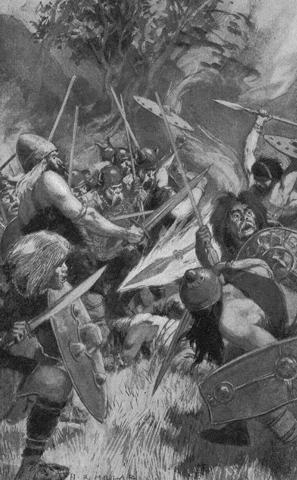
Ireland's race of gods — arriving with four treasures from four lost cities, winning Ireland twice, then losing it once and withdrawing into the mounds.
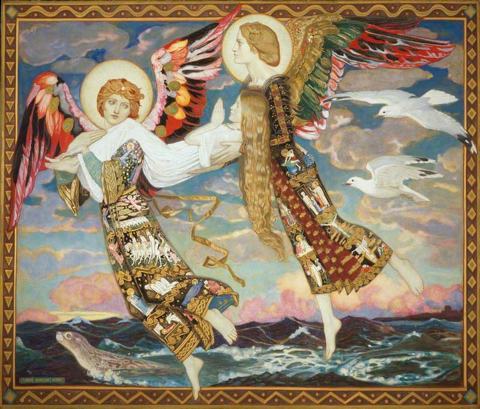
Goddess of poetry, smithcraft and healing — a triple Brigit in the glossaries, a saint at Kildare, and the figure Imbolc still belongs to.
Sources & Further Reading
- 1.Lucian of Samosata. 'Heracles,' a prolalia, in Lucian, Volume I, trans. A. M. Harmon. Loeb Classical Library 14. Harvard University Press, 1913.
- 2.Cath Maige Tuired: The Second Battle of Mag Tuired, ed. and trans. Elizabeth A. Gray. Irish Texts Society vol. 52, 1982 (CELT edition).
- 3.In Lebor Ogaim (The Book of Ogam) and Auraicept na n-Eces (The Primer of the Poets), medieval Irish grammatical tradition.
- 4.McManus, Damian. A Guide to Ogam. Maynooth Monographs 4, An Sagart, 1991.
- 5.MacKillop, James. Dictionary of Celtic Mythology. Oxford University Press, 1998.
- 6.Koch, John T. (ed.). Celtic Culture: A Historical Encyclopedia. ABC-CLIO, 2006.
- 7.MacCulloch, J. A. The Religion of the Ancient Celts. T. & T. Clark, 1911.
Spot an error or have a source to suggest? Write to info@viseterna.com. We cite primary sources and modern scholarship, and we correct fast.